Thank you for visiting SNEWPapers!
Sign up free
Editorial
January 3, 1803
Jenks' Portland Gazette. Maine Advertiser
Portland, Cumberland County, Maine
What is this article about?
This editorial, the first in a series, argues in favor of Maine's separation from Massachusetts, emphasizing moderation in the process, Maine's maturity in population and wealth compared to other new states like Kentucky and Tennessee, and the benefits of independence.
Clipping
OCR Quality
98%
Excellent
Full Text
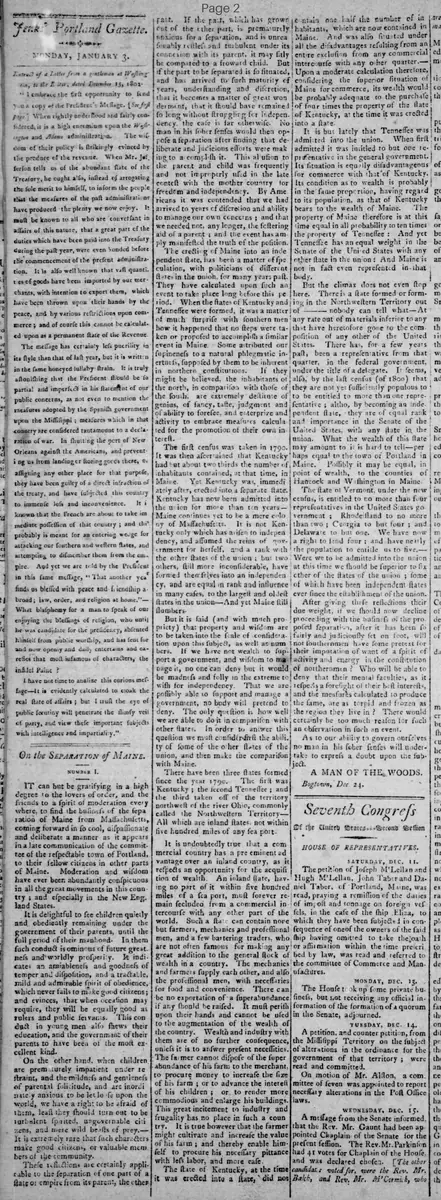
On the SEPARATION of MAINE.
NUMBER I.
IT can but be gratifying in a high degree to the lovers of order, and the friends to a spirit of moderation everywhere, to find the business of the separation of Maine from Massachusetts, coming forward in so cool, dispassionate and deliberate a manner as it appears in a late communication of the committee of the respectable town of Portland, to their fellow citizens in other parts of Maine. Moderation and wisdom have ever been abundantly conspicuous in all the great movements in this country; and especially in the New England States.
It is delightful to see children quietly and obediently remaining under the government of their parents, until the full period of their manhood. In them such conduct is ominous of future greatness and worldly prosperity. It indicates an amiableness and goodness of temper and disposition, and a tractable, mild and admirable spirit of obedience, which never fails to make good citizens; and evinces, that when occasion may require, they will be equally good as rulers and public servants. This conduct in young men also shows their education, and the government of their parents to have been of the most excellent kind.
On the other hand, when children are prematurely impatient under restraint, and the mildness and gentleness of parental solicitude, and are inordinately anxious to be let loose upon the world, we have a right to be afraid of them, lest they should turn out to be turbulent spirited, ungovernable citizens, and mere wild beasts of prey.
It is extremely rare that such characters make good citizens, or valuable members of the community.
These reflections are certainly applicable to the separation of one part of a state or empire from its parent, the other part. If the part, which has grown out of the other part, is prematurely anxious for a separation, and is unreasonable, restless and turbulent under its connexion with its parent, it may fitly be compared to a froward child. But if the part to be separated is so situated, and has arrived to such maturity of years, understanding and discretion, that it becomes a matter of great wonderment, that it should have remained so long without struggling for independency, the case is far otherwise. No man in his sober senses would then oppose a separation after finding that deliberate and judicious efforts were making to accomplish it. This allusion to the parent and child was frequently and not improperly used in the late contest with the mother country for freedom and independency. By Americans it was contended that we had arrived to years of discretion and ability to manage our own concerns; and that we needed not, any longer, the fostering aid of a parent; and the event has amply manifested the truth of the position.
The erecting of Maine into an independent state, has been a matter of speculation, with politicians of different states in the union, for many years past. They have calculated upon such an event to take place long before this period. When the states of Kentucky and Tennessee were formed, it was a matter of much surprise with southern men how it happened that no steps were taken or proposed to accomplish a similar event in Maine. Some attributed our supineness to a natural phlegmatic inertness, supposed by them to be inherent in northern constitutions. If they might be believed, the inhabitants of the north, in comparison with those of the south, are extremely destitute of genius, of fancy, taste, judgment and of ability to foresee, and enterprize and activity to embrace measures calculated for the promotion of their own interest.
The first census was taken in 1790. It was then ascertained that Kentucky had but about two thirds the number of inhabitants contained, at that time, in Maine. Yet Kentucky was immediately after, erected into a separate state.
Kentucky has now been admitted into the union for more than ten years—Maine continues yet to be a mere colony of Massachusetts. It is not Kentucky only which has arisen to independency, and assumed the reins of government for herself, and a rank with the other states of the union: but two others, still more inconsiderable, have formed themselves into an independency, and are equal in rank and influence in many cases, to the largest and oldest states in the union—And yet Maine still slumbers—
But it is said (and with much propriety) that property and wisdom are to be taken into the scale of consideration upon this subject, as well as numbers. If we have not wealth to support a government, and wisdom to manage it, no one can deny but it would be madness and folly in the extreme to wish for independency. That we are possibly able to support and manage a government, no body will pretend to deny. The only question is how well we are able to do it in comparison with other states. In order to answer this question we must consider—first the ability of some of the other states of the union, and then make the comparison with Maine.
There have been three states formed since the year 1790. The first was Kentucky; the second Tennessee; and the third taken off of the territory northwest of the river Ohio, commonly called the Northwestern Territory— All which are inland states, not within five hundred miles of any sea port.
It is undoubtedly true that a commercial country has a pre-eminent advantage over an inland country, as it respects an opportunity for the acquisition of wealth. An inland state, having no part of it within five hundred miles of a sea port, must forever remain excluded from a commercial intercourse with any other part of the world. Such a state can contain none but farmers, mechanics and professional men, and a few bartering traders, who are not often famous for making any great addition to the general stock of wealth in a country. The mechanics and farmers supply each other, and also the professional men, with necessaries for food and convenience. There can be no exportation of a superabundance if any should be raised. It must perish upon their hands and cannot be used to the augmentation of the wealth of the country. Wealth and industry with them are of no further consequence, unless it is to answer present necessities. The farmer cannot dispose of the super abundance of his farm to the merchant, to procure money to increase the size of his farm; or to advance the interest of his children; or to render more commodious and enlarge his buildings. This great incitement to industry and frugality has no place in such a country. It is true however that the farmer might cultivate and increase the value of his farm: and thereby enable himself to procure his necessary pittance with less labor, and more ease.
The state of Kentucky, at the time it was erected into a state, did not contain one half the number of inhabitants, which are now contained in Maine. And was also situated under all the disadvantages resulting from an entire exclusion from any commercial intercourse with any other quarter.—
Upon a moderate calculation therefore, considering the superior situation of Maine for commerce, its wealth would be probably adequate to the purchase of four times the property of the state of Kentucky, at the time it was erected into a state.
It is but lately that Tennessee was admitted into the union. When first admitted it was entitled to but one representative in the general government. Its situation is equally disadvantageous for commerce with that of Kentucky. Its condition as to wealth is probably in the same proportion, having regard to its population, as that of Kentucky bears to the wealth of Maine. The property of Maine therefore is at this time equal in all probability to ten times the property of Tennessee: And yet Tennessee has an equal weight in the Senate of the United States with any other state in the union: And Maine is not in fact even represented in that body.
But the climax does not even stop here. There is a state formed or forming in the Northwestern Territory out of—nobody can tell what—At any rate out of materials inferior to any that have heretofore gone to the composition of any other of the United States. There has, for a few years past, been a representative from that quarter, in the federal government, under the title of a delegate. It seems, also, by the last census (of 1800) that they are not yet sufficiently populous to be entitled to more than one representative; altho' by becoming an independent state, they are of equal rank and importance in the Senate of the United States, with any state in the union. What the wealth of this state may amount to it is hard to tell—perhaps equal to the town of Portland in Maine. Possibly it may be equal, in point of wealth, to the counties of Hancock and Washington in Maine.
The state of Vermont, under the new census, is entitled to no more than four representatives in the United States government; Rhode Island to no more than two: Georgia to but four; and Delaware to but one. We have now a right to send four; and have nearly the population to entitle us to five.— Were we to be admitted into the union at this time we should be superior to six other of the states of the union; some of which have been independent states ever since the establishment of the union.
After giving these reflections their due weight, if we should now decline proceeding with the business of the proposed separation, after it has been so fairly and judiciously set on foot, will not southernmen have some pretext for their imputation of want of a spirit of activity and energy in the constitution of northernmen? Who will be able to deny that their mental faculties, as it respects a foresight of their best interests, and the measures calculated to produce the same, are as torpid and frozen as the region they live in? There would certainly be too much reason for such an observation in such an event.
As to our ability to govern ourselves no man in his sober senses will undertake to express a doubt upon the subject.
A MAN OF THE WOODS.
NUMBER I.
IT can but be gratifying in a high degree to the lovers of order, and the friends to a spirit of moderation everywhere, to find the business of the separation of Maine from Massachusetts, coming forward in so cool, dispassionate and deliberate a manner as it appears in a late communication of the committee of the respectable town of Portland, to their fellow citizens in other parts of Maine. Moderation and wisdom have ever been abundantly conspicuous in all the great movements in this country; and especially in the New England States.
It is delightful to see children quietly and obediently remaining under the government of their parents, until the full period of their manhood. In them such conduct is ominous of future greatness and worldly prosperity. It indicates an amiableness and goodness of temper and disposition, and a tractable, mild and admirable spirit of obedience, which never fails to make good citizens; and evinces, that when occasion may require, they will be equally good as rulers and public servants. This conduct in young men also shows their education, and the government of their parents to have been of the most excellent kind.
On the other hand, when children are prematurely impatient under restraint, and the mildness and gentleness of parental solicitude, and are inordinately anxious to be let loose upon the world, we have a right to be afraid of them, lest they should turn out to be turbulent spirited, ungovernable citizens, and mere wild beasts of prey.
It is extremely rare that such characters make good citizens, or valuable members of the community.
These reflections are certainly applicable to the separation of one part of a state or empire from its parent, the other part. If the part, which has grown out of the other part, is prematurely anxious for a separation, and is unreasonable, restless and turbulent under its connexion with its parent, it may fitly be compared to a froward child. But if the part to be separated is so situated, and has arrived to such maturity of years, understanding and discretion, that it becomes a matter of great wonderment, that it should have remained so long without struggling for independency, the case is far otherwise. No man in his sober senses would then oppose a separation after finding that deliberate and judicious efforts were making to accomplish it. This allusion to the parent and child was frequently and not improperly used in the late contest with the mother country for freedom and independency. By Americans it was contended that we had arrived to years of discretion and ability to manage our own concerns; and that we needed not, any longer, the fostering aid of a parent; and the event has amply manifested the truth of the position.
The erecting of Maine into an independent state, has been a matter of speculation, with politicians of different states in the union, for many years past. They have calculated upon such an event to take place long before this period. When the states of Kentucky and Tennessee were formed, it was a matter of much surprise with southern men how it happened that no steps were taken or proposed to accomplish a similar event in Maine. Some attributed our supineness to a natural phlegmatic inertness, supposed by them to be inherent in northern constitutions. If they might be believed, the inhabitants of the north, in comparison with those of the south, are extremely destitute of genius, of fancy, taste, judgment and of ability to foresee, and enterprize and activity to embrace measures calculated for the promotion of their own interest.
The first census was taken in 1790. It was then ascertained that Kentucky had but about two thirds the number of inhabitants contained, at that time, in Maine. Yet Kentucky was immediately after, erected into a separate state.
Kentucky has now been admitted into the union for more than ten years—Maine continues yet to be a mere colony of Massachusetts. It is not Kentucky only which has arisen to independency, and assumed the reins of government for herself, and a rank with the other states of the union: but two others, still more inconsiderable, have formed themselves into an independency, and are equal in rank and influence in many cases, to the largest and oldest states in the union—And yet Maine still slumbers—
But it is said (and with much propriety) that property and wisdom are to be taken into the scale of consideration upon this subject, as well as numbers. If we have not wealth to support a government, and wisdom to manage it, no one can deny but it would be madness and folly in the extreme to wish for independency. That we are possibly able to support and manage a government, no body will pretend to deny. The only question is how well we are able to do it in comparison with other states. In order to answer this question we must consider—first the ability of some of the other states of the union, and then make the comparison with Maine.
There have been three states formed since the year 1790. The first was Kentucky; the second Tennessee; and the third taken off of the territory northwest of the river Ohio, commonly called the Northwestern Territory— All which are inland states, not within five hundred miles of any sea port.
It is undoubtedly true that a commercial country has a pre-eminent advantage over an inland country, as it respects an opportunity for the acquisition of wealth. An inland state, having no part of it within five hundred miles of a sea port, must forever remain excluded from a commercial intercourse with any other part of the world. Such a state can contain none but farmers, mechanics and professional men, and a few bartering traders, who are not often famous for making any great addition to the general stock of wealth in a country. The mechanics and farmers supply each other, and also the professional men, with necessaries for food and convenience. There can be no exportation of a superabundance if any should be raised. It must perish upon their hands and cannot be used to the augmentation of the wealth of the country. Wealth and industry with them are of no further consequence, unless it is to answer present necessities. The farmer cannot dispose of the super abundance of his farm to the merchant, to procure money to increase the size of his farm; or to advance the interest of his children; or to render more commodious and enlarge his buildings. This great incitement to industry and frugality has no place in such a country. It is true however that the farmer might cultivate and increase the value of his farm: and thereby enable himself to procure his necessary pittance with less labor, and more ease.
The state of Kentucky, at the time it was erected into a state, did not contain one half the number of inhabitants, which are now contained in Maine. And was also situated under all the disadvantages resulting from an entire exclusion from any commercial intercourse with any other quarter.—
Upon a moderate calculation therefore, considering the superior situation of Maine for commerce, its wealth would be probably adequate to the purchase of four times the property of the state of Kentucky, at the time it was erected into a state.
It is but lately that Tennessee was admitted into the union. When first admitted it was entitled to but one representative in the general government. Its situation is equally disadvantageous for commerce with that of Kentucky. Its condition as to wealth is probably in the same proportion, having regard to its population, as that of Kentucky bears to the wealth of Maine. The property of Maine therefore is at this time equal in all probability to ten times the property of Tennessee: And yet Tennessee has an equal weight in the Senate of the United States with any other state in the union: And Maine is not in fact even represented in that body.
But the climax does not even stop here. There is a state formed or forming in the Northwestern Territory out of—nobody can tell what—At any rate out of materials inferior to any that have heretofore gone to the composition of any other of the United States. There has, for a few years past, been a representative from that quarter, in the federal government, under the title of a delegate. It seems, also, by the last census (of 1800) that they are not yet sufficiently populous to be entitled to more than one representative; altho' by becoming an independent state, they are of equal rank and importance in the Senate of the United States, with any state in the union. What the wealth of this state may amount to it is hard to tell—perhaps equal to the town of Portland in Maine. Possibly it may be equal, in point of wealth, to the counties of Hancock and Washington in Maine.
The state of Vermont, under the new census, is entitled to no more than four representatives in the United States government; Rhode Island to no more than two: Georgia to but four; and Delaware to but one. We have now a right to send four; and have nearly the population to entitle us to five.— Were we to be admitted into the union at this time we should be superior to six other of the states of the union; some of which have been independent states ever since the establishment of the union.
After giving these reflections their due weight, if we should now decline proceeding with the business of the proposed separation, after it has been so fairly and judiciously set on foot, will not southernmen have some pretext for their imputation of want of a spirit of activity and energy in the constitution of northernmen? Who will be able to deny that their mental faculties, as it respects a foresight of their best interests, and the measures calculated to produce the same, are as torpid and frozen as the region they live in? There would certainly be too much reason for such an observation in such an event.
As to our ability to govern ourselves no man in his sober senses will undertake to express a doubt upon the subject.
A MAN OF THE WOODS.
What sub-type of article is it?
Constitutional
What keywords are associated?
Maine Separation
State Independence
Population Comparison
Wealth Assessment
Moderation In Politics
New England States
Commercial Advantages
What entities or persons were involved?
Maine
Massachusetts
Portland Committee
Kentucky
Tennessee
Northwestern Territory
Vermont
Rhode Island
Georgia
Delaware
Editorial Details
Primary Topic
Advocacy For Maine's Separation From Massachusetts
Stance / Tone
Supportive Of Separation With Moderate And Reasoned Argumentation
Key Figures
Maine
Massachusetts
Portland Committee
Kentucky
Tennessee
Northwestern Territory
Vermont
Rhode Island
Georgia
Delaware
Key Arguments
Maine's Separation Process Is Proceeding With Moderation And Wisdom
Analogy Of Mature Child Seeking Independence From Parent
Maine Has More Population Than Kentucky Had At Statehood In 1790
Maine's Commercial Advantages Make It Wealthier Than Inland States Like Kentucky And Tennessee
New States Like Tennessee Have Equal Senate Representation Despite Less Wealth And Population
Maine's Population Entitles It To More Representatives Than Several Existing States
Delaying Separation Would Confirm Southern Stereotypes Of Northern Inertness
Maine Has The Ability To Govern Itself