Thank you for visiting SNEWPapers!
Sign up free
Alexandria Daily Gazette, Commercial & Political
Alexandria, Virginia
What is this article about?
The New York Commercial Advertiser reports on strained US-England relations, citing a London opposition paper's view that no reconciliation is likely without Britain revoking orders in council and guaranteeing the American flag. US propositions demand renouncing search rights, which Britain rejects, insisting on France's decrees being addressed first. The embargo persists amid threats of war with either France or England.
Clipping
OCR Quality
Full Text
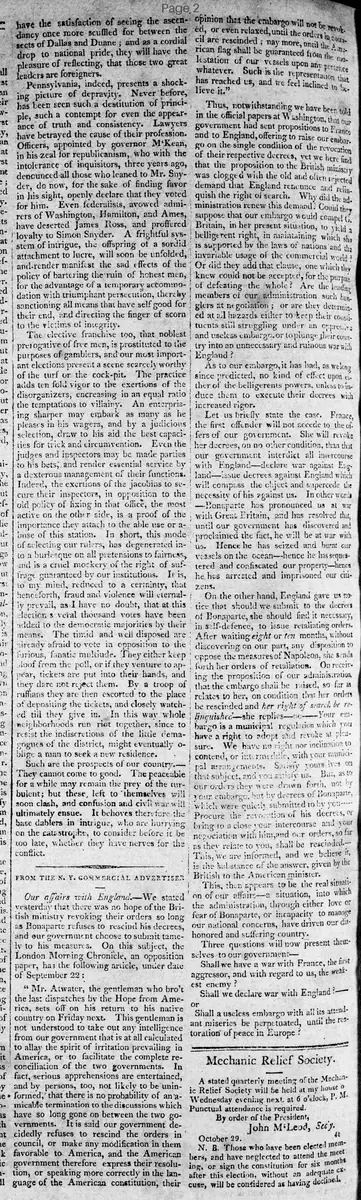
Our affairs with England. -- We stated yesterday that there was no hope of the British ministry revoking their orders so long as Bonaparte refuses to rescind his decrees, and our government choose to submit tamely to his measures. On this subject, the London Morning Chronicle, an opposition paper, has the following article, under date of September 22:
"Mr. Atwater, the gentleman who brought the last dispatches by the Hope from America, sets off on his return to his native country on Friday next. This gentleman is not understood to take out any intelligence from our government that is at all calculated to allay the spirit of irritation prevailing in America, or to facilitate the complete reconciliation of the two governments. In fact, serious apprehensions are entertained, and by persons, too, not likely to be uninformed, that there is no probability of an amicable termination to the discussions which have so long gone on between the two governments. It is said our government decidedly refuses to rescind the orders in council, or make any modification in them favorable to America, and the American government therefore express their resolution, or speaking more correctly in the language of the American constitution, their opinion that the embargo will not be revoked, or even relaxed, until the orders in council are rescinded; nay more, until the American flag shall be guaranteed from the molestation of our vessels upon any pretence whatever. Such is the representation that has reached us, and we feel inclined to believe it."
Thus, notwithstanding we have been told in the official papers at Washington, that our government had sent propositions to France and to England, offering to raise our embargo on the single condition of the revocation of their respective decrees, yet we here find that the proposition to the British ministry was clogged with the old and often rejected demand that England renounce and relinquish the right of search. Why did the administration renew this demand. Could they suppose that our embargo would compel G. Britain, in her present situation, to yield a belligerent right, in maintaining which she is supported by the laws of nations and the invariable usage of the commercial world! Or did they add that clause, one which they knew could not be accepted, for the purpose of defeating the whole? Are the leading members of our administration such bunglers at negotiation; or are they determined at all hazards either to keep their constituents still struggling under an oppressive and useless embargo, or to plunge their country into an unnecessary and ruinous war with England?
As to our embargo, it has had, as we long since predicted, no kind of effect upon either of the belligerent powers, unless to induce them to execute their decrees with increased rigor.
Let us briefly state the case. France, the first offender will not accede to the offers of our government. She will revoke her decrees, on no other condition, than that our government interdict all intercourse with England -- declare war against England -- issue decrees against England which will compass the object and supercede the necessity of his against us. In other words -- Bonaparte has pronounced us at war with Great Britain, and has resolved that, until our government has discovered and proclaimed the fact, he will be at war with us. Hence he has seized and burnt our vessels on the ocean -- hence he has sequestered and confiscated our property -- hence he has arrested and imprisoned our citizens.
On the other hand, England gave us notice that should we submit to the decrees of Bonaparte, she should find it necessary, in self-defence, to issue retaliating orders. After waiting eight or ten months, without discovering on our part, any disposition to oppose the measures of Napoleon, she sends forth her orders of retaliation. On receiving the proposition of our administration, that the embargo shall be raised, so far as relates to her, on condition that her orders be rescinded and her right of search be relinquished -- she replies -- no -- Your embargo is a municipal regulation which you have a right to adopt and revoke at pleasure. We have no right nor inclination to contend, or interfere, with your municipal arrangements. Satisfy yourselves on that subject, and you satisfy us. But, as to our orders they were drawn forth, not by your embargo, but by decrees of Bonaparte, which were quietly submitted to by you -- Procure the revocation of his decrees, or bring to a close your intercourse and your negotiation with him, and our orders, so far as they relate to you, shall be rescinded. -- This, we are informed, and we believe it, is the substance of the answer, given by the British to the American minister.
This, then appears to be the real situation of our affairs -- a situation, into which the administration, through either love or fear of Bonaparte, or incapacity to manage our national concerns, have driven our dishonored and suffering country.
Three questions will now present themselves to our government --
Shall we have a war with France, the first aggressor, and with regard to us, the weakest enemy?
Shall we declare war with England? -- or
Shall a useless embargo with all its attendant miseries be perpetuated, until the restoration of peace in Europe?
What sub-type of article is it?
What keywords are associated?
What entities or persons were involved?
Where did it happen?
Foreign News Details
Primary Location
London
Event Date
September 22
Key Persons
Outcome
british refusal to rescind orders in council or relinquish right of search; us determination to maintain embargo until british concessions; french insistence on us war declaration against england; ongoing seizures of us vessels and property by france; potential war with france or england.
Event Details
The London Morning Chronicle reports serious apprehensions of no amicable resolution between US and Britain, with Britain refusing to modify orders in council and US insisting on embargo until full concessions including flag protection. US propositions to Britain include renouncing search rights, rejected as belligerent prerogative. France demands US declare war on England to revoke decrees, continuing aggressions against US shipping. Britain conditions orders' rescission on US addressing French decrees first. Editorial questions US administration's negotiation strategy amid embargo's ineffectiveness.