Thank you for visiting SNEWPapers!
Sign up free
The Virginia Gazette
Williamsburg, Virginia
What is this article about?
An anonymous letter to the Virginia Provincial Congress condemns an address by the New York Council and eleven Assembly members to their Lieutenant Governor as a dangerous defection undermining colonial unity against British threats. It urges immediate condemnation, economic boycotts of the signers, thanks to dissenting New Yorkers, and recommendations to other provinces to shun them, emphasizing the need to prevent prolonged conflict.
Merged-components note: This is a continuation of the same letter to the Provincial Congress of Virginia, spanning pages 1 and 2; the second component was incorrectly labeled as editorial but is part of the letter.
Clippings
1 of 2
OCR Quality
Full Text
Tullium Ciceronem.
To the Gentlemen of the PROVINCIAL CONGRESS of VIRGINIA.
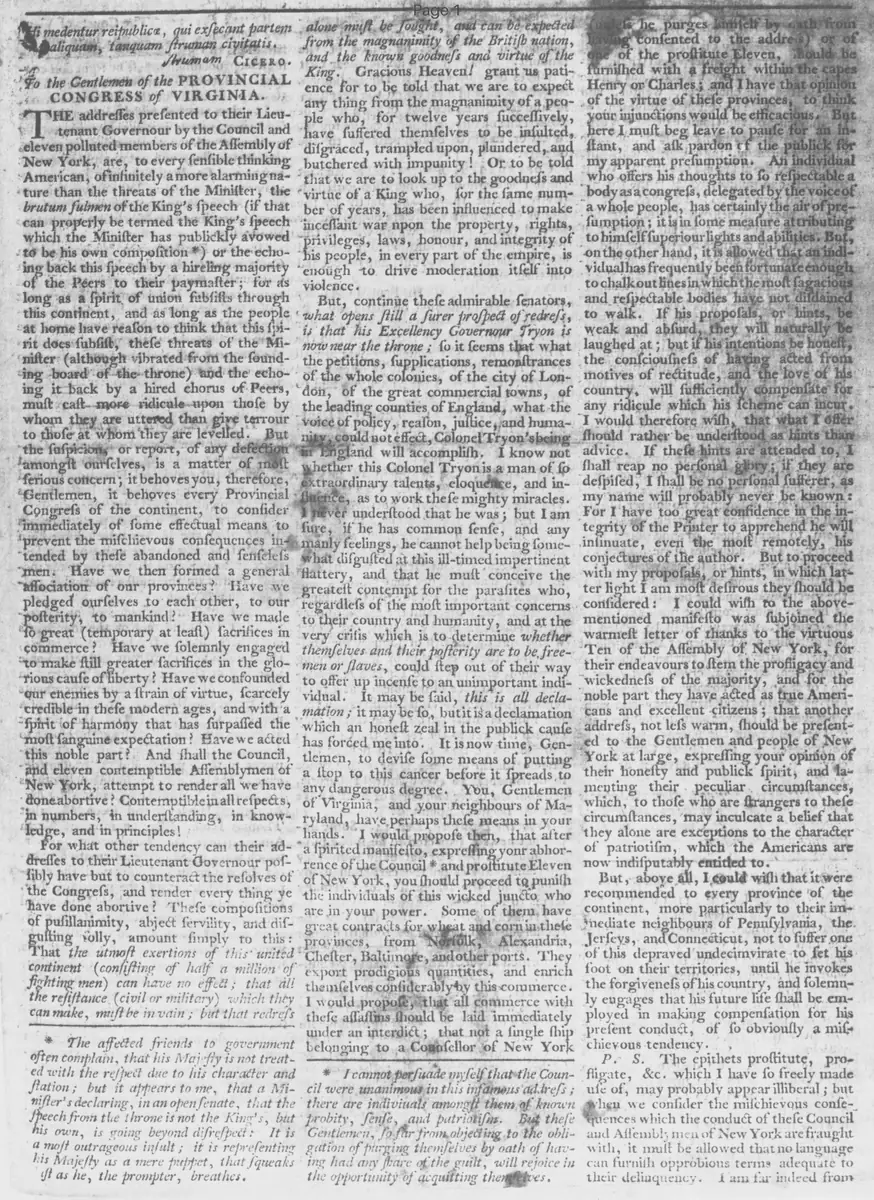
The address presented to their Lieutenant Governor by the Council and eleven polluted members of the Assembly of New York, are, to every sensible thinking American, of infinitely a more alarming nature than the threats of the Minister. The brutum fulmen of the King's speech (if that can properly be termed the King's speech which the Minister has publicly avowed to be his own composition *) or the echoing back this speech by a hireling majority of the Peers to their paymaster; for as long as a spirit of union subsists through this continent, and as long as the people at home have reason to think that this spirit does subsist, these threats of the Minister (although vibrated from the sounding board of the throne) and the echoing it back by a hired chorus of Peers, must cast more ridicule upon those by whom they are uttered than give terror to those at whom they are levelled. But the suspicion, or report, of any defection amongst ourselves, is a matter of most serious concern; it behoves you, therefore, Gentlemen, it behoves every Provincial Congress of the continent, to consider immediately of some effectual means to prevent the mischievous consequences intended by these abandoned and senseless men. Have we then formed a general association of our provinces? Have we pledged ourselves to each other, to our posterity, to mankind? Have we made so great (temporary at least) sacrifices in commerce? Have we solemnly engaged to make still greater sacrifices in the glorious cause of liberty? Have we confounded our enemies by a train of virtue, scarcely credible in these modern ages, and with a spirit of harmony that has surpassed the most sanguine expectation? Have we acted this noble part? And shall the Council, and eleven contemptible Assemblymen of New York, attempt to render all we have done abortive? Contemptible in all respects, in numbers, in understanding, in knowledge, and in principles!
For what other tendency can their address to their Lieutenant Governor possibly have but to counteract the resolves of the Congress, and render every thing we have done abortive? These compositions of pusillanimity, abject servility, and disgusting folly, amount simply to this: That the utmost exertions of this united continent (consisting of half a million of fighting men) can have no effect: that all the resistance, (civil or military) which they can make, must be in vain; but that redress alone must be sought, and can be expected from the magnanimity of the British nation, and the known goodness and virtue of the King. Gracious Heaven! grant us patience to be told that we are to expect any thing from the magnanimity of a people who, for twelve years successively, have suffered themselves to be insulted, disgraced, trampled upon, plundered, and butchered with impunity! Or to be told that we are to look up to the goodness and virtue of a King who, for the same number of years, has been influenced to make incessant war upon the property, rights, privileges, laws, honour, and integrity of his people, in every part of the empire, is enough to drive moderation itself into violence.
But, continue these admirable senators, what opens a still surer prospect of redress, is that his Excellency Governor Tryon is now near the throne: so it seems that what the petitions, supplications, remonstrances of the whole colonies, of the city of London, of the great commercial towns, of the leading counties of England, what the voice of policy, reason, justice, and humanity, could not effect, Colonel Tryon's being in England will accomplish. I know not whether this Colonel Tryon is a man of so extraordinary talents, eloquence, and influence, as to work these mighty miracles. I never understood that he was; but I am sure, if he has common sense, and any manly feelings, he cannot help being somewhat disgusted at this ill-timed impertinent flattery, and that he must conceive the greatest contempt for the parasites who, regardless of the most important concerns to their country and humanity, and at the very crisis which is to determine whether themselves and their posterity are to be freemen or slaves, could step out of their way to offer up incense to an unimportant individual. It may be said, this is all declamation; it may be so, but it is a declamation which an honest zeal in the public cause has forced me into. It is now time, Gentlemen, to devise some means of putting a stop to this cancer before it spreads to any dangerous degree. You, Gentlemen of Virginia, and your neighbours of Maryland, have perhaps these means in your hands. I would propose then, that after a spirited manifesto, expressing your abhorrence of the Council * and prostitute Eleven of New York, you should proceed to punish the individuals of this wicked junto who are in your power. Some of them have great contracts for wheat and corn in these provinces, from Norfolk, Alexandria, Chester, Baltimore, and other ports. They export prodigious quantities, and enrich themselves considerably by this commerce. I would propose, that all commerce with these assassins should be laid immediately under an interdict; that not a single ship belonging to a Counsellor of New York as he purges himself by oath from consented to the address) or of one of the prostitute Eleven, should be furnished with a freight within the capes of Henry or Charles; and I have that opinion of the virtue of these provinces, to think your injunctions would be efficacious. But here I must beg leave to pause for an Instant, and ask pardon of the public for my apparent presumption. An individual who offers his thoughts to so respectable a body as a congress, delegated by the voice of a whole people, has certainly the air of presumption; it is in some measure attributing to himself superior lights and abilities. But, on the other hand, it is allowed that an individual has frequently been fortunate enough to chalk out lines in which the most sagacious and respectable bodies have not disdained to walk. If his proposals, or hints, be weak and absurd, they will naturally be laughed at; but if his intentions be honest, the consciousness of having acted from motives of rectitude, and the love of his country, will sufficiently compensate for any ridicule which his scheme can incur. I would therefore wish, that what I offer should rather be understood as hints than advice. If these hints are attended to, I shall reap no personal glory; if they are despised, I shall be no personal sufferer, as my name will probably never be known: For I have too great confidence in the integrity of the Printer to apprehend he will insinuate, even the most remotely, his conjectures of the author. But to proceed with my proposals, or hints, in which latter light I am most desirous they should be considered: I could wish to the above-mentioned manifesto was subjoined the warmest letter of thanks to the virtuous Ten of the Assembly of New York, for their endeavours to stem the profligacy and wickedness of the majority, and for the noble part they have acted as true Americans and excellent citizens; that another address, not less warm, should be presented to the Gentlemen and people of New York at large, expressing your opinion of their honesty and public spirit, and lamenting their peculiar circumstances, which, to those who are strangers to these circumstances, may inculcate a belief that they alone are exceptions to the character of patriotism, which the Americans are now indisputably entitled to.
But, above all, I could wish that it were recommended to every province of the continent, more particularly to their immediate neighbours of Pennsylvania, the Jerseys, and Connecticut, not to suffer one of this depraved undecimvirate to set his foot on their territories, until he invokes the forgiveness of his country, and solemnly engages that his future life shall be employed in making compensation for his present conduct, of so obviously a mischievous tendency.
P. S. The epithets prostitute, profligate, &c. which I have so freely made use of, may probably appear illiberal; but when we consider the mischievous consequences which the conduct of these Council and Assembly men of New York are fraught with, it must be allowed that no language can furnish opprobrious terms adequate to their delinquency. I am far indeed from
* The affected friends to government often complain, that his Majesty is not treated with the respect due to his character and station; but it appears to me, that a Minister's declaring, in an open senate, that the Speech from the throne is not the King's, but his own, is going beyond disrespect: It is a most outrageous insult; it is representing his Majesty as a mere puppet, that squeaks as he, the prompter, breathes.
* I cannot persuade myself that the Council were unanimous in this infamous address; there are individuals amongst them of known probity, sense, and patriotism. But these Gentlemen, so far from objecting to the obligation of purging themselves by oath of having had any share of the guilt, will rejoice in the opportunity of acquitting themselves.
apprehending that their weight and influence are sufficient to shake the virtue of the continent, or occasion any defection. I do not believe that an individual (much less a set of men) will be found who will be stupid and wicked enough to tread in their steps, the infamous * * * of Philadelphia, and a small perverse drivelling knot of Quakers, who form his senate and court, excepted. This worthy lately fixed his residence at New York, with the professed intention of working with some congenial spirits in that city towards the ruin of the whole fabrick which the Congress had been raising. Indeed, it is most probable that he was the principal compiler; if not the dictator, of the wretched address. The style and sentiments are certainly his; the same nit, fog, and darkness, which overcast all his productions, envelop the address: and the same narrow crooked politics, low cunning, malignancy, and treachery, discoverable through the mist, fog, and obscurity of all his works and actions, betray themselves in the address. It may now be asked, as I have represented the character, weight, and credit, of these eleven Assemblymen, of the majority of the Council of New York, and their Philadelphian coadjutor, or more properly dictator, in so despicable a light, wherefore I should sound the alarm? What mischiefs can possibly result from the utmost such men can do? I answer, that although they can neither occasion any defection, nor present the least prospect of success to the enemies of America and liberty, they can do very considerable mischief: They can procrastinate the issue; they can (and most probably will) prolong the inconveniencies which we must, more or less, feel during the contest. There is nothing more certain than that the Ministry have proceeded to the enormous lengths they have done upon the presumption that the attacks upon Boston would not have been taken up by the other provinces, as the cause of the whole. * There is therefore nothing more certain than that the appearance of our firmness and unanimity must soon have overthrown them, or forced them into a total change of measures; but the least appearance that this firmness and unanimity no longer subsists will encourage them to persist, and enable them to keep their ground some time longer. These addresses of New York will give this appearance; so that whatever the Gentlemen, the merchants, the tradesmen, the mechanicks, and the people of America at large, suffer from the prolongation of the contest, whatever shall be added to the distresses and burthen of the people at home, whatever shall farther impair the commerce, strength, credit, and reputation of the mother country, and bring her still nearer to total bankruptcy and ruin, whatever shall farther alienate the affections of the child from the parent, may justly be imputed to this abject Council and eleven prostitute Assemblymen of New York. That this is the principle they acted upon is now put out of dispute by the conduct of Lord North in the House of Commons, and some speeches directed to him.
What sub-type of article is it?
What themes does it cover?
What keywords are associated?
What entities or persons were involved?
Letter to Editor Details
Recipient
To The Gentlemen Of The Provincial Congress Of Virginia
Main Argument
the address by new york's council and eleven assembly members to their lieutenant governor undermines colonial unity and encourages british persistence; the virginia congress should issue a manifesto condemning them, impose commercial interdicts on the signers, thank dissenting new yorkers, and urge other provinces to shun them to prevent defection and prolonging the conflict.
Notable Details