Thank you for visiting SNEWPapers!
Sign up free
The Columbus Journal
Columbus, Platte County, Nebraska
What is this article about?
In this serialized novel, wealthy American Burton H. Barnes marries Enid Anstruther after rescuing her brother Edward and his Corsican wife Marina from a vendetta. Kidnappings ensue, leading to pursuits across Corsica involving bandits, discoveries of hidden allies, and political intrigue against a scheming count. Chapters detail escapes, confrontations, and desperate searches amid mountain wilds and towers.
Merged-components note: Merged continuation of serialized literary story with intervening image illustration based on sequential reading order and content coherence.
Clipping
OCR Quality
Full Text
Burton H. Barnes, a wealthy American touring Corsica, rescues the young English lieutenant, Edward Gerard Anstruther, and his Corsican bride, Marina, daughter of the Paolis, from the murderous vendetta, understanding that his reward is to be the hand of the girl he loves, Enid Anstruther, sister of the English lieutenant. The four fly from Ajaccio to Marseilles on board the French steamer Constantine. The vendetta pursues and as the quartet are about to board the train for London at Marseilles, Marina is handed a mysterious note which causes her to collapse and necessitates a postponement of the journey. Barnes and Enid are married. Soon after their wedding Barnes' bride disappears. Barnes discovers she has been kidnapped and taken to Corsica. The groom secures a fishing vessel and is about to start in pursuit of his bride's captors when he hears a scream from the villa and rushes back to hear that Anstruther's wife, Marina, is also missing. Barnes is compelled to depart for Corsica without delay, and so he leaves the search for Marina to her husband while he goes to hunt for Enid. Just before Barnes' boat lands on Corsica's shore Marina is discovered hiding in a corner of the vessel. She explains her action by saying she has come to help Barnes rescue his wife from the Corsicans. When Barnes and Marina arrive in Corsica he is given a note written by Enid informing him that the kidnapping is for the purpose of entrapping Barnes so the vendetta may kill him. Barnes and Marina have unusual adventures in their search for Enid. They come in sight of her and her captors in the Corsican mountain wilds just as the night approaches. In seeking shelter from a storm the couple enter a hermitage and there to their amazement they discover Tomasso, the foster father of Marina, who was supposed to have been killed by De Belloc's soldiers, and for whose death Barnes had been vendettaed. Tomasso learns that Marina's husband did not kill her brother. Many wrongs are righted. Barnes is surprised in the hermitage by Rochini and Romano, the two detested bandits, who had been searching for him to murder him for his money. The bandits attempt to take away Marina. Barnes darts out the door. The bandits start to pursue, but as they reach the door both are laid low by Barnes' revolver. Members of the Bellacoscia enter and Barnes is honored for his great service to the community in killing the hated Rochini and Romano. The release of Enid is promised. Barnes is conveyed in triumph to Bocognano. Marina acquaints the Bellacoscia with Saliceti's plot against her husband and the people are instructed to vote against him at the coming election. Barnes is taken to the mansion of the Paolis to meet Enid. Marina receives a telegram. She starts for Bastia to meet her husband. Entering the room to greet his wife Barnes is bewildered to find the adventuress La Belle Blackwood, but not Enid. She had been substituted for the American's bride by a shrewd plot. Lieut. Anstruther arrives to find Marina and learns that she has been lured away by the telegram which had been sent by another without his knowledge. The two start in search of Marina. Barnes and Edwin take different roads in their search. Edwin is trapped in a tower where he is made prisoner. In endeavoring to escape he opens a trap door where he finds Emory, the detective, who had been imprisoned there previously.
CHAPTER XVI.-Continued.
"Oh, hang it, what have they done to you, smarty?" growls the detective angrily. Then he cries: "Glory hallelujah! Bully for you!" for Edwin has run down the ladder and is busy trying to unloosen the irons from the American's legs.
"They've got keys somewhere," snarls Emory.
"Hang it, think of their cheek, manacling a detective."
Edwin is up the ladder again. He strikes another match and on the ground story finds, after some little delay, a bunch of keys hanging on the wall. After some trouble with the locks, which are rusty, Elijah's legs are released and he ascends with Edwin, his jaws almost snapping with rage as he tells his wrongs.
"I was playing the fisherman at St. Tropez," he says.
"I had got onto them, all right. I knew the head devil, the elder man, Cipriano, when, like a fool, I went on board of that big, cursed fishing felucca to them, pretending to want to get a job, thinking I would find out what the devil they were driving at. That was the end of me. I hadn't more than got in the forecastle than I was covered with two long knives, and that scar-faced fellow said to me: 'The first time, you were warned to keep out of this affair. This is the second time.' They were savage enough to kill me, but they simply corded me up and threw me in the hold, and oh, what a time I had as their infernal vessel dashed about the Mediterranean after you. When they gave up chasing you they stopped here and put me away carefully in that hole down there.'"
Suddenly he cries: "What are you doing?" for Edwin has his hands in an iron ring and is trying to pull up another trap door in the flooring.
"I want tools by which we can break enough masonry from one of these embrasures to get out!" says the sailor.
But pulling up the trap door, both he and the American gaze astounded into the other vault. Two red flaming eyes encounter theirs.
"If you come to kill me, I'll die like a Corsican, my teeth in your throat!" cries a low, hoarse voice.
Then as Anstruther lights another match, a shriek rises to them: "The husband of Marina, Madre di Dio!"
"Tomasso!" exclaims Edwin, adding: "In God's name, where is my wife?"
"Diavolo, of course, you've come here to find her. At the fork of the Bastia road I thought the Lucchese captured my mistress and myself and forced us to drive toward the east. Coming over the mountains, their language told me they were not 'Lucchese,' but Corsicans.' I would have told Marina, but when I got out to water the horses at the little fountain up near Pietra, two of them struck me insensible and I awoke and found myself here. But, Signore, I beg you to note one thing. Your true wife and my honored mistress believes she was rescued from the 'Lucchese' by Cipriano Danella, and she is grateful to him. Get me to the light that I may aid you." The old Corsican has faintly staggered up; a moment later he is pulled from the vault by the strong hands of Anstruther and the detective.
"This is old Tomasso Monaldi," says Edwin shortly, "who was supposed to be killed."
"Holy smoke, the fellow who was Barnes about!"
"Yes. But Tomasso's words make them feel they have little time to lose. Besides, Emory is always whispering with white lips: "This tower is mined!" Together they go up the stairs, carefully examining every orifice in the building, but find them all loopholes too small to permit the exit of a man.
"There is nothing but to get out of the upper chamber," says Edwin. "I'm a sailor. With half a chance, a single vine, with even the assistance of our clothes torn into lengths, I can scramble down. Some way I'll do it."
They have reached the upper room. Anstruther has thrown off his coat and vest, kicked off his shoes and taken off his stockings. Toes will cling to the rough stonework better than boots. He picks up the letter and the concluding sentences seem to make him crazy. He springs to the window and a muttered oath parts his white lips, for he encounters a grillage of heavy iron so securely fastened on the outside that it is impossible for him to make exit. But even as Edwin struggles with the grating, he utters a low cry, half of longing, half of despair. Upon the portico of the modern portion of the farmhouse, pleasant with vines and flowers, almost reclining in a hammock is Marina. Robed in white, the young wife looks like a dream of love to her despairing husband. Her face is flushed, if not happily, at least excitedly. To her, speaking-the distance is too great for Edwin to understand the words, but apparently from the gestures they are those of amity-is Count Cipriano Danella, his eyes sparkling vivaciously, his costume the romantic one of Corsica.
CHAPTER XVII.
Whiffs in the Air.
Some time after midday, Mr. Barnes, in pursuit of Anstruther, reaches Ponte-alla-Lecchia, where the people are now crowding about the polling house. He doesn't stop here and continues rapidly on, notwithstanding the sun is very hot, the dust is very heavy. As he climbs the high hills toward Morosaglia, he commences to find cyclamen flowers, quite faded now and having but little perfume.
"By Jove," he remarks, "I gave Edwin the right path. I should have turned back and followed him last night, not to-day."
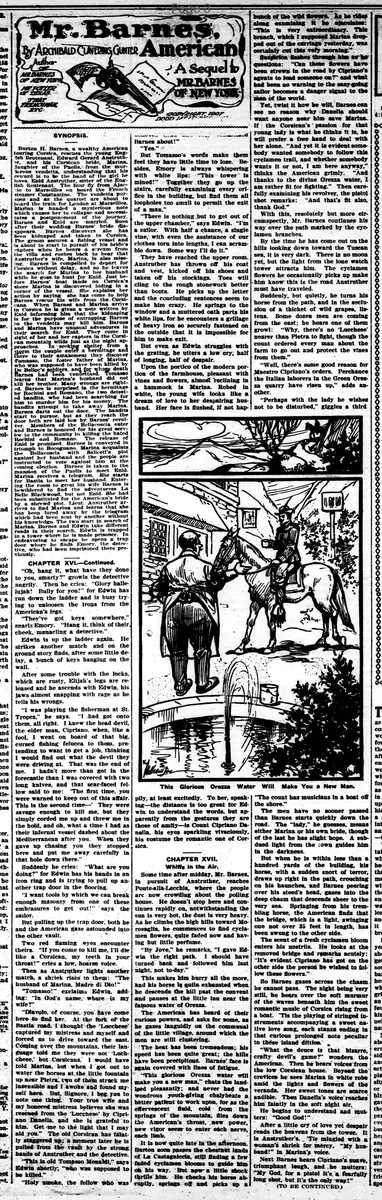
This makes him hurry all the more, and his horse is quite exhausted when he descends the hill past the convent and pauses at the little inn near the famous water of Orezza. The American has heard of their curious powers, and asks for some, as he gazes languidly on the commune of the little village, around which the men are still clustering. The heat has been tremendous; his speed has been quite great; the hills have been precipitous. Barnes' face is again covered with lines of fatigue. This glorious Orezza water will make you a new man," chats the landlord pleasantly; and never had the wondrous youth-giving chalybeate a better patient to work upon, for as the effervescent fluid, cold from the springs of the mountain, flies down the American's throat, new power, new vigor seem to enter each nerve, each limb. It is now quite late in the afternoon. Burton soon passes the chestnut lands of La Castagniccia, still finding a few faded cyclamen blooms to guide him on his way. But now a little shock thrills him. He checks his horse abruptly, springs off and picks up a bunch of the wild sowbane. As he rides along examining it he ejaculates:
"This is very extraordinary. This branch, which I supposed Marina dropped out of the carriage yesterday, was certainly cut this very morning."
Suspicion flashes through him as he questions: "Can these flowers have been strewn in the road by Cipriano's agents to lead someone on?" and what had been no warning to the easy-going sailor becomes a danger signal to the man of the world. Yet, twist it how he will, Barnes can see no reason why Danella should want anyone near him save Marina. If the Corsican's passion for that young lady is what he thinks it is, he will prefer a free hand to deal with her alone. "And yet it is evident somebody wanted somebody to follow this cyclamen trail, and whether somebody wants it or not, I am here anyway," thinks the American grimly.
"And thanks to the divine Orezza water, I am rather fit for fighting."
Then carefully examining his revolver, the pistol shot remarks: "And that's fit also, thank God."
With this, resolutely but more circumspectly, Mr. Barnes continues his way over the path marked by the cyclamen branches. By the time he has come out on the hills looking down toward the Tuscan sea, it is very dark. There is no moon yet, but the light from the lone watch tower attracts him. The cyclamen flowers he occasionally picks up make him know this is the road Anstruther must have traveled. Suddenly, but quietly, he turns his horse from the path, and in the seclusion of a thicket of wild grapes, listens. Some dozen men are coming from the east: he hears one of them growl:
"Why, there's no 'Lucchese' nearer than Pietra to fight, though the count ordered every man about the farm to go out and protect the vines from them."
"Well, there's some good reason for Maestro Cipriano's orders. Perchance the Italian laborers in the Green Orezza quarry have risen up," adds another.
"Perhaps with the lady he wishes not to be disturbed," giggles a third.
"The count has musicians in a boat on the shore."
The men have no sooner passed than Barnes starts quickly down the road. The "lady," he guesses, means either Marina or his own bride, though of the last he has slight hope. A subdued light from the town guides him in the darkness. But when he is within less than a hundred yards of the building, his horse, with a sudden snort of terror, draws up right in the path, crouching on his haunches, and Barnes peering over his steed's head, gazes into the deep chasm that descends sheer to the very sea. Springing from his trembling horse, the American finds that the bridge, which is a light, swinging one not over 35 feet in length, has been swung to the other side. The scent of a fresh cyclamen bloom enters his nostrils. He looks at the removed bridge and remarks acutely:
"It's evident Cipriano has got on the other side the person he wished to follow these flowers."
So Barnes gazes across the chasm he cannot pass. The night-being very still, he hears over the soft murmur of the waves beneath him the sweet romantic music of Corsica rising from a boat. 'Tis the playing of stringed instruments accompanying a sweet native love song, each stanza ending in that curious prolonged note peculiar to these island ditties.
"What the deuce is that bizarre, crafty, devil's game?" wonders the American. Then he hears voices from the low Corsican house. Beyond the crevices he sees Marina in white robe amid the lights and flowers of the veranda. Her sweet tones are scarce audible. Then Danella's voice reaches him faintly in the soft night air. He begins to understand and mutters: "Good God!" After a little cry of love yet despair rends the heavens from the tower. It is Anstruther's. 'Tis mingled with a woman's shriek for mercy. "My husband!" in Marina's voice. Next Barnes hears Cipriano's suave, triumphant laugh, and he mutters:
"My God, for a pistol it's a fearfully long shot, but it's the only way!"
What sub-type of article is it?
What themes does it cover?
What keywords are associated?
Literary Details
Subject
Vendetta And Kidnappings In Corsica
Form / Style
Serialized Adventure Novel Chapter
Key Lines