Thank you for visiting SNEWPapers!
Sign up free
The Detroit Tribune
Detroit, Wayne County, Michigan
What is this article about?
Bishop John Owen Smith reports widespread Southern support for equal rights based on responses to his anti-discrimination speeches, urging church leadership on human relations at a Methodist council meeting in Birmingham, Ala.
Clipping
OCR Quality
Full Text
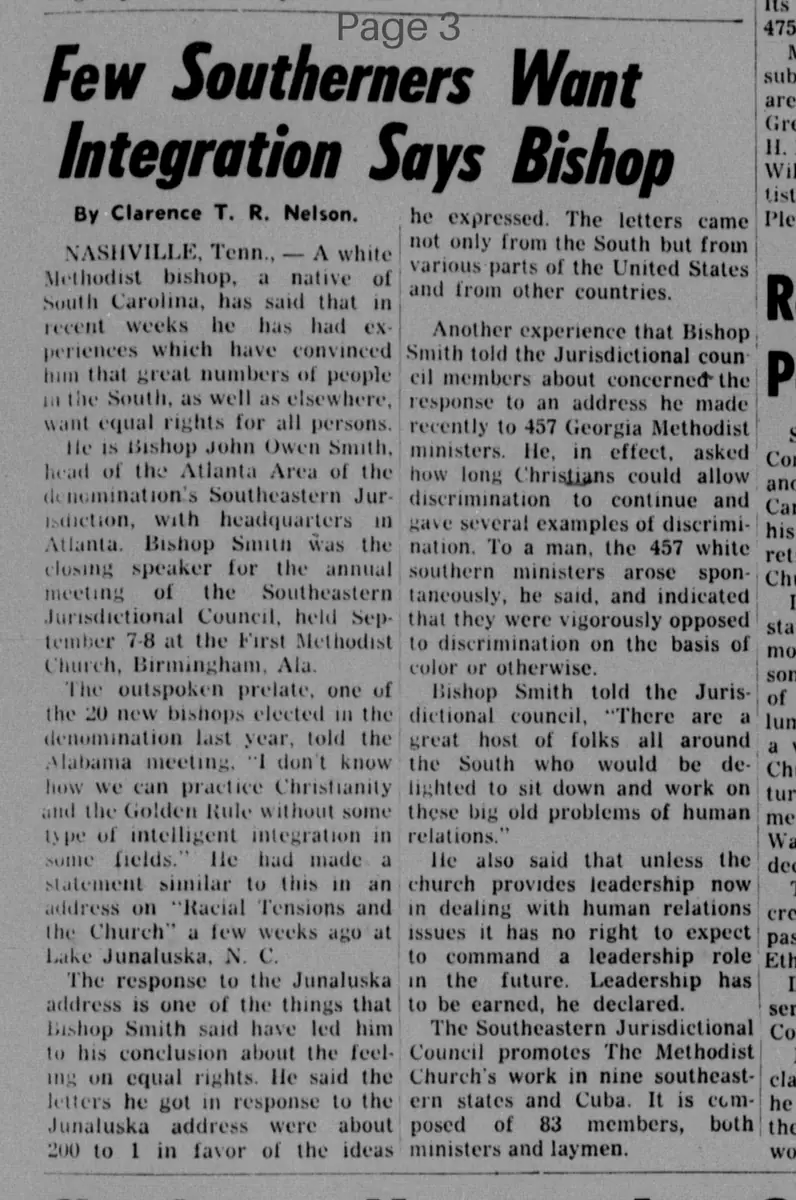
By Clarence T. R. Nelson.
NASHVILLE, Tenn., - A white Methodist bishop, a native of South Carolina, has said that in recent weeks he has had experiences which have convinced him that great numbers of people in the South, as well as elsewhere, want equal rights for all persons.
He is Bishop John Owen Smith, head of the Atlanta Area of the denomination's Southeastern Jurisdiction, with headquarters in Atlanta. Bishop Smith was the closing speaker for the annual meeting of the Southeastern Jurisdictional Council, held September 7-8 at the First Methodist Church, Birmingham, Ala.
The outspoken prelate, one of the 20 new bishops elected in the denomination last year, told the Alabama meeting. "I don't know how we can practice Christianity and the Golden Rule without some type of intelligent integration in some fields." He had made a statement similar to this in an address on "Racial Tensions and the Church" a few weeks ago at Lake Junaluska, N. C.
The response to the Junaluska address is one of the things that Bishop Smith said have led him to his conclusion about the feeling on equal rights. He said the letters he got in response to the Junaluska address were about 200 to 1 in favor of the ideas he expressed. The letters came not only from the South but from various parts of the United States and from other countries.
Another experience that Bishop Smith told the Jurisdictional council members about concerned the response to an address he made recently to 457 Georgia Methodist ministers. He, in effect, asked how long Christians could allow discrimination to continue and gave several examples of discrimination. To a man, the 457 white southern ministers arose spontaneously, he said, and indicated that they were vigorously opposed to discrimination on the basis of color or otherwise.
Bishop Smith told the Jurisdictional council, "There are a great host of folks all around the South who would be delighted to sit down and work on these big old problems of human relations."
He also said that unless the church provides leadership now in dealing with human relations issues it has no right to expect to command a leadership role in the future. Leadership has to be earned, he declared.
The Southeastern Jurisdictional Council promotes The Methodist Church's work in nine southeastern states and Cuba. It is composed of 83 members, both ministers and laymen.
What sub-type of article is it?
What themes does it cover?
What keywords are associated?
What entities or persons were involved?
Where did it happen?
Story Details
Key Persons
Location
Nashville, Tenn.; Atlanta, Ga.; Birmingham, Ala.; Lake Junaluska, N.C.; Georgia
Event Date
September 7 8
Story Details
Bishop John Owen Smith, a white Methodist bishop from South Carolina, shares experiences convincing him that many Southerners support equal rights and integration. He spoke at the Southeastern Jurisdictional Council in Birmingham, Ala., citing positive responses to his addresses on racial tensions at Lake Junaluska, N.C., and to Georgia Methodist ministers who opposed discrimination.