Thank you for visiting SNEWPapers!
Sign up free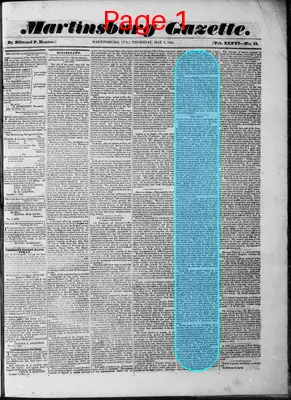
Editorial
May 7, 1835
Martinsburg Gazette
Martinsburg, Berkeley County, West Virginia
What is this article about?
Extract from Mr. Hammond's 1825 report praising the press's role in enlightening humanity, advocating for its freedom from censorship, and emphasizing its power in shaping public opinion and driving reforms, contrasting it with tyrannical controls in Europe.
Clipping

OCR Quality
95%
Excellent
Full Text
THE PRESS.
Extract from Mr. Hammond's report on the subject of the public printing. read in the House of Representatives, February 21, 1825.
That the art of printing has done more to enlighten and exalt the human mind, than all the other arts together, will perhaps be denied by no one, who will take the trouble to investigate the history of his race. Its discovery forms an era in human annals. Beyond it all is dreary and obscure, except here & there a bright spot, to relieve the eye from the painful contemplation of a darkness so universal. Art and science, it is true, had made considerable progress in some favored communities, but a knowledge of the discoveries and improvements upon which we delight to dwell, was confined to a fortunate few, who, however they might have been inclined to disseminate what they knew, had it not in their power to effect an object so full of patriotism and benevolence. The living mass that makes up all, of what is denominated either savage or barbarous nations, and constitutes a vast majority of the most highly cultivated nations of antiquity, was doomed to perpetual ignorance and degradation in the moral world. No mode of escape could be devised for Them. Books were scarce; the process of multiplying them by copies, the work of clerks, and the enormous prices consequent upon this mode of multiplication, must forever have shut out a large portion of such nations from the principal sources of mental enjoyment.
Printing, at a single blow demolished these barriers. It threw open all the doors of the temple, and permitted the poor and ignorant to walk in unmolested, to gaze upon the resplendent beauties that adorned its walls, and to bear off the invaluable treasures that filled its courts—treasures that were the accumulation of ages, and which till that moment, had been concealed from the eye of the multitude. A great moral revolution was effected in the twinkling of an eye. Before that period, kings, nobles, and governors, were every thing, and the people nothing. From that period the people became every thing and kings, nobles, and governors, nothing. The literal existence of this contrast, of this astonishing transformation, it is true, has not been realized, but the work has been going on. The rays of light are falling on the most benighted regions; the force of truth is breaking through all opposition; and the period is not far distant when man will stand forth in the freedom, the dignity, and the majesty of his nature, liberated from the shackles that have so long degraded body and soul; when the people will be completely sovereign; and an enlightened public opinion shall be the only rule of action to all in authority, from the highest to the lowest station. This time will come, and this will be the work of the press.
Ought this great moral engine to be free? Whatever difference of opinion may have existed elsewhere upon this subject, there seems to have been none among our ancestors. A censorship of the press has been established under most, if not all the tyrannical governments of Europe. The court of Rome set the example in the latter part of the fifteenth century; other despotic governments adopted the principle and made the press propagate such sentiments and opinions only, as suited the views of those who controlled its movements. No works of any kind, could see the light, but such as had been licensed by the government. The people, so far from being blessed by the art, which seemed to have been invented for their use alone, were not only deprived of its benefits, but had its immense power turned against themselves, and their country flooded with doctrines and opinions calculated to rivet their chains more firmly, and to doom them to a perpetual servitude.
To the honor of our ancestors, be it known, that this censorship of the press was first abolished in England. This great event took place in the year 1694. Since that time the English press has been free. A censorship is unknown in this country. The lofty spirit of American liberty would trample upon an effort to limit the freedom of discussion. Truth courts investigation, and he who fears it, is generally conscious that truth is against him.
Freedom of speech and of the press are one and the same thing. In a small community, all may assemble for deliberation, and hear what the other has to advance for the general good. This was the case, in some of the ancient republics. But in a large country this cannot be; and resort must be had to the press, or the circulation of acts and opinions that are connected with the public interest.
The freedom of speech enjoyed by members of this house, would be of little avail, if they were not allowed to print & circulate their sentiments among their constituents, and in the country at large. Errors, indiscretions, corruptions, and usurpations, might exist to an alarming extent, yet reform would be utterly hopeless. Before a reform can take place in the legislation or administration of a republican government, we must first reform public opinion. How is this to be done, unless the people can be approached through the medium of the press, and induced to read and consider the productions of those who are laboring for the public welfare?
The history of the world, for the last century, scarcely furnishes an instance of a revolution in government, that has not been produced, in a good degree, by the genial influence of the press. In some cases, the books and pamphlets, and in others the newspapers, have wrought a change in public opinion, that has been followed up by civil commotion, tending to enlarge the liberties of the people. Uniformly, the newspaper presses have led off in favor of liberal principles. Witness the recent revolution in France and Belgium. Whenever any portion of the press lags behind, it is in the pay and under the control of individuals whose interests are adverse to those of the majority. Let reform it goes with the people, as certainly as water seeks its level.
A great deal has been said of the licentiousness of the press; but not a charge can be made against it, that does not apply in principle to the printers and publishers of books, and the freedom of speech. Do the public journals abuse their liberty? So do those who print pernicious books, circulate scandalous reports. Do the newspapers defame great and good men? So do the others; and often in a more permanent and dangerous form. Have they condemned sound doctrine in ethics and politics, and maintained principles that must overthrow all governments, resolve society into its elements? Books and orators do the same thing, in a more seductive and effectual manner. It is impossible to separate them. To condemn one, is to pass sentence against the others.
If the press has a great influence in the formation and communication of opinions, is it not all important, that we should elevate & purify it, by all means in our power. This can never be done by proscription. All experience proves, that men of talents and virtue, who have a desire for distinction, will select that path which is most likely to lead them to their object. Do we desire to see men of high character, and splendid talents, engaged in conducting the periodieals of our country? Render the profession honorable. To degrade it, is to drive them from it, and to abandon your public press to the superintendence of incompetent and unprincipled individuals, wholly unworthy of so high a trust. There is a great deal of the odium of the profession attaches to each member of it, honest and pure as he may be; and perhaps there is no position in society, where it is so difficult for a man to retain a pure character, as at the editorial desk. If this be true, does it not follow that there is no one, in which a character so preserved more richly deserves the public approbation? A man who becomes an editor, makes of himself a target for the arrows of detraction, and an object of blackening abuse; and if it be difficult in this situation, to maintain perfect purity of character, it is still more difficult to appear so. The resolute advocate of free principles in all ages, whether acting as orators, statesmen, or editors, have been objects of brutal attack by the minions of power and corruption.
Extract from Mr. Hammond's report on the subject of the public printing. read in the House of Representatives, February 21, 1825.
That the art of printing has done more to enlighten and exalt the human mind, than all the other arts together, will perhaps be denied by no one, who will take the trouble to investigate the history of his race. Its discovery forms an era in human annals. Beyond it all is dreary and obscure, except here & there a bright spot, to relieve the eye from the painful contemplation of a darkness so universal. Art and science, it is true, had made considerable progress in some favored communities, but a knowledge of the discoveries and improvements upon which we delight to dwell, was confined to a fortunate few, who, however they might have been inclined to disseminate what they knew, had it not in their power to effect an object so full of patriotism and benevolence. The living mass that makes up all, of what is denominated either savage or barbarous nations, and constitutes a vast majority of the most highly cultivated nations of antiquity, was doomed to perpetual ignorance and degradation in the moral world. No mode of escape could be devised for Them. Books were scarce; the process of multiplying them by copies, the work of clerks, and the enormous prices consequent upon this mode of multiplication, must forever have shut out a large portion of such nations from the principal sources of mental enjoyment.
Printing, at a single blow demolished these barriers. It threw open all the doors of the temple, and permitted the poor and ignorant to walk in unmolested, to gaze upon the resplendent beauties that adorned its walls, and to bear off the invaluable treasures that filled its courts—treasures that were the accumulation of ages, and which till that moment, had been concealed from the eye of the multitude. A great moral revolution was effected in the twinkling of an eye. Before that period, kings, nobles, and governors, were every thing, and the people nothing. From that period the people became every thing and kings, nobles, and governors, nothing. The literal existence of this contrast, of this astonishing transformation, it is true, has not been realized, but the work has been going on. The rays of light are falling on the most benighted regions; the force of truth is breaking through all opposition; and the period is not far distant when man will stand forth in the freedom, the dignity, and the majesty of his nature, liberated from the shackles that have so long degraded body and soul; when the people will be completely sovereign; and an enlightened public opinion shall be the only rule of action to all in authority, from the highest to the lowest station. This time will come, and this will be the work of the press.
Ought this great moral engine to be free? Whatever difference of opinion may have existed elsewhere upon this subject, there seems to have been none among our ancestors. A censorship of the press has been established under most, if not all the tyrannical governments of Europe. The court of Rome set the example in the latter part of the fifteenth century; other despotic governments adopted the principle and made the press propagate such sentiments and opinions only, as suited the views of those who controlled its movements. No works of any kind, could see the light, but such as had been licensed by the government. The people, so far from being blessed by the art, which seemed to have been invented for their use alone, were not only deprived of its benefits, but had its immense power turned against themselves, and their country flooded with doctrines and opinions calculated to rivet their chains more firmly, and to doom them to a perpetual servitude.
To the honor of our ancestors, be it known, that this censorship of the press was first abolished in England. This great event took place in the year 1694. Since that time the English press has been free. A censorship is unknown in this country. The lofty spirit of American liberty would trample upon an effort to limit the freedom of discussion. Truth courts investigation, and he who fears it, is generally conscious that truth is against him.
Freedom of speech and of the press are one and the same thing. In a small community, all may assemble for deliberation, and hear what the other has to advance for the general good. This was the case, in some of the ancient republics. But in a large country this cannot be; and resort must be had to the press, or the circulation of acts and opinions that are connected with the public interest.
The freedom of speech enjoyed by members of this house, would be of little avail, if they were not allowed to print & circulate their sentiments among their constituents, and in the country at large. Errors, indiscretions, corruptions, and usurpations, might exist to an alarming extent, yet reform would be utterly hopeless. Before a reform can take place in the legislation or administration of a republican government, we must first reform public opinion. How is this to be done, unless the people can be approached through the medium of the press, and induced to read and consider the productions of those who are laboring for the public welfare?
The history of the world, for the last century, scarcely furnishes an instance of a revolution in government, that has not been produced, in a good degree, by the genial influence of the press. In some cases, the books and pamphlets, and in others the newspapers, have wrought a change in public opinion, that has been followed up by civil commotion, tending to enlarge the liberties of the people. Uniformly, the newspaper presses have led off in favor of liberal principles. Witness the recent revolution in France and Belgium. Whenever any portion of the press lags behind, it is in the pay and under the control of individuals whose interests are adverse to those of the majority. Let reform it goes with the people, as certainly as water seeks its level.
A great deal has been said of the licentiousness of the press; but not a charge can be made against it, that does not apply in principle to the printers and publishers of books, and the freedom of speech. Do the public journals abuse their liberty? So do those who print pernicious books, circulate scandalous reports. Do the newspapers defame great and good men? So do the others; and often in a more permanent and dangerous form. Have they condemned sound doctrine in ethics and politics, and maintained principles that must overthrow all governments, resolve society into its elements? Books and orators do the same thing, in a more seductive and effectual manner. It is impossible to separate them. To condemn one, is to pass sentence against the others.
If the press has a great influence in the formation and communication of opinions, is it not all important, that we should elevate & purify it, by all means in our power. This can never be done by proscription. All experience proves, that men of talents and virtue, who have a desire for distinction, will select that path which is most likely to lead them to their object. Do we desire to see men of high character, and splendid talents, engaged in conducting the periodieals of our country? Render the profession honorable. To degrade it, is to drive them from it, and to abandon your public press to the superintendence of incompetent and unprincipled individuals, wholly unworthy of so high a trust. There is a great deal of the odium of the profession attaches to each member of it, honest and pure as he may be; and perhaps there is no position in society, where it is so difficult for a man to retain a pure character, as at the editorial desk. If this be true, does it not follow that there is no one, in which a character so preserved more richly deserves the public approbation? A man who becomes an editor, makes of himself a target for the arrows of detraction, and an object of blackening abuse; and if it be difficult in this situation, to maintain perfect purity of character, it is still more difficult to appear so. The resolute advocate of free principles in all ages, whether acting as orators, statesmen, or editors, have been objects of brutal attack by the minions of power and corruption.
What sub-type of article is it?
Press Freedom
What keywords are associated?
Press Freedom
Printing History
Censorship Abolition
Public Opinion
Moral Revolution
Newspaper Influence
Editorial Profession
What entities or persons were involved?
Mr. Hammond
House Of Representatives
Court Of Rome
English Ancestors
American Liberty
Editorial Details
Primary Topic
Freedom And Importance Of The Press
Stance / Tone
Strongly Pro Freedom Of The Press
Key Figures
Mr. Hammond
House Of Representatives
Court Of Rome
English Ancestors
American Liberty
Key Arguments
Printing Enlightened Humanity And Democratized Knowledge.
Censorship In Europe Turned The Press Against The People.
Abolition Of Censorship In England In 1694 And Its Absence In America.
Freedom Of The Press Is Essential For Circulating Opinions In Large Countries.
Press Reforms Public Opinion And Drives Governmental Revolutions.
Charges Of Press Licentiousness Apply Equally To Books And Speech.
Elevate The Press By Honoring The Profession, Not Proscribing It.