Thank you for visiting SNEWPapers!
Sign up free
Literary
July 26, 1841
Vermont Watchman And State Journal
Montpelier, Washington County, Vermont
What is this article about?
An aged woman in Burlington, NJ, recounts her family's emigration from Holland during the French invasion. Her husband served under Prince William V, who addressed his people in church, absolved their allegiance, and led them in singing Psalm 46 before fleeing to England. The family followed to America out of loyalty.
Clipping
OCR Quality
95%
Excellent
Full Text
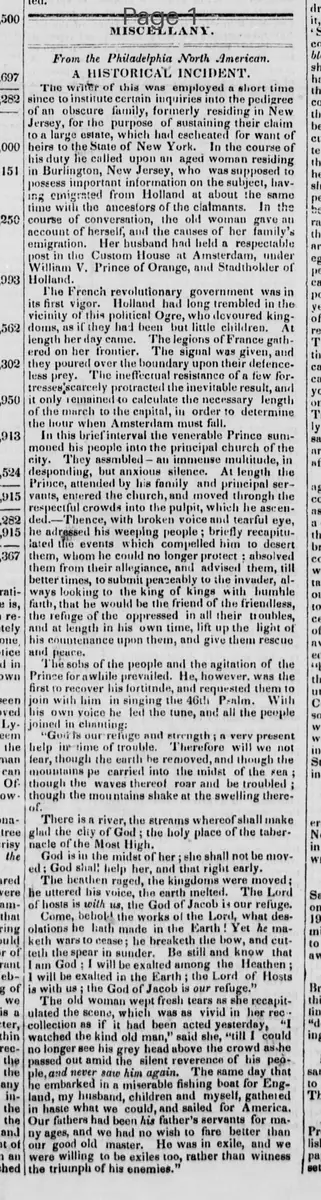
MISCELLANY
From the Philadelphia North American.
A HISTORICAL INCIDENT.
The writer of this was employed a short time since to institute certain inquiries into the pedigree of an obscure family, formerly residing in New Jersey, for the purpose of sustaining their claim to a large estate, which had escheated for want of heirs to the State of New York. In the course of his duty he called upon an aged woman residing in Burlington, New Jersey, who was supposed to possess important information on the subject, having emigrated from Holland at about the same time with the ancestors of the claimants. In the course of conversation, the old woman gave an account of herself, and the causes of her family's emigration. Her husband had held a respectable post in the Custom House at Amsterdam, under William V. Prince of Orange, and Stadtholder of Holland.
The French revolutionary government was in its first vigor. Holland had long trembled in the vicinity of this political Ogre, who devoured kingdoms, as if they had been but little children. At length her day came. The legions of France gathered on her frontier. The signal was given, and they poured over the boundary upon their defenceless prey. The ineffectual resistance of a few fortresses scarcely protracted the inevitable result, and it only remained to calculate the necessary length of the march to the capital, in order to determine the hour when Amsterdam must fall.
In this brief interval the venerable Prince summoned his people into the principal church of the city. They assembled— an immense multitude, in desponding, but anxious silence. At length the Prince, attended by his family and principal servants, entered the church, and moved through the respectful crowds into the pulpit, which he ascended.—Thence, with broken voice and tearful eye, he addressed his weeping people; briefly recapitulated the events which compelled him to desert them, whom he could no longer protect ; absolved them from their allegiance, and advised them, till better times, to submit peaceably to the invader, always looking to the king of kings with humble faith, that he would be the friend of the friendless, the refuge of the oppressed in all their troubles, and at length in his own time, lift up the light of his countenance upon them, and give them rescue and peace.
The sobs of the people and the agitation of the Prince for awhile prevailed. He, however. was the first to recover his fortitude, and requested them to join with him in singing the 46th Psalm. With his own voice he led the tune, and all the people joined in chanting:
"God is our refuge and strength; a very present help in time of trouble. Therefore will we not fear, though the earth be removed, and though the mountains be carried into the midst of the sea; though the waves thereof roar and be troubled; though the mountains shake at the swelling thereof.
There is a river, the streams whereof shall make glad the city of God ; the holy place of the tabernacle of the Most High.
God is in the midst of her ; she shall not be moved; God shall help her, and that right early.
The heathen raged, the kingdoms were moved; he uttered his voice, the earth melted. The Lord of hosts is with us, the God of Jacob is our refuge.
Come, behold the works of the Lord, what desolations he hath made in the Earth! He maketh wars to cease: he breaketh the bow, and cutteth the spear in sunder. Be still and know that I am God ; I will be exalted among the Heathen I will be exalted in the Earth; the Lord of Hosts is with us ; the God of Jacob is our refuge."
The old woman wept fresh tears as she recapitulated the scene, which was as vivid in her recollection as if it had been acted yesterday, "I watched the kind old man," said she, "till I could no longer see his grey head above the crowd as he passed out amid the silent reverence of his people, and never saw him again. The same day that he embarked in a miserable fishing boat for England, my husband, children and myself, gathered in haste what we could, and sailed for America. Our fathers had been his father's servants for many ages, and we had no wish to fare better than our good old master. He was in exile, and we were willing to be exiles too, rather than witness the triumph of his enemies."
From the Philadelphia North American.
A HISTORICAL INCIDENT.
The writer of this was employed a short time since to institute certain inquiries into the pedigree of an obscure family, formerly residing in New Jersey, for the purpose of sustaining their claim to a large estate, which had escheated for want of heirs to the State of New York. In the course of his duty he called upon an aged woman residing in Burlington, New Jersey, who was supposed to possess important information on the subject, having emigrated from Holland at about the same time with the ancestors of the claimants. In the course of conversation, the old woman gave an account of herself, and the causes of her family's emigration. Her husband had held a respectable post in the Custom House at Amsterdam, under William V. Prince of Orange, and Stadtholder of Holland.
The French revolutionary government was in its first vigor. Holland had long trembled in the vicinity of this political Ogre, who devoured kingdoms, as if they had been but little children. At length her day came. The legions of France gathered on her frontier. The signal was given, and they poured over the boundary upon their defenceless prey. The ineffectual resistance of a few fortresses scarcely protracted the inevitable result, and it only remained to calculate the necessary length of the march to the capital, in order to determine the hour when Amsterdam must fall.
In this brief interval the venerable Prince summoned his people into the principal church of the city. They assembled— an immense multitude, in desponding, but anxious silence. At length the Prince, attended by his family and principal servants, entered the church, and moved through the respectful crowds into the pulpit, which he ascended.—Thence, with broken voice and tearful eye, he addressed his weeping people; briefly recapitulated the events which compelled him to desert them, whom he could no longer protect ; absolved them from their allegiance, and advised them, till better times, to submit peaceably to the invader, always looking to the king of kings with humble faith, that he would be the friend of the friendless, the refuge of the oppressed in all their troubles, and at length in his own time, lift up the light of his countenance upon them, and give them rescue and peace.
The sobs of the people and the agitation of the Prince for awhile prevailed. He, however. was the first to recover his fortitude, and requested them to join with him in singing the 46th Psalm. With his own voice he led the tune, and all the people joined in chanting:
"God is our refuge and strength; a very present help in time of trouble. Therefore will we not fear, though the earth be removed, and though the mountains be carried into the midst of the sea; though the waves thereof roar and be troubled; though the mountains shake at the swelling thereof.
There is a river, the streams whereof shall make glad the city of God ; the holy place of the tabernacle of the Most High.
God is in the midst of her ; she shall not be moved; God shall help her, and that right early.
The heathen raged, the kingdoms were moved; he uttered his voice, the earth melted. The Lord of hosts is with us, the God of Jacob is our refuge.
Come, behold the works of the Lord, what desolations he hath made in the Earth! He maketh wars to cease: he breaketh the bow, and cutteth the spear in sunder. Be still and know that I am God ; I will be exalted among the Heathen I will be exalted in the Earth; the Lord of Hosts is with us ; the God of Jacob is our refuge."
The old woman wept fresh tears as she recapitulated the scene, which was as vivid in her recollection as if it had been acted yesterday, "I watched the kind old man," said she, "till I could no longer see his grey head above the crowd as he passed out amid the silent reverence of his people, and never saw him again. The same day that he embarked in a miserable fishing boat for England, my husband, children and myself, gathered in haste what we could, and sailed for America. Our fathers had been his father's servants for many ages, and we had no wish to fare better than our good old master. He was in exile, and we were willing to be exiles too, rather than witness the triumph of his enemies."
What sub-type of article is it?
Essay
What themes does it cover?
Political
Religious
Liberty Freedom
What keywords are associated?
Historical Incident
French Invasion
Prince William V
Psalm 46
Dutch Emigration
Exile Loyalty
What entities or persons were involved?
From The Philadelphia North American.
Literary Details
Title
A Historical Incident.
Author
From The Philadelphia North American.
Form / Style
Narrative Prose Recounting A Historical Event
Key Lines
"God Is Our Refuge And Strength; A Very Present Help In Time Of Trouble. Therefore Will We Not Fear, Though The Earth Be Removed, And Though The Mountains Be Carried Into The Midst Of The Sea; Though The Waves Thereof Roar And Be Troubled; Though The Mountains Shake At The Swelling Thereof."
"The Heathen Raged, The Kingdoms Were Moved; He Uttered His Voice, The Earth Melted. The Lord Of Hosts Is With Us, The God Of Jacob Is Our Refuge."
"I Watched The Kind Old Man," Said She, "Till I Could No Longer See His Grey Head Above The Crowd As He Passed Out Amid The Silent Reverence Of His People, And Never Saw Him Again."