Thank you for visiting SNEWPapers!
Sign up free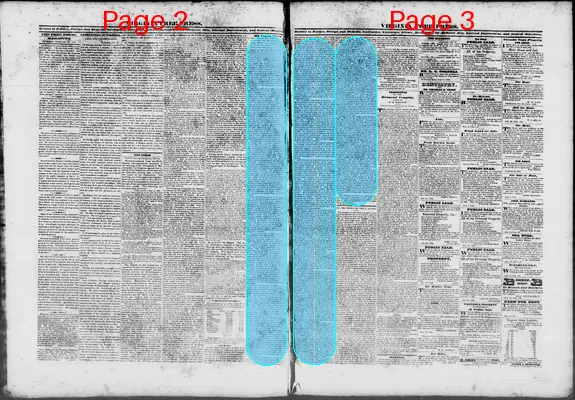
Virginia Free Press
Charles Town, Jefferson County, West Virginia
What is this article about?
In a U.S. Senate speech on Monday, January 10, 1834, Henry Clay criticizes the Executive's removal of public deposits from the Bank of the United States, blames it for widespread economic distress, defends open debate on public petitions, and calls for restoring constitutional authority over the bank's future.
Merged-components note: Continuation of Henry Clay's speech across pages; sequential reading orders and topic coherence
Clippings

1 of 2
OCR Quality
Full Text
In the Senate of the United States, on Monday the 10th inst.—the North Carolina Resolutions, adverse to the course of the Executive in removing the public money from the Bank of the United States, being under consideration—
Mr. Clay observed, that the Senator from Georgia (Mr. Forsyth) had informed the Senate, merely to record against discussion on such trifling matters as those of presenting petitions from the unfolding their distresses and invoking relief from Congress. I (said Mr. C.) protest against the gentleman's remark; and to say, that I shall not avail myself of the gratuitous admonition which he has given. I am well aware that discussion is not grateful to the ears of presumptuous power, when the wisdom of its measures is questioned, and that it prefers a state of perfect submission and of entire acquiescence, leaving the exclusive care of public affairs to itself. I hope an independent Senate will never be wanting to speak out boldly and fearlessly its sentiments to the country on the important concerns of the People.
The supporters of the Administration presented a remarkable figure in the Senate. They commenced, by ascribing the general distress to the Bank; or rather, to go further back, they began by a confident denial of the existence of any distress. The senior member from Pennsylvania, (Mr. Wilkins) who I am sorry not to see in his place, took that up; and stated that up to the last of November, after the branch at Pittsburgh had called in half a million of dollars, no suffering was felt, and he attributed the subsequent distresses as arose in that community to that call. I should imagine that, if it occasioned distress, it would have been felt during the process of the call. It was then the pressure must have been experienced, during the mere fact of the curtailment had become the only cause; but no, says the gentleman, it was not then felt: when he left his constituents all were prosperous and contented. Why, sir, if the period of their sufferings is to be fixed at the time of the gentleman's "promotion from his neighbors, he had better go back to them, and let us see whether, in the pleasure of again meeting them, he can restore their prosperity and happiness.
At length the evidence of deep, wide-spread, alarming distress, is poured upon us, in a mass, and so convincing, that no one is hardy enough any longer to controvert the fact. But the friends of the Administration, unwilling to own what the whole country feels and knows to be the true cause, the usurpation of the Executive, are perpetually taxing their ingenuity to find out some other. The Senator from Pennsylvania says, that the debate in this Senate has produced the existing state of things. That this debate has agitated the country, occasioned the scarcity of money, checked the operations of business, and led to the afflicting bankruptcies which have fortunately occurred. The gentleman even goes further, he ascribes all these terrible consequences to a speech which I had the honor of addressing to the Senate some weeks ago. Well, sir, if one speech be competent to produce such extensive scenes of distress, and to excite a panic so general, another may be able to bring relief and tranquility. And I hope the gentleman will hasten to complete the speech, one half of which he made two days ago, and by it restore to a suffering people, the confidence, the sound currency, the prosperity of which they have been deprived.
From the distress which is so generally felt, the gentleman from Georgia elicits himself that the South is yet exempt, that the town of Augusta is particularly easy and prosperous; and that cotton has recently experienced the great advance of a half cent per pound. It may be true that some small portions of the Union are yet unaffected. But how long can they preserve their enviable exemption? How long can any part of the country remain uninfluenced by a total derangement of the currency, and a prostration of public confidence? And is it kind in the honorable gentleman, because his particular town of Augusta does not yet feel the mischief, which sooner or later must sweep over the whole land, to oppose investigation into the causes or the adoption of obvious and appropriate remedies?
Since gentlemen have been compelled reluctantly to admit the prevalence of distress, there is one cause of it, ever ready, which they are constantly assigning: The Bank, the Bank! How really stands the matter? The President, in his famous manifesto of September, avowed, that one of the objects was to compel the Bank to wind up its affairs. The Secretary of the Treasury repeats the same purpose in his report to Congress. The Bank (say they) had but a little more than two years to run, before the expiration of its charter, and it ought to begin to wind up; that is, to curtail its discounts and business. The Executive does more by its measures it compels the Bank to call in its loans from other sources. In this state of things, the Bank, from the necessity of its position, begins to wind up; and as soon as it commences the operation, as soon as it adopts the very course which the President and secretary declare have been their object, an outcry is raised against the Bank. And gentlemen see, in the very effect which the Executive measures were designed to produce, in the fulfilment of its avowed object, that the Bank is aiming at a re-charter.
If any one will take the trouble to look to the case, he will find that the process of winding up, on which the President sets so firmly resolved, puts necessarily produce great, extensive, and not very temporary distress. The Bank has out on loan fifty-five millions of dollars. If that sum be called in by the 4th of March, 1836, a period of less than two years, the curtailment must be, if it were distributed equally through the whole time, at the rate of two millions per month. But as the Bank has, after its charter has expired, two years longer to close its business, let us suppose that the curtailment shall be performed in four years instead of two, and equally distributed. This will require upward of a million per month. Can the country, without suffering, bear a reduction of two or even one million per month? The banking system is so connected and interwoven together, that, when the Bank of the United States, or a system of Banks, of large and extensive business, calls in, all must call in. As is the opposite case, when one freely puts out, all may. They move together, whether in expansion or contraction of accommodations. When a call is made, for a considerable sum, payment is effected, in part, at least, in the notes of the Bank; and these notes become a credit in the possession of the collecting Bank, for which it may demand specie; and the debtor Banks must reduce the discounts to their customers to obtain the requisite supply of specie. If, on the other hand, large issues are made, these issues form a basis on which other Banks may operate and extend their business.
The President resorts to a high-handed measure which violates, as we believe, the Constitution—imposes upon the laws wrested from an equitable and control of the public treasure. Political and remonstrance, and fill the city with their Committees, sent here to expose their grievances, and to solicit speedy and effectual redress. Under these circumstances, the gentleman from Georgia rises in his place, and tells us that all discussion, in presenting these petitions, is unprofitable; and, remonstrating against it, he expresses the hope that, hereafter, the business may be quietly transacted.
I tell the gentleman from Georgia, and to pay tell the President, that, when the Constitution has been outraged, the liberties of the country brought in danger, and the highest interest of the People put in jeopardy, the Senate will not be silent—Congress will not be silent—the People will not be silent until I am prepared to bow my back to the yoke of despotism, for one, I will remonstrate, and protest, and loudly proclaim the danger impending over us. I have no doubt that discussion is painful, and provokingly impertinent, to the tenant of yonder White House—that he would prefer dead silence and universal submission; but I trust that these miserable petitions, as the Senator from Georgia denominates them, will continue to come in; that the country will become sensible to the reality of the existing dangers; that discussion, in every form, and on every occasion, will take place; and that, finally, the Constitution and the laws will resume their accustomed authority.
The gentleman professes to perceive, in these miserable petitions, party purposes, and the objects of party only. He believes that the sole design of the vast movements, of which we every day hear, is to displace those in power, and to introduce others. Why, sir, would the thousands, and tens of thousands, that are every day and every where assembling, and expressing their grievances, in unexaggerated language, meet for such a purpose only? Would the men of business quit their work-shops, their counting-rooms, their offices, and many of them at great personal inconvenience, repair to the seat of the General Government for any such object? Would they come here to present their miserable petitions? No election of President, of members of Congress, or of members of the State Legislatures, is just at hand. Most of those elections are as far removed, in point of time, as they well can be. That of Chief Magistrate is three years distant.
If we did not know that, in many instances, the People, without distinction of party, met and united in these petitions, or without assembling together, subscribed to them, we might be perfectly sure that nothing but severe and pervasive distress, actually felt, and still greater anticipated, could occasion the general excitement of which we have daily proofs.
And what are the remedies by those in possession of the Government? None, none. Idle, and visionary, and chimerical schemes, are indeed sometimes thrown out, but they even are not seriously proposed. A member not now in his seat, (Mr. Rives,) has suggested one of these schemes, which is to banish all paper from circulation, and to resort exclusively to hard money. A more wild and impracticable project never entered the head of man. It would be a gross imposition upon the community (of course I do not mean any thing disrespectful to the honorable Senator,) to attempt such a purpose. Congress has no power to accomplish it. How can it effect the destruction, or reach the State Banks? What authority has it to put them down? How utterly unavailing would be the measure of refusing to receive their notes in payment of duties? They would still be used in all the business of society, and, choking up all the channels of circulation, would finally force themselves, as they did in 1815 and 1816, into the general treasury, as the only means left to the People to pay their contributions to the Government.
Hard money! Why, sir, let us glance at some of the obvious effects of a resort to the precious metals as the only medium of circulation. The whole currency of the United States may be stated at about $120,000,000, ninety in convertible paper, and thirty in specie, either in the vaults of the Banks, or in the hands of the people. This sum of one hundred and twenty millions is the representative of the property of the country, and constitutes the means of transacting its business. It represents the value, determines the price, and is the instrument of affecting alienations of the property of the country. What would be the immediate effect on property if the sudden withdrawal of the paper currency of the country; that is to say, three-fourths of its actual currency? Property would sink down to one-fourth of its present value. It would sink lower. For we know that, when property is generally falling, the fears of men are in advance of the actual depression, and carry them to a point much below what it ought to be. As, in the opposite case, when it is rising, their hopes carry them ahead of the actual rise, and the spirit of speculation prompts them to give more than its actual value.
What would be the effect upon debt? Every man, if three-fourths of the currency were stricken down, would have to pay four dollars for every one he owed. A single example will illustrate the state of things. Suppose a man to be now worth $10,000 and to owe $10,000. He could, in the present state of things, pay off his debt, and have a residuum of $10,000. But in the contingency supposed, it would take his whole property, and probably more, to pay his debt, and he would be left destitute.
Nor is such a project desirable, if it were practicable, and Congress possessed power to adopt and enforce it. The introduction of bank notes, convertible into the precious metals, at the will of the holder, is a great facility in the transaction of the business and commerce of mankind. Some common standard of value exists in all forms of human society. It supersedes, even in the savage state, the practice of simple barter. The substitution of the precious metals, for the ruder objects employed, in the first stages of commercial operations, was not a greater improvement than that of substituting a sound, safe, and convertible paper currency, to the direct employment of a metallic medium. Such paper, well regulated, entitled to and possessing the confidence of the public, saves labor, economizes time, and avoids risk. Compared to a cumbrous metallic currency, it is what sails, or the power of steam, are to oars, in navigation: or Rail-roads and McAdamized roads are to natural and unimproved highways, in travelling. A metallic currency indeed! Who believes it possible? Who thinks that society can be thrown back, from its present advanced state, centuries? Why, let us look at its effect upon a single operation. How are the three millions of dollars annually received for public lands to be collected in specie? Are they to be wagoned across the mountains to the remote land office of the West, and wagoned back again?
No, sir, you may put down the Bank, and refuse to charter any other United States Bank—and what then? Hundreds of other Banks, beyond our control, will spring up, like mushrooms, in every direction, in spite of you. Acting without concert, irresponsible to you, each will seek, by all sorts of mortage, to throw out its paper, and, sooner or later, and I fear the time will not be very long, the country will be overspread with a spurious circulation, and a general explosion must inevitably ensue. Already, in anticipation of the downfall of the Bank, numerous projects of local banks are under consideration in the State Legislatures. In Ohio, Kentucky, and Indiana, ultimately, no doubt, in all the States, these projects are, or will be, proposed. One in the State of Indiana has passed, or is likely to pass, for, I believe, several millions, and I have seen with regret, one in Kentucky, for the moderate sum of five millions, is favorably considered.
What ought Congress to do? Let us first vindicate the authority of the Constitution and laws, rebuke usurpation, and assert the independence.
This is our first duty. Until this be done, until the balances of the Constitution are restored, all legislation will be vain and nugatory. Let us again separate the purse and the sword. Whilst they are united in the hands of one man, of what avail is our action? When, and not until this paramount duty is performed, let us take up for consideration the subject of a Bank. Gentlemen tell us that the question now pending, is, Bank or no Bank. It is no such thing. It is Constitution or no Constitution; the predominance of the laws, or the uncontrolled will of one man. When the Constitution and the laws shall again resume their just sway, the question will not even then be, Bank or no Bank. That this is a question long since settled—settled by experience, by the necessity of the case, and in the judgment of those who are denouncing the existing Bank. They know that a United States Bank must exist. And the question is not Bank or no Bank, but the location of the Bank. It is a question between Pennsylvania and New York—Philadelphia and the City of New York—Chestnut street and Wall street.
The gentleman from New York, (Mr. Wright,) it is true, declares that he is opposed to any Bank of the United States. But he is only one gentleman; he may not be here when the question shall come up; he may be otherwise provided for; he may review and alter his judgment. I understand that, in the State of New York, by common consent, a sort of statute of limitation exists against all political opinions of two years' duration.
Bank or no Bank! There is no such question now or hereafter likely to arise. All feel and own that a United States Bank is indispensable. And I have but little doubt that the very spot is now in view, if the ground be not actually laid off, on which a magnificent banking-house is contemplated in Wall street. Why, what did the President tell the New York Committee of merchants which lately visited him? That the Government, (not Congress,) but the Government—in his sense of the term, that he was determined to try the experiment of the league banks, and if that failed he would try some other.
And what other, that failing, but the Wall street Bank? What did the gentleman from Illinois (Mr. Kane) tell us the other day? Substantially that it was not the Bank that was objected to, but the President of the Bank: not the vessel, but the commander. There can be very little doubt, that, if the Corporation had turned out its able, experienced, and faithful President, and put in some Executive favorite, as another Corporation did, we should perceive less opposition to the Bank.
The Senator from Illinois prefers the fifty bark canoes, lashed together with the grape vine. By the by, the gentleman from Pennsylvania (Mr. Wilkins) found out that the grape vine had three ends to it, one more than I ever knew any other cord or ligament to possess.
The Senator from Illinois prefers being one of the crew in the squadron under the auspices of Admiral Taney. Admiral Tawney! (said Mr. Clay.) Why, sir, the very sound of the name is enough to repress every martial emotion, and to dampen all chivalrous ardor. If good currency, good reasons, or any thing else good, can issue from such a source, I shall be agreeably disappointed. No, sir; I will not embark with the gentleman under such a commander. Give me, in preference, the old Commodore—the able, zealous, faithful, long-tried Commodore, and the star-spangled banner waving at the mast head of Old Ironsides. The name of Biddle is patriotic—Revolutionary—and implies gallantry, and honor, and probity.
Mr. President, I have most unexpectedly been drawn into this debate. I rose, simply to protest, most solemnly, against the remonstrance of the gentleman from Georgia, who would stifle the voice of distress, and the accents of despair, as they are transmitted to us from the People, by cutting off all discussion. I repeat that, although the freedom of the press has been recently assailed by the Executive, the liberty of speech yet remains; and, whilst I continue to retain a seat in this body, I shall freely use it, all remonstrances notwithstanding, in exposing Executive encroachments and abuses, and in warning the People of the dangers which threaten their highest interests Mr. Wilkins described, on a previous day.
one of the ends to be fastened to the boats: another had taken root throughout the country; and with the third he supposed the People to be pulling the boats ashore.
Pronounced Tawney.
What sub-type of article is it?
What themes does it cover?
What keywords are associated?
What entities or persons were involved?
Where did it happen?
Story Details
Key Persons
Location
Senate Of The United States
Event Date
Monday The 10th Inst.
Story Details
Henry Clay delivers a speech protesting against stifling discussion on public petitions regarding economic distress caused by the Executive's removal of deposits from the Bank of the United States, criticizes administration supporters, explains the bank's winding up process leading to distress, rejects hard money schemes, and urges restoration of constitutional authority before addressing the bank issue.