Thank you for visiting SNEWPapers!
Sign up free
The Patowmac Guardian, And Berkeley Advertiser
Martinsburg, Shepherdstown, Berkeley County, Jefferson County, West Virginia
What is this article about?
Record of U.S. House of Representatives sessions from December 9-16, covering chaplain election, committee formations for bills on arts, electors, debt, militia, and bank; responses to President's speech on credit, Kentucky statehood, Indian affairs, navigation, judiciary, and revenues; adoption of address to President Washington.
Clipping
OCR Quality
Full Text
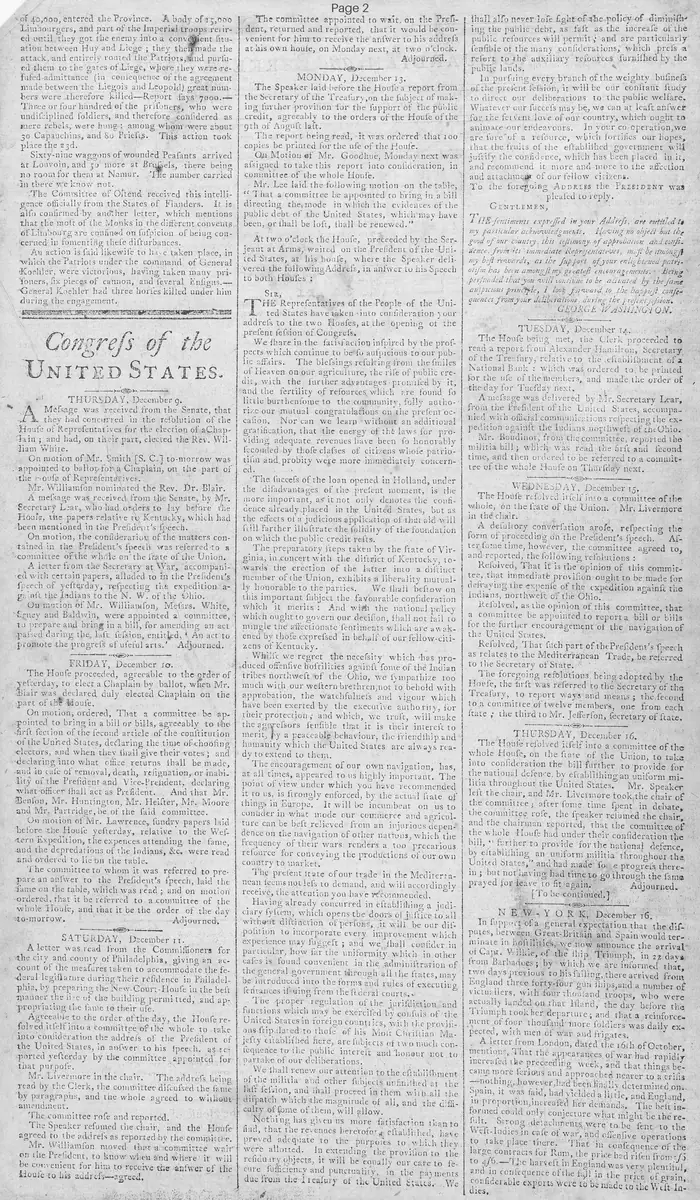
THURSDAY, December 9.
Message was received from the Senate, that they had concurred in the resolution of the House of Representatives for the election of a Chaplain: and had, on their part, elected the Rev. William White.
On motion of Mr. Smith [S. C.] to-morrow was appointed to ballot for a Chaplain, on the part of the House of Representatives.
Mr. Williamson nominated the Rev. Dr. Blair.
A message was received from the Senate, by Mr. Secretary Lear, who had orders to lay before the House, the papers relative to Kentucky, which had been mentioned in the President's speech.
On motion, the consideration of the matters contained in the President's speech was referred to a committee of the whole on the state of the Union.
A letter from the Secretary at War, accompanied with certain papers, alluded to in the President's speech of yesterday, respecting the expedition against the Indians to the N. W. of the Ohio.
On motion of Mr. Williamson, Messrs. White, Seney and Baldwin, were appointed a committee, to prepare and bring in a bill, for amending an act passed during the last session, entitled, An act to promote the progress of useful arts. Adjourned.
FRIDAY, December 10.
The House proceeded, agreeable to the order of yesterday, to elect a Chaplain by ballot, when Mr. Blair was declared duly elected Chaplain on the part of the House.
On motion, ordered, That a committee be appointed to bring in a bill or bills, agreeably to the first section of the second article of the constitution of the United States, declaring the time of choosing electors, and when they shall give their votes; and declaring into what office returns shall be made, and in case of removal, death, resignation, or inability of the President and Vice-President, declaring what officer shall act as President. And that Mr. Benson, Mr. Huntington, Mr. Vining, Mr. Moore and Mr. Partridge, be of the said committee.
On motion of Mr. Lawrence, sundry papers laid before the House yesterday, relative to the Western Expedition, the expences attending the same, and the depredations of the Indians, &c. were read and ordered to lie on the table.
The committee to whom it was referred to prepare an answer to the President's speech, laid the same on the table, which was read: and on motion ordered, that it be referred to a committee of the whole House, and that it be the order of the day to-morrow.
Adjourned.
SATURDAY, December 11.
A letter was read from the Commissioners for the city and county of Philadelphia, giving an account of the measures taken to accommodate the federal legislature during their residence in Philadelphia, by preparing the New Court-House in the best manner the size of the building permitted; and appropriating the same to their use.
Agreeable to the order of the day, the House resolved itself into a committee of the whole to take into consideration the address of the President of the United States, in answer to his speech, as reported yesterday by the committee appointed for that purpose.
Mr. Livermore in the chair. The address being read by the Clerk, the committee discussed the same by paragraphs, and the whole agreed to without amendment.
The committee rose and reported.
The Speaker resumed the chair, and the House agreed to the address as reported by the committee.
Mr. Williamson moved that a committee wait on the President, to know when and where it will be convenient for him to receive the answer of the House to his address—agreed.
The committee appointed to wait on the President, returned and reported, that it would be convenient for him to receive the answer to his address at his own house, on Monday next, at two o'clock.
Adjourned.
MONDAY, December 13.
The Speaker laid before the House a report from the Secretary of the Treasury, on the subject of making further provision for the support of the public credit, agreeably to the orders of the House of the 9th of August last.
The report being read, it was ordered that 100 copies be printed for the use of the House.
On Motion of Mr. Goodhue, Monday next was assigned to take this report into consideration, in committee of the whole House.
Mr. Lee laid the following motion on the table,
"That a committee be appointed to bring in a bill directing the mode in which the evidences of the public debt of the United States, which may have been, or shall be lost, shall be renewed."
At two o'clock the House, preceded by the Sergeant at Arms, waited on the President of the United States, at his house, where the Speaker delivered the following Address, in answer to his Speech to both Houses:
SIR,
The Representatives of the People of the United States have taken into consideration your address to the two Houses, at the opening of the present session of Congress.
We share in the satisfaction inspired by the prospects which continue to be so auspicious to our public affairs. The blessings resulting from the smiles of Heaven on our agriculture, the rise of public credit, with the further advantages promised by it, and the fertility of resources which are found so little burthensome to the community, fully authorize our mutual congratulations on the present occasion. Nor can we learn without an additional gratification, that the energy of the laws for providing adequate revenues have been so honorably seconded by those classes of citizens whose patriotism and probity were more immediately concerned.
The success of the loan opened in Holland, under the disadvantages of the present moment, is the more important, as it not only denotes the confidence already placed in the United States, but as the effects of a judicious application of that aid will still farther illustrate the solidity of the foundation on which the public credit rests.
The preparatory steps taken by the state of Virginia, in concert with the district of Kentucky, towards the erection of the latter into a distinct member of the Union, exhibits a liberality mutually honorable to the parties. We shall bestow on this important subject the favorable consideration which it merits: And with the national policy which ought to govern our decision, shall not fail to mingle the affectionate sentiments which are awakened by those expressed in behalf of our fellow-citizens of Kentucky.
Whilst we regret the necessity which has produced offensive hostilities against some of the Indian tribes northwest of the Ohio, we sympathize too much with our western brethren, not to behold with approbation, the watchfulness and vigour which have been exerted by the executive authority, for their protection; and which, we trust, will make the aggressors sensible that it is their interest to merit, by a peaceable behaviour, the friendship and humanity which the United States are always ready to extend to them.
The encouragement of our own navigation, has, at all times, appeared to us highly important. The point of view under which you have recommended it to us, is strongly enforced, by the actual state of things in Europe. It will be incumbent on us to consider in what mode our commerce and agriculture can be best relieved from an injurious dependence on the navigation of other nations, which the frequency of their wars renders a too precarious resource for conveying the productions of our own country to market.
The present state of our trade in the Mediterranean seems not less to demand, and will accordingly receive, the attention you have recommended.
Having already concurred in establishing a judiciary system, which opens the doors of justice to all without distinction of persons, it will be our disposition to incorporate every improvement which experience may suggest; and we shall consider in particular, how far the uniformity which in other cases is found convenient in the administration of the general government through all the states, may be introduced into the forms and rules of executing sentences issuing from the federal courts.
The proper regulation of the jurisdiction and functions which may be exercised by consuls of the United States in foreign countries, with the provisions stipulated to those of his Most Christian Majesty established here, are subjects of too much consequence to the public interest and honour not to partake of our deliberations.
We shall renew our attention to the establishment of the militia and other subjects unfinished at the last session, and shall proceed in them with all the dispatch which the magnitude of all, and the difficulty of some of them, will allow.
Nothing has given us more satisfaction than to find, that the revenues heretofore established, have proved adequate to the purposes to which they were allotted. In extending the provision to the residuary objects, it will be equally our care to secure sufficiency and punctuality in the payments due from the Treasury of the United States. We shall also never lose sight of the policy of diminishing the public debt, as fast as the increase of the public resources will permit; and are particularly sensible of the many considerations, which press a resort to the auxiliary resources furnished by the public lands.
In pursuing every branch of the weighty business of the present session, it will be our constant study to direct our deliberations to the public welfare.
Whatever our success may be, we can at least answer for the fervent love of our country, which ought to animate our endeavours. In your co-operation, we are sure of a resource, which fortifies our hopes, that the fruits of the established government will justify the confidence, which has been placed in it, and recommend it more and more to the affection and attachment of our fellow citizens.
To the foregoing Address the President was pleased to reply.
GENTLEMEN,
The sentiments expressed in your Address, are entitled to my particular acknowledgments. Having no object but the good of our country, this testimony of approbation and confidence, from its immediate Representatives, must be amongst my best rewards, as the support of your enlightened patriotism has been amongst my greatest encouragements. Being persuaded that you will continue to be actuated by the same auspicious principle, I look forward to the happiest consequences from your deliberations, during the present session.
GEORGE WASHINGTON.
TUESDAY, December 14.
The House being met, the Clerk proceeded to read a report from Alexander Hamilton, Secretary of the Treasury, relative to the establishment of a National Bank: which was ordered to be printed for the use of the members, and made the order of the day for Tuesday next.
A message was delivered by Mr. Secretary Lear, from the President of the United States, accompanied with official communications respecting the expedition against the Indians northwest of the Ohio.
Mr. Boudinot, from the committee, reported the militia bill; which was read the first and second time, and then ordered to be referred to a committee of the whole House on Thursday next.
WEDNESDAY, December 15.
The House resolved itself into a committee of the whole, on the state of the Union. Mr. Livermore in the chair.
A desultory conversation arose, respecting the form of proceeding on the President's speech. After some time, however, the committee agreed to, and reported, the following resolutions:
Resolved, That it is the opinion of this committee, that immediate provision ought to be made for defraying the expense of the expedition against the Indians, northwest of the Ohio.
Resolved, as the opinion of this committee, that a committee be appointed to report a bill or bills for the further encouragement of the navigation of the United States.
Resolved, That such part of the President's speech as relates to the Mediterranean Trade, be referred to the Secretary of State.
The foregoing resolutions being adopted by the House, the first was referred to the Secretary of the Treasury, to report ways and means; the second to a committee of twelve members, one from each state: the third to Mr. Jefferson, secretary of state.
THURSDAY, December 16.
The House resolved itself into a committee of the whole House, on the state of the Union, to take into consideration the bill further to provide for the national defence, by establishing an uniform militia throughout the United States. Mr. Speaker left the chair, and Mr. Livermore took the chair of the committee; after some time spent in debate, the committee rose, the Speaker resumed the chair, and the chairman reported, that the committee of the whole House had under their consideration the bill, "further to provide for the national defence, by establishing an uniform militia throughout the United States," and had made some progress therein; but not having had time to go through the same prayed for leave to sit again.
Adjourned.
[To be continued.]
What sub-type of article is it?
What keywords are associated?
What entities or persons were involved?
Where did it happen?
Domestic News Details
Primary Location
United States Congress
Event Date
December 9 16
Key Persons
Event Details
Proceedings of the House of Representatives from December 9 to 16, including election of Chaplain Rev. Dr. Blair, receipt of messages and papers from Senate and President on Kentucky and Indian expedition, committee appointments for bills on useful arts, presidential electors, public debt, militia, and national bank; consideration of President's speech and address in response; resolutions on Indian expedition, navigation, and Mediterranean trade.