Thank you for visiting SNEWPapers!
Sign up free
Literary
April 8, 1830
Martinsburg Gazette And Public Advertiser
Martinsburg, Berkeley County, West Virginia
What is this article about?
Report of Mr. Buckingham's lectures on ancient Egypt, highlighting engineering marvels like Cleopatra's Needle, the Pyramids, Memnon statue, Thebes temple, and Alexandria's water tanks. Describes mummies used by Arabs as fuel and medicine due to embalming spices.
Clipping
OCR Quality
95%
Excellent
Full Text
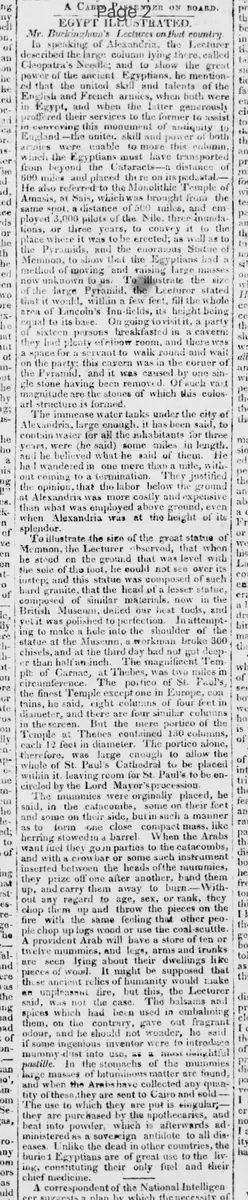
EGYPT ILLUSTRATED.
Mr. Buckingham's Lectures on that country. In speaking of Alexandria, the Lecturer described the large column lying there, called Cleopatra's Needle; and to show the great power of the ancient Egyptians, he mentioned that the united skill and talents of the English and French armies, when both were in Egypt, and when the latter generously proffered their services to the former to assist in conveying this monument of antiquity to England—the united skill and power of both armies were unable to move this column, which, the Egyptians must have transported from beyond the Cataracts—a distance of 600 miles and placed it on its pedestal.
He also referred to the Monolithic Temple of Amasis, at Sais, which was brought from the same spot, a distance of 500 miles, and employed 3,000 pilots of the Nile, three inundations, or three years, to convey it to the place where it was to be erected; as well as to the Pyramids, and the enormous Statue of Memnon, to show that the Egyptians had a method of moving and raising large masses now unknown to us. To illustrate the size of the large Pyramid, the Lecturer stated that it would, within a few feet, fill the whole area of Lincoln's Inn-fields, its height being equal to its base. On going to visit it, a party of sixteen persons breakfasted in a cavern: they had plenty of elbow room, and there was a space for a servant to walk round and wait on the party: this cavern was in the corner of the Pyramid, and it was caused by one single stone having been removed. Of such vast magnitude are the stones of which this colossal structure is formed.
The immense water tanks under the city of Alexandria, large enough, it has been said, to contain water for all the inhabitants for three years, were (he said) some miles in length, and he believed what he said of them. He had wandered in one more than a mile, without coming to a termination. They justified the opinion, that the labor below the ground at Alexandria was more costly and expensive than what was employed above ground, even when Alexandria was at the height of its splendor.
To illustrate the size of the great statue of Memnon, the Lecturer observed, that when he stood on the ground that was level with the sole of the foot, he could not see over its instep: and this statue was composed of such hard granite, that the head of a lesser statue, composed of similar materials, now in the British Museum, defied our best tools, and yet it was polished to perfection. In attempting to make a hole into the shoulder of the statue at the Museum, a workman broke 300 chisels, and at the third day had not got deeper than half an inch. The magnificent Temple of Carnac, at Thebes, was two miles in circumference. The portico of St. Paul's, the finest Temple except one in Europe, contains, he said, eight columns of four feet in diameter, and there are four similar columns in the screen. But the mere portico of the Temple at Thebes contained 130 columns, each 12 feet in diameter. The portico alone, therefore, was large enough to allow the whole of St. Paul's Cathedral to be placed within it, leaving room for St. Paul's to be encircled by the Lord Mayor's procession.
The mummies were originally placed, he said, in the catacombs, some on their feet and some on their side, but in such a manner as to form one close compact mass, like herrings stowed in a barrel. When the Arabs want fuel they go in parties to the catacombs, and with a crowbar or some such instrument inserted between the heads of the mummies, they prize off one after another, bind them up, and carry them away to burn.—Without any regard to age, sex, or rank, they chop them up and throw the pieces on the fire with the same feeling that other people chop up logs of wood or use the coal-scuttle. A provident Arab will have a store of ten or twelve mummies, and legs, arms and trunks are seen lying about their dwellings like pieces of wood. It might be supposed that these ancient relics of humanity would make an unpleasant fire, but this, the Lecturer said, was not the case. The balsams and spices which had been used in embalming them, on the contrary, gave out fragrant odour, and he should not wonder, he said, if some ingenious inventor were to introduce mummy-dust into use, as a most delightful pastille. In the stomachs of the mummies large masses of bituminous matter are found, and when the Arabs have collected any quantity of these, they are sent to Cairo and sold.—The use to which they are put is singular;—they are purchased by the apothecaries, and beat into powder, which is afterwards administered as a sovereign antidote to all diseases. Unlike the dead in other countries, the buried Egyptians are of great use to the living, constituting their only fuel and their chief medicine.
Mr. Buckingham's Lectures on that country. In speaking of Alexandria, the Lecturer described the large column lying there, called Cleopatra's Needle; and to show the great power of the ancient Egyptians, he mentioned that the united skill and talents of the English and French armies, when both were in Egypt, and when the latter generously proffered their services to the former to assist in conveying this monument of antiquity to England—the united skill and power of both armies were unable to move this column, which, the Egyptians must have transported from beyond the Cataracts—a distance of 600 miles and placed it on its pedestal.
He also referred to the Monolithic Temple of Amasis, at Sais, which was brought from the same spot, a distance of 500 miles, and employed 3,000 pilots of the Nile, three inundations, or three years, to convey it to the place where it was to be erected; as well as to the Pyramids, and the enormous Statue of Memnon, to show that the Egyptians had a method of moving and raising large masses now unknown to us. To illustrate the size of the large Pyramid, the Lecturer stated that it would, within a few feet, fill the whole area of Lincoln's Inn-fields, its height being equal to its base. On going to visit it, a party of sixteen persons breakfasted in a cavern: they had plenty of elbow room, and there was a space for a servant to walk round and wait on the party: this cavern was in the corner of the Pyramid, and it was caused by one single stone having been removed. Of such vast magnitude are the stones of which this colossal structure is formed.
The immense water tanks under the city of Alexandria, large enough, it has been said, to contain water for all the inhabitants for three years, were (he said) some miles in length, and he believed what he said of them. He had wandered in one more than a mile, without coming to a termination. They justified the opinion, that the labor below the ground at Alexandria was more costly and expensive than what was employed above ground, even when Alexandria was at the height of its splendor.
To illustrate the size of the great statue of Memnon, the Lecturer observed, that when he stood on the ground that was level with the sole of the foot, he could not see over its instep: and this statue was composed of such hard granite, that the head of a lesser statue, composed of similar materials, now in the British Museum, defied our best tools, and yet it was polished to perfection. In attempting to make a hole into the shoulder of the statue at the Museum, a workman broke 300 chisels, and at the third day had not got deeper than half an inch. The magnificent Temple of Carnac, at Thebes, was two miles in circumference. The portico of St. Paul's, the finest Temple except one in Europe, contains, he said, eight columns of four feet in diameter, and there are four similar columns in the screen. But the mere portico of the Temple at Thebes contained 130 columns, each 12 feet in diameter. The portico alone, therefore, was large enough to allow the whole of St. Paul's Cathedral to be placed within it, leaving room for St. Paul's to be encircled by the Lord Mayor's procession.
The mummies were originally placed, he said, in the catacombs, some on their feet and some on their side, but in such a manner as to form one close compact mass, like herrings stowed in a barrel. When the Arabs want fuel they go in parties to the catacombs, and with a crowbar or some such instrument inserted between the heads of the mummies, they prize off one after another, bind them up, and carry them away to burn.—Without any regard to age, sex, or rank, they chop them up and throw the pieces on the fire with the same feeling that other people chop up logs of wood or use the coal-scuttle. A provident Arab will have a store of ten or twelve mummies, and legs, arms and trunks are seen lying about their dwellings like pieces of wood. It might be supposed that these ancient relics of humanity would make an unpleasant fire, but this, the Lecturer said, was not the case. The balsams and spices which had been used in embalming them, on the contrary, gave out fragrant odour, and he should not wonder, he said, if some ingenious inventor were to introduce mummy-dust into use, as a most delightful pastille. In the stomachs of the mummies large masses of bituminous matter are found, and when the Arabs have collected any quantity of these, they are sent to Cairo and sold.—The use to which they are put is singular;—they are purchased by the apothecaries, and beat into powder, which is afterwards administered as a sovereign antidote to all diseases. Unlike the dead in other countries, the buried Egyptians are of great use to the living, constituting their only fuel and their chief medicine.
What sub-type of article is it?
Essay
What themes does it cover?
Death Mortality
Religious
What keywords are associated?
Egypt
Alexandria
Pyramids
Memnon Statue
Mummies
Ancient Engineering
Thebes Temple
What entities or persons were involved?
Mr. Buckingham
Literary Details
Title
Egypt Illustrated.
Author
Mr. Buckingham
Subject
Lectures On Egypt
Form / Style
Descriptive Prose On Ancient Egyptian Wonders
Key Lines
The United Skill And Power Of Both Armies Were Unable To Move This Column, Which, The Egyptians Must Have Transported From Beyond The Cataracts—A Distance Of 600 Miles And Placed It On Its Pedestal.
The Mummies Were Originally Placed, He Said, In The Catacombs, Some On Their Feet And Some On Their Side, But In Such A Manner As To Form One Close Compact Mass, Like Herrings Stowed In A Barrel.
Unlike The Dead In Other Countries, The Buried Egyptians Are Of Great Use To The Living, Constituting Their Only Fuel And Their Chief Medicine.