Thank you for visiting SNEWPapers!
Sign up free
Letter to Editor
October 7, 1789
Gazette Of The United States
New York, New York County, New York
What is this article about?
A letter to the Tablet's author reflects on the importance of eloquence in free governments, citing historical examples, and argues against teaching oratory to young children, as it fosters vanity and poor habits; instead, prioritize reading and delay declamation until judgment develops.
Clipping
OCR Quality
98%
Excellent
Full Text
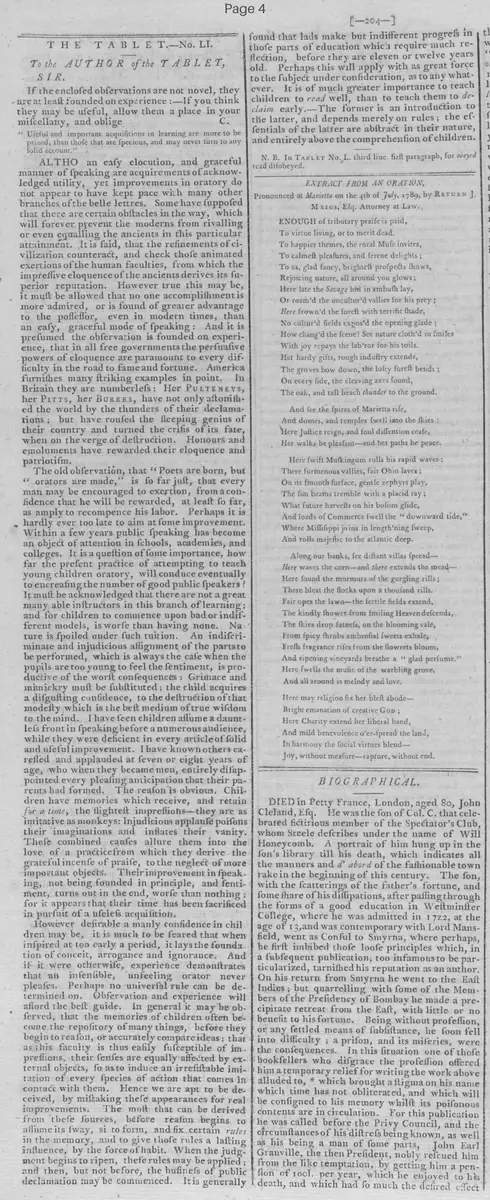
THE TABLET: No. LI.
To the AUTHOR of the TABLET,
SIR.
If the enclosed observations are not novel, they are at least founded on experience:—If you think they may be useful, allow them a place in your miscellany, and oblige
C.
"Useful and important acquisitions in learning are more to be prized, than those that are precious, and may never turn to any solid account."
ALTHO an easy elocution, and graceful manner of speaking are acquirements of acknowledged utility, yet improvements in oratory do not appear to have kept pace with many other branches of the belle lettres. Some have supposed that there are certain obstacles in the way, which will forever prevent the moderns from rivalling or even equalling the ancients in this particular attainment. It is said, that the refinements of civilization counteract, and check those animated exertions of the human faculties, from which the impressive eloquence of the ancients derives its superior reputation. However true this may be, it must be allowed that no one accomplishment is more admired, or is found of greater advantage to the possessor, even in modern times, than an easy, graceful mode of speaking: And it is presumed the observation is founded on experience, that in all free governments the persuasive powers of eloquence are paramount to every difficulty in the road to fame and fortune. America furnishes many striking examples in point. In Britain they are numberless: Her Pulteneys, her Pitts, her Burkes, have not only astonished the world by the thunders of their declamations; but have roused the sleeping genius of their country and turned the crisis of its fate, when on the verge of destruction. Honours and emoluments have rewarded their eloquence and patriotism.
The old observation, that "Poets are born, but orators are made," is so far just, that every man may be encouraged to exertion, from a confidence that he will be rewarded, at least so far, as amply to recompence his labor. Perhaps it is hardly ever too late to aim at some improvement. Within a few years public speaking has become an object of attention in schools, academies, and colleges. It is a question of some importance, how far the present practice of attempting to teach young children oratory, will conduce eventually to encreasing the number of good public speakers? It must be acknowledged that there are not a great many able instructors in this branch of learning; and for children to commence upon bad or indifferent models, is worse than having none. Nature is spoiled under such tuition. An indiscriminate and injudicious assignment of the parts to be performed, which is always the case when the pupils are too young to feel the sentiment, is productive of the worst consequences: Grimace and mimicry must be substituted; the child acquires a disgusting confidence, to the destruction of that modesty which is the best medium of true wisdom to the mind. I have seen children assume a dauntless front in speaking before a numerous audience, while they were deficient in every article of solid and useful improvement. I have known others caressed and applauded at seven or eight years of age, who when they became men, entirely disappointed every pleasing anticipation that their parents had formed. The reason is obvious. Children have memories which receive, and retain for a time, the slightest impressions—they are as imitative as monkeys: Injudicious applause poisons their imaginations and inflates their vanity. These combined causes allure them into the love of a practice from which they derive the grateful incense of praise, to the neglect of more important objects. Their improvement in speaking, not being founded in principle, and sentiment, turns out in the end, worse than nothing; for it appears that their time has been sacrificed in pursuit of a useless acquisition.
However desirable a manly confidence in children may be, it is much to be feared that when inspired at too early a period, it lays the foundation of conceit, arrogance and ignorance. And if it were otherwise, experience demonstrates that an insensible, unfeeling orator never pleases. Perhaps no universal rule can be determined on. Observation and experience will afford the best guide. In general it may be observed, that the memories of children often become the repository of many things, before they begin to reason, or accurately compare ideas; that as this faculty is thus easily susceptible of impressions, their senses are equally affected by external objects, so as to induce an irresistible imitation of every species of action that comes in contact with them. Hence we are apt to be deceived, by mistaking these appearances for real improvements. The most that can be derived from these sources, before reason begins to assume its way, is to form, and fix certain rules in the memory, and to give those rules a lasting influence, by the force of habit. When the judgment begins to ripen, these rules may be applied; and then, but not before, the business of public declamation may be commenced. It is generally found that lads make but indifferent progress in those parts of education which require much reflection, before they are eleven or twelve years old. Perhaps this will apply with as great force to the subject under consideration, as to any whatever. It is of much greater importance to teach children to read well, than to teach them to declaim early.—The former is an introduction to the latter, and depends merely on rules; the essentials of the latter are abstract in their nature, and entirely above the comprehension of children.
N. B. In TABLET No. L. third line, first paragraph, for "oucyed" read "disobeyed."
To the AUTHOR of the TABLET,
SIR.
If the enclosed observations are not novel, they are at least founded on experience:—If you think they may be useful, allow them a place in your miscellany, and oblige
C.
"Useful and important acquisitions in learning are more to be prized, than those that are precious, and may never turn to any solid account."
ALTHO an easy elocution, and graceful manner of speaking are acquirements of acknowledged utility, yet improvements in oratory do not appear to have kept pace with many other branches of the belle lettres. Some have supposed that there are certain obstacles in the way, which will forever prevent the moderns from rivalling or even equalling the ancients in this particular attainment. It is said, that the refinements of civilization counteract, and check those animated exertions of the human faculties, from which the impressive eloquence of the ancients derives its superior reputation. However true this may be, it must be allowed that no one accomplishment is more admired, or is found of greater advantage to the possessor, even in modern times, than an easy, graceful mode of speaking: And it is presumed the observation is founded on experience, that in all free governments the persuasive powers of eloquence are paramount to every difficulty in the road to fame and fortune. America furnishes many striking examples in point. In Britain they are numberless: Her Pulteneys, her Pitts, her Burkes, have not only astonished the world by the thunders of their declamations; but have roused the sleeping genius of their country and turned the crisis of its fate, when on the verge of destruction. Honours and emoluments have rewarded their eloquence and patriotism.
The old observation, that "Poets are born, but orators are made," is so far just, that every man may be encouraged to exertion, from a confidence that he will be rewarded, at least so far, as amply to recompence his labor. Perhaps it is hardly ever too late to aim at some improvement. Within a few years public speaking has become an object of attention in schools, academies, and colleges. It is a question of some importance, how far the present practice of attempting to teach young children oratory, will conduce eventually to encreasing the number of good public speakers? It must be acknowledged that there are not a great many able instructors in this branch of learning; and for children to commence upon bad or indifferent models, is worse than having none. Nature is spoiled under such tuition. An indiscriminate and injudicious assignment of the parts to be performed, which is always the case when the pupils are too young to feel the sentiment, is productive of the worst consequences: Grimace and mimicry must be substituted; the child acquires a disgusting confidence, to the destruction of that modesty which is the best medium of true wisdom to the mind. I have seen children assume a dauntless front in speaking before a numerous audience, while they were deficient in every article of solid and useful improvement. I have known others caressed and applauded at seven or eight years of age, who when they became men, entirely disappointed every pleasing anticipation that their parents had formed. The reason is obvious. Children have memories which receive, and retain for a time, the slightest impressions—they are as imitative as monkeys: Injudicious applause poisons their imaginations and inflates their vanity. These combined causes allure them into the love of a practice from which they derive the grateful incense of praise, to the neglect of more important objects. Their improvement in speaking, not being founded in principle, and sentiment, turns out in the end, worse than nothing; for it appears that their time has been sacrificed in pursuit of a useless acquisition.
However desirable a manly confidence in children may be, it is much to be feared that when inspired at too early a period, it lays the foundation of conceit, arrogance and ignorance. And if it were otherwise, experience demonstrates that an insensible, unfeeling orator never pleases. Perhaps no universal rule can be determined on. Observation and experience will afford the best guide. In general it may be observed, that the memories of children often become the repository of many things, before they begin to reason, or accurately compare ideas; that as this faculty is thus easily susceptible of impressions, their senses are equally affected by external objects, so as to induce an irresistible imitation of every species of action that comes in contact with them. Hence we are apt to be deceived, by mistaking these appearances for real improvements. The most that can be derived from these sources, before reason begins to assume its way, is to form, and fix certain rules in the memory, and to give those rules a lasting influence, by the force of habit. When the judgment begins to ripen, these rules may be applied; and then, but not before, the business of public declamation may be commenced. It is generally found that lads make but indifferent progress in those parts of education which require much reflection, before they are eleven or twelve years old. Perhaps this will apply with as great force to the subject under consideration, as to any whatever. It is of much greater importance to teach children to read well, than to teach them to declaim early.—The former is an introduction to the latter, and depends merely on rules; the essentials of the latter are abstract in their nature, and entirely above the comprehension of children.
N. B. In TABLET No. L. third line, first paragraph, for "oucyed" read "disobeyed."
What sub-type of article is it?
Informative
Reflective
Persuasive
What themes does it cover?
Education
What keywords are associated?
Oratory
Eloquence
Public Speaking
Children Education
Declamation
Reading Skills
Vanity In Youth
What entities or persons were involved?
C.
The Author Of The Tablet
Letter to Editor Details
Author
C.
Recipient
The Author Of The Tablet
Main Argument
eloquence is highly valuable in free societies, but teaching oratory to young children is counterproductive, fostering vanity and poor habits; instead, focus on reading and delay declamation until children are older and their judgment has developed.
Notable Details
Quotes: 'Useful And Important Acquisitions In Learning Are More To Be Prized, Than Those That Are Precious, And May Never Turn To Any Solid Account.'
References Ancient Vs. Modern Oratory
Examples: American And British Orators Like Pulteneys, Pitts, Burkes
Observation: 'Poets Are Born, But Orators Are Made.'
Critique Of Early Teaching Leading To Grimace, Mimicry, And Loss Of Modesty