Thank you for visiting SNEWPapers!
Sign up free
The Daily Morning Journal And Courier
New Haven, New Haven County, Connecticut
What is this article about?
U.S. Department of Agriculture engineers C. G. Elliott and L. L. Hidinger survey Colville Valley swamps for drainage to reclaim about 35,000 acres of submerged land caused by irrigation overflow. Efforts aim to support large-scale irrigation by addressing drainage, with similar projects in Southern states and Florida Everglades. Local organization needed to fund and execute work after surveys.
Clipping
OCR Quality
Full Text
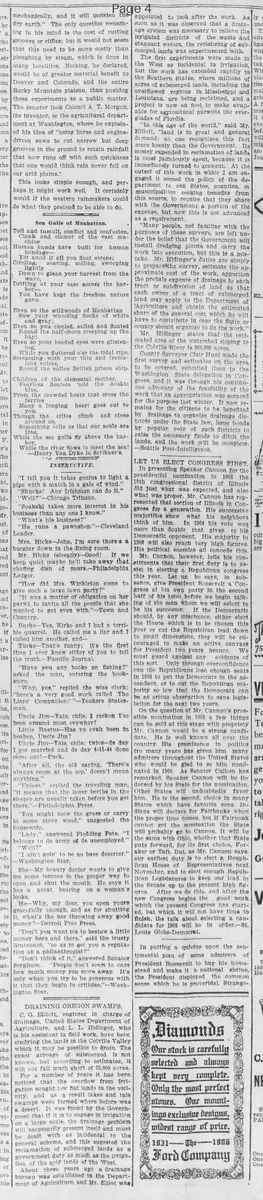
C. G. Elliott, engineer in charge of drainage, United States Department of Agriculture, and L. L. Hidinger, who is his assistant in field work, have been studying the lands in the Colville Valley which it may be possible to drain. The exact acreage of submerged is not known, but according to estimates, it will not fall much short of 35,000 acres. For a number of years it has been noticed that the overflow from irrigation sought low flat lands in the vicinity, and as a result lakes and tule swamps were formed where before was a desert. It was found by the Government that if it is to engage in irrigation on a large scale, the drainage problem will necessarily present itself and must be dealt with as incidental to the general scheme, and this suggested the reclamation of submerged lands as a government duty as much as the irrigation of the arid lands of the West. About three years ago a drainage bureau was established in the Department of Agriculture, and Mr. Elliot was appointed to look after the work. As soon as it was observed that a drainage system was necessary to relieve the irrigated districts of the waste and stagnant waters, the reclaiming of submerged lands was experimented with. The first experiments were made in the West as incidental to irrigation, but the work has extended rapidly to the Southern States, where millions of acres of submerged lands, including the overflowed regions in Mississippi and Louisiana, are being reclaimed, and a project is now on foot to make available for agricultural pursuits the everglades of Florida. "In this age of the world," said Mr. Elliott, land is in great and general demand: no one recognizes this fact more keenly than the Government. Its money expended in reclamation of lands is most judiciously spent, because it is immediately turned to account. At the outset of this work in which I am engaged it seemed the policy of the department to ask States, counties, or municipalities seeking benefits from this source, to require that they share with the Government a portion of the expense, but now this is not advanced as a requirement. "Many people, not familiar with the purposes of these surveys, are left under the belief that the Government will install dredging plants and carry the work into execution, but this is a mistake. Mr. Hidinger's duties are simply to prepare the survey, estimate the approximate cost of the work, apportion the probable expense of drainage to each tract or subdivision of land so that each owner of a tract of submerged land may apply to the Department of Agriculture and obtain the estimated share of the general cost which he will have to contribute in case the State or county should organize to do the work." Mr. Hidinger states that the estimated area of the watershed sloping to the Colville River is 960,000 acres. County Surveyor Clair Hunt made the first survey and estimates on the area to be covered, submitted them to the Washington State delegation in Congress, and it was through his continuous advocacy of the feasibility of the work that an appropriation was secured for the purpose last winter. It now remains for the citizens to be benefited by drainage to organize drainage districts under the State law, issue bonds by popular vote of such districts to raise the necessary funds to ditch the lands, and the work will be complete.
-Seattle Post-Intelligencer.
What sub-type of article is it?
What keywords are associated?
What entities or persons were involved?
Where did it happen?
Domestic News Details
Primary Location
Colville Valley
Key Persons
Outcome
potential reclamation of approximately 35,000 acres of submerged land; requires local organization to fund and execute drainage under state law.
Event Details
Engineers from the U.S. Department of Agriculture are studying lands in Colville Valley for drainage to reclaim swamps formed by irrigation overflow. Surveys estimate costs and apportion expenses to landowners. Established about three years ago, the drainage bureau supports irrigation projects; similar reclamations ongoing in Southern states and Florida Everglades. Local surveyor Clair Hunt advocated for appropriation secured last winter.