Thank you for visiting SNEWPapers!
Sign up free
Lynchburg Star
Lynchburg, Virginia
What is this article about?
Report on a speech by Pennsylvania Senator William Maclay opposing federal judicial power over state land titles, arguing it is unnecessary and oppressive, in response to amendments proposed by Kentucky's legislature to the U.S. Constitution.
Merged-components note: Continuation of the 'Domestic Summary' article on Kentucky amendments and judicial power across pages 1 and 2; the content is a political speech and discussion fitting domestic_news rather than editorial.
Clippings
1 of 2
OCR Quality
Full Text
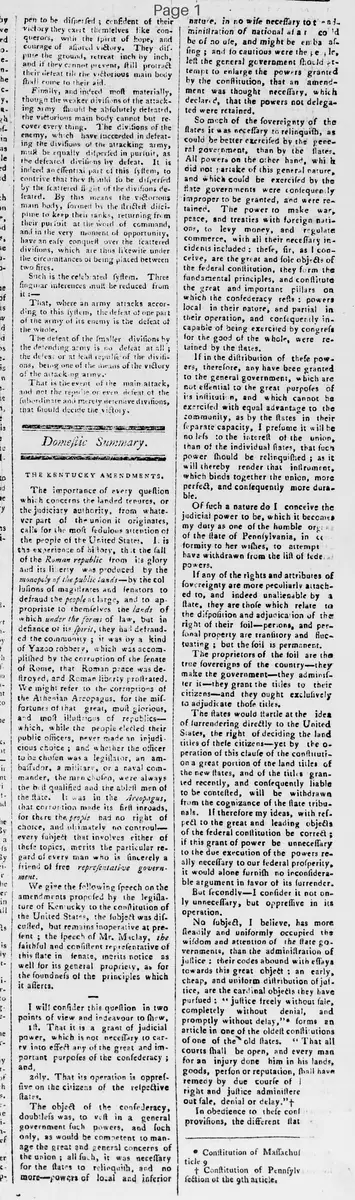
THE KENTUCKY AMENDMENTS,
The importance of every question which concerns the landed tenures, or the judiciary authority, from whatever part of the union it originates, calls for the most assiduous attention of the people of the United States. It is the experience of history, that the fall of the Roman republic from its glory and its liberty was produced by the monopoly of the public lands--by the collusions of magistrates and senators to defraud the people at large, and to appropriate to themselves the lands of which under the forms of law, but in defiance of its spirit, they had defrauded the community; it was by a kind of Yazoo robbery, which was accomplished by the corruption of the senate of Rome, that Roman peace was destroyed, and Roman liberty prostrated.
We might refer to the corruptions of the Athenian Areopagus, for the misfortunes of that great, most glorious, and most illustrious of republics---which, while the people elected their public officers, never made an injudicious choice: and whether the officer to be chosen was a legislator, an ambassador, a military, or a naval commander, the men chosen, were always the best qualified and the ablest men of the state. It was in the Areopagus, that corruption made its first inroads, for there the people had no right of choice, and ultimately no control--every subject that involves either of these topics, merits the particular regard of every man who is sincerely a friend of free representative government.
We give the following speech on the amendments proposed by the legislature of Kentucky to the constitution of the United States, the subject was discussed, but remains inoperative at present; the Speech of Mr. Maclay, the faithful and consistent representative of this state in senate, merits notice as well for its general propriety, as for the soundness of the principles which it asserts.
I will consider this question in two points of view and endeavour to show,
1st. That it is a grant of judicial power, which is not necessary to carry into effect any of the great and important purposes of the confederacy;
and,
2dly. That its operation is oppressive on the citizens of the respective states.
The object of the confederacy, doubtless was, to vest in a general government such powers, and such only, as would be competent to manage the great and general concerns of the union: all such, it was necessary for the states to relinquish, and no more--powers of local and inferior nature, in no wise necessary to the administration of national affairs, could be of no use, and might be embarrassing; and so cautious were the framers, lest the general government should attempt to enlarge the powers granted by the constitution, that an amendment was thought necessary, which declared, that the powers not delegated were retained.
So much of the sovereignty of the states it was necessary to relinquish, as could be better exercised by the general government, than by the states. All powers on the other hand, which did not partake of this general nature, and which could be exercised by the state governments were consequently improper to be granted, and were retained. The power to make war, peace, and treaties with foreign nations, to levy money, and regulate commerce, with all their necessary incidents included: these, sir, as I conceive, are the great and sole objects of the federal constitution, they form the fundamental principles, and constitute the great and important pillars on which the confederacy rests: powers local in their nature, and partial in their operation, and consequently incapable of being exercised by congress for the good of the whole, were retained by the states.
If in the distribution of these powers, therefore, any have been granted to the general government, which are not essential to the great purposes of its institution, and which cannot be exercised with equal advantage to the community, as by the states in their separate capacity, I presume it will be no less to the interest of the union, than of the individual states, that such power should be relinquished: as it will thereby render that instrument, which binds together the union, more perfect, and consequently more durable.
Of such a nature do I conceive the judicial power to be, which it becomes my duty as one of the humble organs of the state of Pennsylvania, in conformity to her wishes, to attempt to have withdrawn from the list of federal powers.
If any of the rights and attributes of sovereignty are more peculiarly attached to, and indeed unalienable by a state, they are those which relate to the disposition and adjudication of the right of their soil--persons, and personal property are transitory and fluctuating: but the soil is permanent. The proprietors of the soil are the true sovereigns of the country--they make the government--they administer it--they grant the titles to their citizens--and they ought exclusively to adjudicate those titles.
The states would startle at the idea of surrendering directly to the United States, the right of deciding the land titles of these citizens--yet by the operation of this clause of the constitution a great portion of the land titles of the new states, and of the titles granted recently, and consequently liable to be contested, will be withdrawn from the cognizance of the state tribunals. If therefore my ideas, with respect to the great and leading objects of the federal constitution be correct; if this grant of power be unnecessary to the due execution of the powers really necessary to our federal prosperity, it would alone furnish no inconsiderable argument in favor of its surrender.
But secondly--I consider it not only unnecessary, but oppressive in its operation.
No subject, I believe, has more steadily and uniformly occupied the wisdom and attention of the state governments, than the administration of justice: their codes abound with essays towards this great object: an early, cheap, and uniform distribution of justice, are the cardinal objects they have pursued: "justice freely without sale, completely without denial, and promptly without delay,"* forms an article in one of the oldest constitutions of one of the old states. "That all courts shall be open, and every man for an injury done him in his lands, goods, person or reputation, shall have remedy by due course of law and justice administered without sale, denial or delay."+
In obedience to these constitutional provisions, the different states have provided...
Constitution of Massachusetts article
Constitution of Pennsylvania section of the 9th article.
States have been uniform in their efforts to effect these objects. In some, circuit courts; in others, county courts: But all in pursuit of the same object, to wit: to administer justice as cheaply and as conveniently as possible to the people in general. If such care and attention be necessary to secure the citizens of the states, against an oppressive administration of justice, when contending in the courts of their own states, no possible provision, it appears to me, can prevent it, when their own controversies are to be decided many hundred miles from the place in which they originated.
I will ask this senate, for a moment, to consider what must be the feelings of a man residing on the banks of the Ohio, the Tennessee, the Mississippi or the margin of Lake Erie, three hundred or one thousand miles distance from this place, whose principal and it may be, his whole wealth, consists of a farm on which he is settled. when Served with a process, and told, he must travel to the banks of the Potomac to defend his title? His feelings must be those of despair. The distance is beyond his power. His enquiry will not be whether he has justice on his side. but whether it is worth his while to sacrifice his time, and risque his subsisting substance in contending with his more powerful antagonist.
But this is not all; his situation may be such as to prevent his making any effort in order to obtain justice. his family may depend on the labor of his hands for bread: can he leave them to perish with hunger? No, humanity forbids it; he is compelled to submit.
These are not the suggestions of fancy; they will prove to be facts, unless they are prevented by the humanity and good sense of the general government.
The evil is the more dangerous as it will increase with the extension of our settlements; it will grow with our growth: are the inhabitants of the Washita, the Red River, and the Mississippi, to travel here to discuss the titles which they are daily obtaining, and respecting which it is impossible, but that disputes will arise between the actual settlers and the land mongers, both anxious they will go to law?
In cases of this kind were few, and in all probability rarely to occur, the inconvenience might possibly be tolerated. But it appears to me to be morally certain, that they must be numerous in all the states of modern creation; as also in those portions of the ancient states, which have been disposed of since the commencement of the revolution. Some of the states disposed of these vacant lands for paper money: this, depreciating rapidly, introduced speculators and land mongers, who, in their struggle to procure large tracts, covered the land of each other over and again with their claims.
Some of the states, who possessed vacant territory, bestowed a portion of it on their officers and soldiers. These claims, through inattention or mismanagement, became subject to litigation—doubtful titles will always produce speculation, and that of the most oppressive kind: the speculation of one artful and cunning upon the ignorant and unwary. In this conflict, in the remote parts of the union, the prospects of the wealthy and artful land monger are flattering, indeed he may almost graduate his chances of success by calculating the degree of resistance which the ignorance or weakness of his antagonist will enable him to make.
But, admitting that every title at its first creation was perfectly free from dispute, it is well known, in a country like ours, where there is no restraint on alienations, and when property, particularly the soil, in new countries is continually changing owners, what a perpetual source of litigation must exist. That inconvenience to the wealthy and oppression to the poor, will result to the remote parts of the union by deciding their controversies in the federal courts, is too evident to deny. Let me now ask, what are the advantages to the parties or to the public, by retaining this jurisdiction? Is it that more complete justice will be rendered? Of that fact I really doubt, at the same time I mean to detract nothing from the talents, integrity or legal acquirements of those who now, or at any future time may, compose the supreme court of the U. States—completely to understand the decisions, principles and laws, both statute and common, which appertain to a single state, and to apply all these with judgment and uniformity, to the variety of cases which occur, is an intelligence possessed but by few men in each state; and even by those few, not without the aid of good talents, much application and long experience.
To become equally versed in the laws of seventeen states I believe not to be within the scope of any man's talents, and the difficulty, instead of decreasing will increase with our population and the accession of new states. In all the states perhaps the most abstruse and difficult branch of the law,
is that which regards the titles to land. In most of them the system is different, is a system of its own very little resembling any to be found in the English books, from which are drawn most of our general legal notions, In some of the states, particularly in Tennessee and Kentucky (in the last of which state this proposition originated) most of whose land titles have been created since the commencement of the revolution. their systems of land laws compose an extensive science of abstruse and difficult investigation; to many of the states will this argument apply, at least to such portions of their territories as have been granted since the separation from Great Britain. It is not among the least of my objections to this jurisdiction, that it implies a distrust in the justice, as well as in the competency of the state courts: It exhibits a principle, odious and injurious in my view, that is by furnishing regulations intended for the accommodation of non-residents and foreigners alone, without having any regard to the inconvenience incurred by the resident citizens. I cannot discern the reason why property as well as persons should not be exclusively under the controul of that government possessing jurisdiction over it. In this opinion I am, I think, supported by the president of the U. States, he, in his speech, when first sworn into office, says 'The support of the state governments in all their rights, as the most competent administration for our domestic concerns and the surest bulwarks against anti-republican tendencies.' And again—' When we consider that this government is charged with the external and mutual relations only of these states: that the states themselves have the principal care of our persons, our property, and our reputation; constituting the great field of human concerns, we may well doubt whether our organization is not too complicated.'
I cannot discern the reason why in any state of things, the laws of the individual states, which regulate the property of those states, should be expounded by judges not amenable to the justice of those laws; I cannot discover the possible danger of partiality in decisions governed as the state courts must be, by honor, by respect for character, by justice, and by long established precedent.
But my strongest objection to this jurisdiction yet remains; an objection which I flatter myself cannot fail to strike every one alike, it is the phenomenon which it exhibits, of two independent judiciaries, of equal and concurrent jurisdiction, and neither acknowledging the superiority of, or, controuling the other this is certainly a solecism in government. It is visionary in theory; and must be mortal in practice. Some tribunal of exclusive final jurisdiction, must exist in all governments—upon no other principle, can one of the purposes of government be obtained; an equal & uniform administration of justice two such courts of appellate jurisdiction cannot exist to suppose their decisions will be the same on similar questions, is to suppose a perfection never yet attributed to man. But it is not necessary to reason on theory, when facts exist a collision of opinions, a clashing of jurisdictions, was foreseen before the ratification of the federal constitution—in Kentucky, as I am told, it has actually happened the title to a tract of 1000 acres of land sold to two different persons, one of whom went into the federal and the other into the state court: the cause has been adjudicated different ways. In one court, the title of one of the purchasers was supported: in the other it was destroyed. These are plain matters of fact; facts of the same kind have taken place in Pennsylvania, but it would be trespassing too long on your patience to go into the detail: these facts are before us, they require no comment, they are the inevitable result of such a state of things—they are effects which must forever flow from such causes.
But these are not all the consequences of this business; what is to prevent a collision, a conflict of authority in these courts in carrying the respective decisions into effect? Whose mandate is to be obeyed? Whom is the posse comitatus to obey? The sheriff or the marshall? Who has the right to interfere and controul this conflict of authority? Sir, I believe the provision is a dangerous, and impracticable one; and I believe that wisdom and policy both require that it should be surrendered.
Far be it from me to detract from the wisdom displayed in this instrument. No human production is perfect. Excellent as it is in general, progressive knowledge and experience (the only unerring tests of human contrivances) have shewn, that it is defective; in 16 years practice it has betrayed many defects which have required to be remedied; some of its provisions have been found impracticable, and have been expunged, without lessening the stability of states, the wisdom of its framers stamped on its face, a caution against its infallibility, by inserting in its provisions for remedying its imperfections—it is not usual to surrender power when once fairly acquired, but the general government of the United States can have no interest different from that of the states. The general government was instituted to promote the general interests of the States. Should the latter be oppressed by any operation of the former, the intention of the confederacy is so far defeated: and every deviation in practice from that object, tends to weaken its ties, I am one of those who believe, that the general and state governments are so intimately connected and so mutually dependant on each other, that the same destiny awaits them both; that their prosperity and duration are inseparable—if this impression be general, of the American people are in a progressive state of political improvement, and not only better understand the true principles of a free government, but also better understand the true art of practicing on these principles than any other people on earth, as I believe they do, it is impossible that any danger can be apprehended or experienced from the amendment now under consideration, as the whole community are equally interested in the existence and prosperity of the general, as of the particular governments. The one as superintending and guarding their general, the other their local rights and interests, it will be equally their wish and care, to confide to each, the powers necessary to accomplish their respective objects.
Should, therefore, powers oppressive or embarrassing in their operation, be at any time improvidently bestowed on the general government; or, powers necessary to its successful administration be omitted to be granted, not a doubt can remain that as long as public virtue exists, they will be surrendered in the one case, and granted in the other.
In this question, there can be no thing local, nothing of party spirit to influence the result, on every portion of the community, or political men of every description, will the regulation be alike operative and salutary. Our opinions on the question are not final, the states will judge for themselves—if it is a proposition which, if its own merits cannot support and carry it through, will fail, all I ask is to give it an experiment. It comes from sections of the union attached to the constitution, and whose ardent zeal for its preservation is too well known and experienced, to be recalled to your recollection.
What sub-type of article is it?
What keywords are associated?
What entities or persons were involved?
Where did it happen?
Domestic News Details
Primary Location
United States
Key Persons
Event Details
Speech by Mr. Maclay in the Senate arguing against federal judicial power over land titles as unnecessary and oppressive, in response to amendments proposed by Kentucky's legislature to limit such jurisdiction to state courts.