Thank you for visiting SNEWPapers!
Sign up free
The Telescope
Warren, Bristol County, Rhode Island
What is this article about?
In the House of Lords on Jan. 29, peers debated the Regent's Speech, praising successes in the Algiers attack and Nepaul war, expressing concerns over domestic distress from war-to-peace transition, revenue deficiency, and critiquing European peace policy towards France. The address was agreed without division.
Merged-components note: This is a continuation of the report on the Imperial Parliament debate in the House of Lords, spanning from page 1 to page 2; the text flows directly from the end of the first component to the start of the second, with sequential reading order.
Clippings
1 of 2
OCR Quality
Full Text
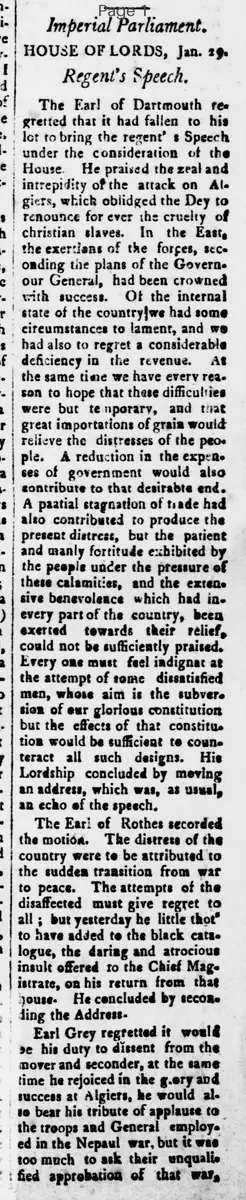
HOUSE OF LORDS, Jan. 29.
Regent's Speech.
The Earl of Dartmouth regretted that it had fallen to his lot to bring the Regent's Speech under the consideration of the House. He praised the zeal and intrepidity of the attack on Algiers, which obliged the Dey to renounce for ever the cruelty of christian slaves. In the East the exertions of the forces, seconding the plans of the Government our General, had been crowned with success. Of the internal state of the country we had some circumstances to lament, and we had also to regret a considerable deficiency in the revenue. At the same time we have every reason to hope that these difficulties were but temporary, and that great importations of grain would relieve the distresses of the people. A reduction in the expenses of government would also contribute to that desirable end. A partial stagnation of trade had also contributed to produce the present distress, but the patient and manly fortitude exhibited by the people under the pressure of these calamities, and the extensive benevolence which had in every part of the country been exerted towards their relief, could not be sufficiently praised. Every one must feel indignant at the attempt of some dissatisfied men, whose aim is the subversion of our glorious constitution but the effects of that constitution would be sufficient to counteract all such designs. His Lordship concluded by moving an address, which was, as usual an echo of the speech.
The Earl of Rothes seconded the motion. The distress of the country were to be attributed to the sudden transition from war to peace. The attempts of the disaffected must give regret to all: but yesterday he little thought to have added to the black catalogue, the daring and atrocious insult offered to the Chief Magistrate, on his return from this house. He concluded by seconding the Address.
Earl Grey regretted it would be his duty to dissent from the mover and seconder, at the same time he rejoiced in the glory and success at Algiers, he would also bear his tribute of applause to the troops and General employed in the Nepaul war, but it was too much to ask their unqualified approbation of that war,
Perhaps the House, at least himself was ignorant of its cause. He expressed also his satisfaction at the assurances held out to us of the continuation of peace, but had considerable fear of that policy which was now stated to be meant to preserve the peace of Europe, which he considered as dangerous in its moral influence on our army, dangerous to the constitution, and destructive of all justice, sound policy, and the liberty of other nations; and all this without obtaining one advantage truly British. Some of the nations of the Continent looked on us as the actual subverters of their liberties;--and others, as having called forth their enemies in the common cause, which, being now no longer necessary, their Government had put down by force.-- The course that he should have preferred would have been to have conciliated the people of France and of any other nation in Europe; or else that we should so far curb the power of France as that, whatever her inclination to disturbance might be, we might view it with unconcern. But a third course had been adopted, which would eventually occasion the present Government of France to go to war with the country which had established it. As to the internal distress of this country, he could find no parallel for it in our history. The speech had assured us it would be but temporary; and such an assurance accorded with the hopes and the wishes of every one: but they would but ill discharge their duty, if they rested on that assurance alone--without examination into the causes of that distress, and how our resources might be improved for its removal. This period had been compared to that which succeeded the American war;-- but he called on those who remembered that period to say, whether then our hospitals, workhouses, and streets were filled with wretches perishing for want of food and clothing, or that the manufacturers or the landed interests were so oppressed as at the present! Besides our debt amounted to nothing like the present, nor did the taxation. The deficiency in the revenue was then but twelve millions, now it was five times the sum. Would any one then say that these two periods of distress were the same either in extent, in their causes, or in the methods of cure. Mr. Pitt's remedy for the former distress was, to lay on new taxes to cover the deficiency of the revenue. If the causes of the distress were the same, the remedies must also be the same; but, (he asked) would the minister now come forward and purpose new taxes to cover the enormous deficiency of last year's revenue? To what amount would the Noble Lord (Liverpool) say he could make his reduction on the Peace Establishment as recommended by the Speech? Would he reduce in 5, 8, or 10 millions? For the deficiency in last year amounted to 21 millions, and with every possible reduction there would be a deficiency to a considerable amount, which must be provided for.--The great cause of our distress was the forced paper circulation an evil which the country had not to labour under, at the close of the American war... They had seen no attempt of Ministers to remove that evil: but on the contrary, it was their intention still to keep up that fatal paper currency. Such outrages as those committed yesterday, called for the indignation of Parliament, and the punishment of the law: but from the best attention he could not bring himself to think it connected with any scheme of the disaffected: but arising from the atrocity of some individuals. He hoped therefore, that in return for the patience and forbearance of the people, they would not deprive them of the Constitution.-- In his opinion, the speech did not go far enough in its pledges of economy and retrenchment.-- He then concluded by moving an amendment to the address, exactly similar to that moved the night previous, by Mr. Brougham, in the House of Commons. Earl Harrowby said, the address which had already been moved, was perfectly sufficient to answer every purpose which such an address could be intended for. No one, who did not remember the end of the American war, could have an idea of the deep despondency which prevailed the public mind on that occasion. It was one thing to say, that when a country was in a state of distress; excessive taxation added to that distress: and it was another thing to assert that taxation was the cause of our distress; for there was last year a reduction of one third of our taxation;--and our distress was nothing while our taxation was much greater than it now was.: The paper currency was another source of our evils in the mind of the noble Earl; but let them strike the balance between the distress it was supposed to have occasioned, and the glory it had produced for us among the nations of Europe, and then who would have recourse to it again, if another crisis should require it. Earl Grosvenor supported the amendment. Earl Bathurst said that on former occasions, when the Regent's Ministers made reduction they always stated that more would be reduced whenever the safety of the country would permit. With respect to the disaffected in this kingdom, they could not shut their eyes to the practice which now prevailed of directing the hatred of the people against the Prince, and not against his ministers. Such things called for their most serious investigation. Marquis Wellesley said the calamity of the country had now come to that height, that no vain and idle hyperboles could conceal calamities which threatened to overwhelm this country. This was no common occasion, in which they used to bandy compliments with the Crown; or to rejoice with it on the triumph of our arms. They were now met under the cry of the people for the meeting of Parliament; and that they had not been assembled sooner, was to him a matter of the greatest surprise and indignation. He could not agree with an address which contained no view of the causes of our distress; or any pledge on the part of Parliament that they would inquire into all the circumstances which have led to it, in order to find out the proper remedy for it. Such was contained in the amendment of his noble friend Grey, whereas the original address contained nothing but an interchange of compliments with the Crown. He was much afraid that the prosperity of our commerce and manufactures during the war:-- rose from temporary causes; and that by the cessation of the war they feel more nearly to their proper level. He remembered no despondency at the close of the American war, but what the Parliament found itself sufficient to affect by recommending retrenchment to the Crown:-- which was at that time adopted. He considered the Nepaul War as originally a war of necessity--- and he agreed in praising the conduct of the Governor General of India, who since he had filled that office had behaved with the strictest integrity, and some degree of ability. Some individuals wished to have universal suffrage and annual Parliaments, which would make the House of Commons the tool of democracy. Such persons shewed, at the first view, that their object was complete revolution, and destruction of all law and Government. No one in the kingdom owed more to the constitution than he did: but he would not attempt to relieve the people of England by sending such factious men to gaols and gibbets; but he would do that by entering immediately into an inquiry into their distress and their causes. Lord Sidmouth rose and said, the Noble Marquis seemed to think that our distresses were of a permanent nature; what remedy then could be applied to them? Such an opinion was calculated for despondency, but for his part he would entertain no such feeling. Last year 18 millions had been taken off the taxes: which amounted to 3 millions more than all the taxes in 1790. The principal cause of our manufacturing distress arose not from the competition of foreign markets, but from foreign capital being employed in repairing the ravages of war. He had concurred with his colleagues recommending reduction, although he knew that the military establishment at home was necessary for the support of the civil power, and although he knew that they had aggravated the general distress by the reductions which had already taken place. The original address was then agreed to without a division. Lord Sidmouth gave notice that he should on Monday present a message from the Prince relative to seditious meetings. Adjourned till Friday.
What sub-type of article is it?
What keywords are associated?
What entities or persons were involved?
Where did it happen?
Foreign News Details
Primary Location
Algiers, Nepaul, Europe
Event Date
Jan. 29
Key Persons
Outcome
success in attack on algiers obliging dey to renounce cruelty to christian slaves; success in nepaul war; continuation of peace in europe; address agreed without division
Event Details
House of Lords debate on Regent's Speech praising military successes in Algiers and Nepaul, critiquing European peace policy especially towards France, discussing domestic distress from war-to-peace transition, revenue deficiency, paper currency, and calls for economy and inquiry into causes; amendment moved but original address agreed.