Thank you for visiting SNEWPapers!
Sign up free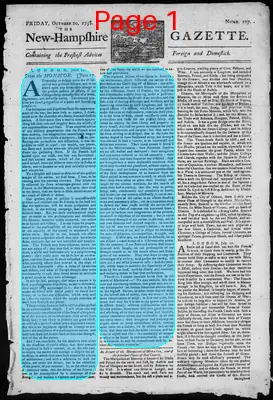
Foreign News
October 20, 1758
The New Hampshire Gazette
Portsmouth, Rockingham County, New Hampshire
What is this article about?
Opinion piece from the Monitor critiquing British tendencies toward despair and overconfidence in the war with France, urging balanced realism after recent Mediterranean and oceanic victories, dated June 17, 178x (context implies late 18th century).
Clipping
OCR Quality
98%
Excellent
Full Text
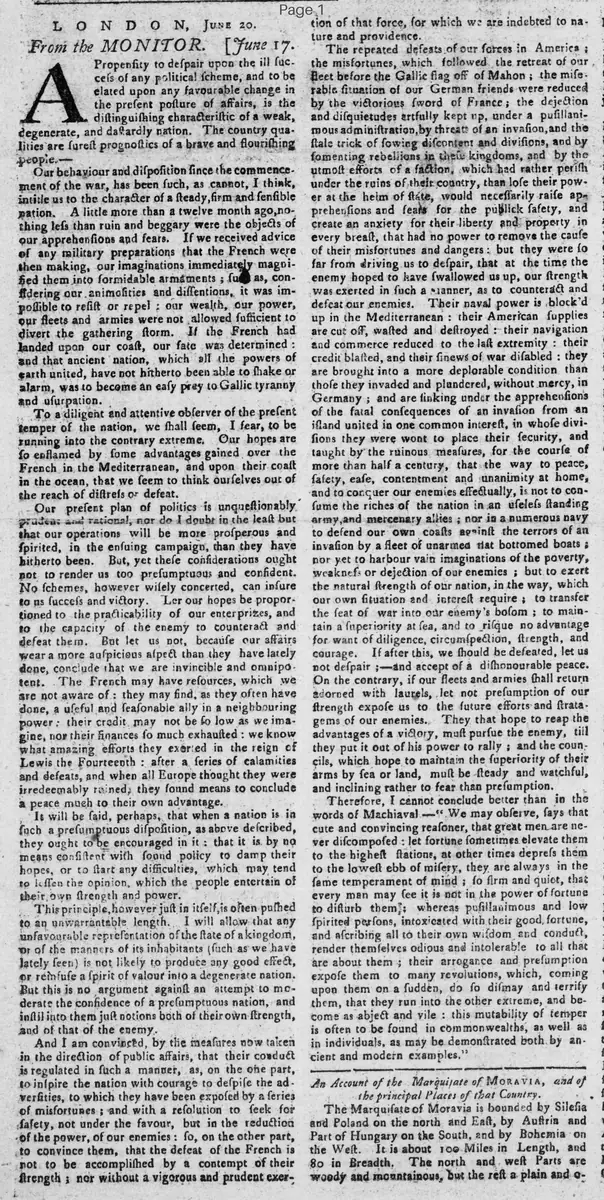
LONDON, JUNE 20.
From the MONITOR. June 17.
Propensity to despair upon the ill success of any political scheme, and to be elated upon any favourable change in the present posture of affairs, is the distinguishing characteristic of a weak, degenerate, and dastardly nation. The country qualities are surest prognostics of a brave and flourishing people.
Our behaviour and disposition since the commencement of the war, has been such, as cannot, I think, entitle us to the character of a steady, firm and sensible nation. A little more than a twelve month ago, nothing less than ruin and beggary were the objects of our apprehensions and fears. If we received advice of any military preparations that the French were then making, our imaginations immediately magnified them into formidable armaments; such as, considering our animosities and dissensions, it was impossible to resist or repel: our wealth, our power, our fleets and armies were not allowed sufficient to divert the gathering storm. If the French had landed upon our coast, our fate was determined: and that ancient nation, which all the powers of earth united, have not hitherto been able to shake or alarm, was to become an easy prey to Gallic tyranny and usurpation.
To a diligent and attentive observer of the present temper of the nation, we shall seem, I fear, to be running into the contrary extreme. Our hopes are so enflamed by some advantages gained over the French in the Mediterranean, and upon their coasts in the ocean, that we seem to think ourselves out of the reach of distress or defeat.
Our present plan of politics is unquestionably prudent and rational, nor do I doubt in the least but that our operations will be more prosperous and spirited, in the ensuing campaign, than they have hitherto been. But, yet these considerations ought not to render us too presumptuous and confident. No schemes, however wisely concerted, can insure to us success and victory. Let our hopes be proportioned to the practicability of our enterprizes, and to the capacity of the enemy to counteract and defeat them. But let us not, because our affairs wear a more auspicious aspect than they have lately done, conclude that we are invincible and omnipotent. The French may have resources, which we are not aware of: they may find, as they often have done, a useful and seasonable ally in a neighbouring power: their credit may not be so low as we imagine, nor their finances so much exhausted: we know what amazing efforts they exerted in the reign of Lewis the Fourteenth: after a series of calamities and defeats, and when all Europe thought they were irredeemably ruined; they found means to conclude a peace much to their own advantage.
It will be said, perhaps, that when a nation is in such a presumptuous disposition, as above described, they ought to be encouraged in it: that it is, by no means consistent with sound policy to damp their hopes, or to start any difficulties, which may tend to weaken the opinion, which the people entertain of their own strength and power.
This principle, however just in itself, is often pushed to an unwarrantable length. I will allow that any unfavourable representation of the state of a kingdom, or of the manners of its inhabitants (such as we have lately seen) is not likely to produce any good effect, or reinfuse a spirit of valour into a degenerate nation. But this is no argument against an attempt to moderate the confidence of a presumptuous nation, and instil into them just notions both of their own strength, and of that of the enemy.
And I am convinced, by the measures now taken in the direction of public affairs, that their conduct is regulated in such a manner, as, on the one part, to inspire the nation with courage to despise the adversities, to which they have been exposed by a series of misfortunes; and with a resolution to seek safety, not under the favour, but in the reduction of the power, of our enemies: so, on the other part, to convince them, that the defeat of the French is not to be accomplished by a contempt of their strength; nor without a vigorous and prudent exertion of that force, for which we are indebted to nature and providence.
From the MONITOR. June 17.
Propensity to despair upon the ill success of any political scheme, and to be elated upon any favourable change in the present posture of affairs, is the distinguishing characteristic of a weak, degenerate, and dastardly nation. The country qualities are surest prognostics of a brave and flourishing people.
Our behaviour and disposition since the commencement of the war, has been such, as cannot, I think, entitle us to the character of a steady, firm and sensible nation. A little more than a twelve month ago, nothing less than ruin and beggary were the objects of our apprehensions and fears. If we received advice of any military preparations that the French were then making, our imaginations immediately magnified them into formidable armaments; such as, considering our animosities and dissensions, it was impossible to resist or repel: our wealth, our power, our fleets and armies were not allowed sufficient to divert the gathering storm. If the French had landed upon our coast, our fate was determined: and that ancient nation, which all the powers of earth united, have not hitherto been able to shake or alarm, was to become an easy prey to Gallic tyranny and usurpation.
To a diligent and attentive observer of the present temper of the nation, we shall seem, I fear, to be running into the contrary extreme. Our hopes are so enflamed by some advantages gained over the French in the Mediterranean, and upon their coasts in the ocean, that we seem to think ourselves out of the reach of distress or defeat.
Our present plan of politics is unquestionably prudent and rational, nor do I doubt in the least but that our operations will be more prosperous and spirited, in the ensuing campaign, than they have hitherto been. But, yet these considerations ought not to render us too presumptuous and confident. No schemes, however wisely concerted, can insure to us success and victory. Let our hopes be proportioned to the practicability of our enterprizes, and to the capacity of the enemy to counteract and defeat them. But let us not, because our affairs wear a more auspicious aspect than they have lately done, conclude that we are invincible and omnipotent. The French may have resources, which we are not aware of: they may find, as they often have done, a useful and seasonable ally in a neighbouring power: their credit may not be so low as we imagine, nor their finances so much exhausted: we know what amazing efforts they exerted in the reign of Lewis the Fourteenth: after a series of calamities and defeats, and when all Europe thought they were irredeemably ruined; they found means to conclude a peace much to their own advantage.
It will be said, perhaps, that when a nation is in such a presumptuous disposition, as above described, they ought to be encouraged in it: that it is, by no means consistent with sound policy to damp their hopes, or to start any difficulties, which may tend to weaken the opinion, which the people entertain of their own strength and power.
This principle, however just in itself, is often pushed to an unwarrantable length. I will allow that any unfavourable representation of the state of a kingdom, or of the manners of its inhabitants (such as we have lately seen) is not likely to produce any good effect, or reinfuse a spirit of valour into a degenerate nation. But this is no argument against an attempt to moderate the confidence of a presumptuous nation, and instil into them just notions both of their own strength, and of that of the enemy.
And I am convinced, by the measures now taken in the direction of public affairs, that their conduct is regulated in such a manner, as, on the one part, to inspire the nation with courage to despise the adversities, to which they have been exposed by a series of misfortunes; and with a resolution to seek safety, not under the favour, but in the reduction of the power, of our enemies: so, on the other part, to convince them, that the defeat of the French is not to be accomplished by a contempt of their strength; nor without a vigorous and prudent exertion of that force, for which we are indebted to nature and providence.
What sub-type of article is it?
War Report
Political
What keywords are associated?
British Morale
War With France
Naval Advantages
Mediterranean Victories
French Resources
National Confidence
What entities or persons were involved?
Lewis The Fourteenth
Where did it happen?
France
Foreign News Details
Primary Location
France
Event Date
June 17
Key Persons
Lewis The Fourteenth
Event Details
Commentary on British national disposition during the war with France, shifting from despair over potential French invasions to overconfidence after naval advantages in the Mediterranean and on French coasts; warns against presumption, recalls French resilience under Louis XIV, advocates balanced realism and vigorous effort for victory.