Thank you for visiting SNEWPapers!
Sign up free
Literary
November 13, 1862
Southern Christian Advocate
Charleston, Charleston County, South Carolina
What is this article about?
Reflective essay on school friendships at Thriftown Academy, where pride and class envy disrupted a close-knit group. Recalls brilliant Lou, who later faced misfortune and died alone, and gentle Sallie, a devoted friend who married happily but died young from illness.
Clipping
OCR Quality
98%
Excellent
Full Text
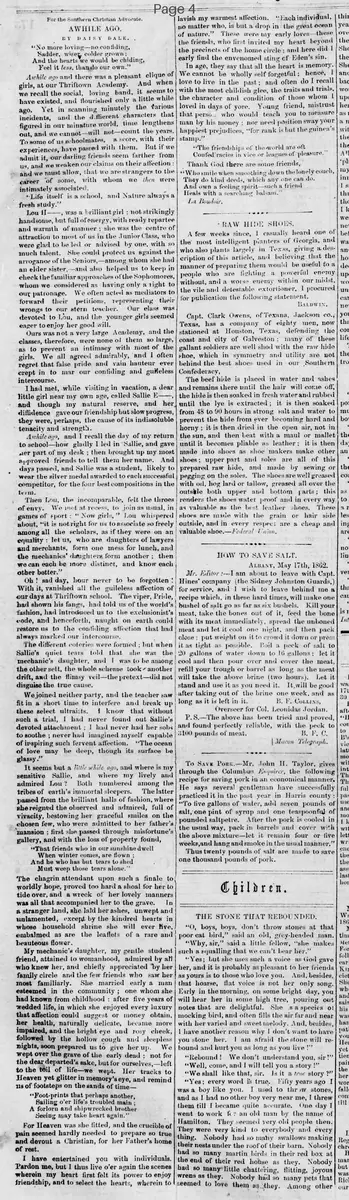
For the Southern Christian Advocate.
AWHILE AGO.
BY DAISY DALE.
"No more loving—no confiding,
Sadder, wiser, colder grown;
And the hearts we would be chiding,
Feel it less, than do our own."
Awhile ago and there was a pleasant clique of girls, at our Thriftown Academy. And when we recall the social, loving band, it seems to have existed, and flourished only a little while ago. Yet in scanning minutely the various incidents, and the different characters that figured in our miniature world, time lengthens out, and we cannot—will not—count the years.
To some of us schoolmates, a score, with their experiences, have passed with them. But if we admit it, our darling friends seem farther from us, and we weaken our claims on their affection; and we must allow, that we are strangers to the career of some, with whom we then were intimately associated.
Life itself is a school, and Nature always a fresh study.
Lou H—, was a brilliant girl; not strikingly handsome, but full of energy, with ready repartee and warmth of manner; she was the centre of attraction to most of us in the Junior Class, who were glad to be led or advised by one, with so much talent. She could protect us against the arrogance of the Seniors,—among whom she had an elder sister,—and also helped us to keep in check the familiar approaches of the Sophomores, whom we considered as having only a right to our patronage. We often acted as mediators to forward their petitions, representing their wrongs to our stern teacher. Our class was devoted to Lou, and the younger girls seemed eager to enjoy her good will.
Ours was not a very large Academy, and the classes, therefore, were none of them so large, as to prevent an intimacy with most of the girls. We all agreed admirably, and I often regret that false pride and vain hauteur ever crept in to mar our confiding and guileless intercourse.
I had met, while visiting in vacation, a dear little girl near my own age, called Sallie E—, and though my natural reserve, and her diffidence gave our friendship but slow progress, they were, perhaps, the cause of its indissoluble tenacity and strength.
Awhile ago, and I recall the day of my return to school—how gladly I led in Sallie, and gave her part of my desk; then brought up my most approved friends to tell them her name. And days passed, and Sallie was a student, likely to wear the silver medal awarded to each successful competitor, for the four best compositions in the term.
Then Lou, the incomparable, felt the throes of envy. We met at recess, to join as usual, in games of sport: "Now girls," Lou whispered about, "it is not right for us to associate so freely among all the scholars, as if they were on an equality: let us, who are daughters of lawyers and merchants, form one mess for lunch, and the mechanics' daughters form another: then we can each be more distinct, and know each other better."
Oh! sad day, hour never to be forgotten! With it, vanished all the guileless affection of our days at Thriftown school. The viper, Pride, had shown his fangs, had told us of the world's fashion, had introduced us to the exclusionist's code, and henceforth, naught on earth could restore us to the confiding affection that had always marked our intercourse.
The different coteries were formed: but when Sallie's quiet tears told that she was the mechanic's daughter, and I was to be among the other set, the whole scheme took another drift, and the flimsy veil—the pretext—did not disguise the true cause.
We joined neither party, and the teacher saw fit in a short time to interfere and break up these select ultraists. I know that without such a trial, I had never found out Sallie's devoted attachment: I had never had her sobs to soothe; never had imagined myself capable of inspiring such fervent affection. "The ocean of love may be deep, though its surface be glassy."
It seems but a little while ago, and where is my sensitive Sallie, and where my lively and admired Lou? Both numbered among the tribes of earth's immortal sleepers. The latter passed from the brilliant halls of fashion, where she reigned the observed and admired, full of vivacity, bestowing her graceful smiles on the chosen few, who were admitted to her father's mansion; first she passed through misfortune's gallery, and with the loss of property found,
That friends who in our sunshine dwell
When winter comes, are flown:
And he who has but tears to shed
Must weep those tears alone.
The chagrin attendant upon such a finale to worldly hope, proved too hard a shoal for her to tide over, and a wreck of her lovely manners was all that accompanied her to the grave. In a stranger land, she laid her ashes, unwept and unlamented, except by the kindred hearts in whose household shrine she will ever live, embalmed as are the leaflets of a rare and beauteous flower.
My mechanic's daughter, my gentle student friend, attained to womanhood, admired by all who knew her, and chiefly appreciated by her family circle and the few friends who saw her most familiarly. She married early a man esteemed in the community; one whom she had known from childhood: after five years of wedded life, in which she enjoyed every luxury that affection could suggest or money obtain, her health, naturally delicate, became more impaired, and the bright eye and rosy cheek, followed by the hollow cough and sleepless nights, soon prepared us to give her up.
We wept over the grave of the early dead; not for the dear departed's sake, but for ourselves,—left to the toil of life—we wept. Her tracks to Heaven yet glitter in memory's eye, and remind us of footsteps on the sands of time—
"Foot-prints that perhaps another,
Sailing o'er life's troubled main;
A forlorn and shipwrecked brother
Seeing may take heart again."
For Heaven was she fitted, and the crucible of pain seemed hardly needed to prepare so true and devout a Christian, for her Father's home of rest.
I have entertained you with individuals. Pardon me, but I thus live o'er again the scenes wherein my heart first felt its power to enjoy friendship, and to select the hearts, wherein to lavish my warmest affection. "Each individual, no matter who, is but a drop in the great ocean of nature." These were my early loves—these the friends, who first invited my heart beyond the precincts of the home circle: and here did I early find the envenomed sting of Eden's sin.
In age, they say that all the heart is memory. We cannot be wholly self forgetful; hence, I love to live in the past: and often do I recall with the most childish glee, the traits and trials the character and condition of those whom I loved in days of yore. Young friend, mistrust that person who would teach you to measure man by his money: nor need position sway your happiest prejudices, "for rank is but the guinea's stamp."
"The friendships of the world are oft
Confederacies in vice or leagues of pleasure."
Thank God there are some friends,
"Who smile when smoothing down the lonely couch,
They do kind deeds, which any one can do.
And own a feeling spirit—such a friend
Heals with a searching balsam."
La Boudoir.
AWHILE AGO.
BY DAISY DALE.
"No more loving—no confiding,
Sadder, wiser, colder grown;
And the hearts we would be chiding,
Feel it less, than do our own."
Awhile ago and there was a pleasant clique of girls, at our Thriftown Academy. And when we recall the social, loving band, it seems to have existed, and flourished only a little while ago. Yet in scanning minutely the various incidents, and the different characters that figured in our miniature world, time lengthens out, and we cannot—will not—count the years.
To some of us schoolmates, a score, with their experiences, have passed with them. But if we admit it, our darling friends seem farther from us, and we weaken our claims on their affection; and we must allow, that we are strangers to the career of some, with whom we then were intimately associated.
Life itself is a school, and Nature always a fresh study.
Lou H—, was a brilliant girl; not strikingly handsome, but full of energy, with ready repartee and warmth of manner; she was the centre of attraction to most of us in the Junior Class, who were glad to be led or advised by one, with so much talent. She could protect us against the arrogance of the Seniors,—among whom she had an elder sister,—and also helped us to keep in check the familiar approaches of the Sophomores, whom we considered as having only a right to our patronage. We often acted as mediators to forward their petitions, representing their wrongs to our stern teacher. Our class was devoted to Lou, and the younger girls seemed eager to enjoy her good will.
Ours was not a very large Academy, and the classes, therefore, were none of them so large, as to prevent an intimacy with most of the girls. We all agreed admirably, and I often regret that false pride and vain hauteur ever crept in to mar our confiding and guileless intercourse.
I had met, while visiting in vacation, a dear little girl near my own age, called Sallie E—, and though my natural reserve, and her diffidence gave our friendship but slow progress, they were, perhaps, the cause of its indissoluble tenacity and strength.
Awhile ago, and I recall the day of my return to school—how gladly I led in Sallie, and gave her part of my desk; then brought up my most approved friends to tell them her name. And days passed, and Sallie was a student, likely to wear the silver medal awarded to each successful competitor, for the four best compositions in the term.
Then Lou, the incomparable, felt the throes of envy. We met at recess, to join as usual, in games of sport: "Now girls," Lou whispered about, "it is not right for us to associate so freely among all the scholars, as if they were on an equality: let us, who are daughters of lawyers and merchants, form one mess for lunch, and the mechanics' daughters form another: then we can each be more distinct, and know each other better."
Oh! sad day, hour never to be forgotten! With it, vanished all the guileless affection of our days at Thriftown school. The viper, Pride, had shown his fangs, had told us of the world's fashion, had introduced us to the exclusionist's code, and henceforth, naught on earth could restore us to the confiding affection that had always marked our intercourse.
The different coteries were formed: but when Sallie's quiet tears told that she was the mechanic's daughter, and I was to be among the other set, the whole scheme took another drift, and the flimsy veil—the pretext—did not disguise the true cause.
We joined neither party, and the teacher saw fit in a short time to interfere and break up these select ultraists. I know that without such a trial, I had never found out Sallie's devoted attachment: I had never had her sobs to soothe; never had imagined myself capable of inspiring such fervent affection. "The ocean of love may be deep, though its surface be glassy."
It seems but a little while ago, and where is my sensitive Sallie, and where my lively and admired Lou? Both numbered among the tribes of earth's immortal sleepers. The latter passed from the brilliant halls of fashion, where she reigned the observed and admired, full of vivacity, bestowing her graceful smiles on the chosen few, who were admitted to her father's mansion; first she passed through misfortune's gallery, and with the loss of property found,
That friends who in our sunshine dwell
When winter comes, are flown:
And he who has but tears to shed
Must weep those tears alone.
The chagrin attendant upon such a finale to worldly hope, proved too hard a shoal for her to tide over, and a wreck of her lovely manners was all that accompanied her to the grave. In a stranger land, she laid her ashes, unwept and unlamented, except by the kindred hearts in whose household shrine she will ever live, embalmed as are the leaflets of a rare and beauteous flower.
My mechanic's daughter, my gentle student friend, attained to womanhood, admired by all who knew her, and chiefly appreciated by her family circle and the few friends who saw her most familiarly. She married early a man esteemed in the community; one whom she had known from childhood: after five years of wedded life, in which she enjoyed every luxury that affection could suggest or money obtain, her health, naturally delicate, became more impaired, and the bright eye and rosy cheek, followed by the hollow cough and sleepless nights, soon prepared us to give her up.
We wept over the grave of the early dead; not for the dear departed's sake, but for ourselves,—left to the toil of life—we wept. Her tracks to Heaven yet glitter in memory's eye, and remind us of footsteps on the sands of time—
"Foot-prints that perhaps another,
Sailing o'er life's troubled main;
A forlorn and shipwrecked brother
Seeing may take heart again."
For Heaven was she fitted, and the crucible of pain seemed hardly needed to prepare so true and devout a Christian, for her Father's home of rest.
I have entertained you with individuals. Pardon me, but I thus live o'er again the scenes wherein my heart first felt its power to enjoy friendship, and to select the hearts, wherein to lavish my warmest affection. "Each individual, no matter who, is but a drop in the great ocean of nature." These were my early loves—these the friends, who first invited my heart beyond the precincts of the home circle: and here did I early find the envenomed sting of Eden's sin.
In age, they say that all the heart is memory. We cannot be wholly self forgetful; hence, I love to live in the past: and often do I recall with the most childish glee, the traits and trials the character and condition of those whom I loved in days of yore. Young friend, mistrust that person who would teach you to measure man by his money: nor need position sway your happiest prejudices, "for rank is but the guinea's stamp."
"The friendships of the world are oft
Confederacies in vice or leagues of pleasure."
Thank God there are some friends,
"Who smile when smoothing down the lonely couch,
They do kind deeds, which any one can do.
And own a feeling spirit—such a friend
Heals with a searching balsam."
La Boudoir.
What sub-type of article is it?
Essay
What themes does it cover?
Friendship
Social Manners
Death Mortality
What keywords are associated?
School Friendships
Pride
Envy
Class Divisions
Death
Memory
Christian Reflection
What entities or persons were involved?
By Daisy Dale.
Literary Details
Title
Awhile Ago.
Author
By Daisy Dale.
Key Lines
"No More Loving—No Confiding,
Sadder, Wiser, Colder Grown;
And The Hearts We Would Be Chiding,
Feel It Less, Than Do Our Own."
"Now Girls," Lou Whispered About, "It Is Not Right For Us To Associate So Freely Among All The Scholars, As If They Were On An Equality: Let Us, Who Are Daughters Of Lawyers And Merchants, Form One Mess For Lunch, And The Mechanics' Daughters Form Another: Then We Can Each Be More Distinct, And Know Each Other Better."
That Friends Who In Our Sunshine Dwell
When Winter Comes, Are Flown:
And He Who Has But Tears To Shed
Must Weep Those Tears Alone.
"Foot Prints That Perhaps Another,
Sailing O'er Life's Troubled Main;
A Forlorn And Shipwrecked Brother
Seeing May Take Heart Again."