Thank you for visiting SNEWPapers!
Sign up free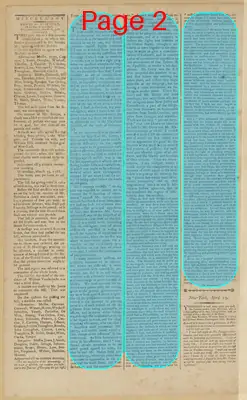
Editorial
April 19, 1788
The New York Journal, And Daily Patriotic Register
New York, New York County, New York
What is this article about?
A Maryland delegate to the Constitutional Convention defends his conduct and positions against accusations by the 'land-holder' in the Maryland Journal. He refutes claims of animosity with Mr. Gerry, explains private meetings to oppose the proposed system, and clarifies his views on representation and federal powers.
Clipping
OCR Quality
95%
Excellent
Full Text
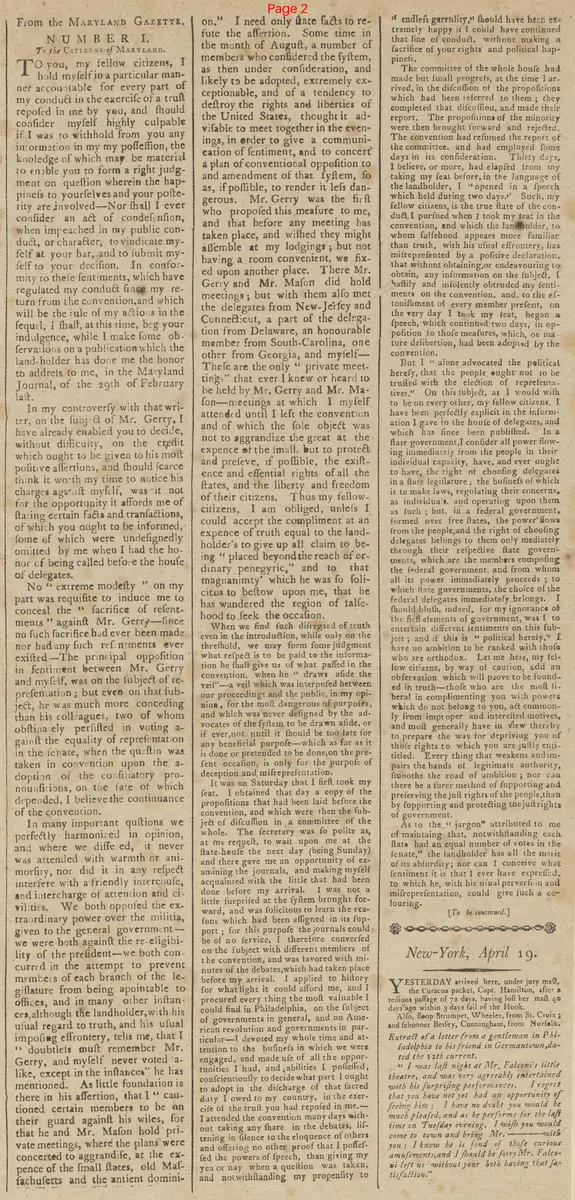
From the MARYLAND GAZETTE.
NUMBER I.
To the CITIZENS of MARYLAND.
To you, my fellow citizens, I hold myself in a particular manner accountable for every part of my conduct in the exercise of a trust reposed in me by you, and should consider myself highly culpable if I was to withhold from you any information in my possession, the knowledge of which may be material to enable you to form a right judgment on questions wherein the happiness to yourselves and your posterity are involved—Nor shall I ever consider an act of condescension, when impeached in my public conduct, or character, to vindicate myself at your bar, and to submit myself to your decision. In conformity to these sentiments, which have regulated my conduct since my return from the convention, and which will be the rule of my actions in the sequel, I shall, at this time, beg your indulgence, while I make some observations on a publication which the land-holder has done me the honor to address to me, in the Maryland Journal, of the 29th of February last.
In my controversy with that writer, on the subject of Mr. Gerry, I have already enabled you to decide, without difficulty, on the credit which ought to be given to his most positive assertions, and should scarce think it worth my time to notice his charges against myself, was it not for the opportunity it affords me of stating certain facts and transactions, of which you ought to be informed, some of which were undesignedly omitted by me when I had the honor of being called before the house of delegates.
No "extreme modesty" on my part was requisite to induce me to conceal the "sacrifice of resentments" against Mr. Gerry—since no such sacrifice had ever been made nor had any such resentments ever existed—The principal opposition in sentiment between Mr. Gerry and myself, was on the subject of representation; but even on that subject, he was much more conceding than his colleagues, two of whom obstinately persisted in voting against the equality of representation in the senate, when the question was taken in convention upon the adoption of the conciliatory propositions, on the fate of which depended, I believe, the continuance of the convention.
In many important questions we perfectly harmonized in opinion, and where we differed, it never was attended with warmth or animosity, nor did it in any respect interfere with a friendly intercourse, and interchange of attention and civilities. We both opposed the extraordinary power over the militia, given to the general government—we were both against the re-eligibility of the president—we both concurred in the attempt to prevent members of each branch of the legislature from being appointable to offices, and in many other instances, although the landholder, with his usual regard to truth, and his usual imposing effrontery, tells me, that I "doubtless must remember Mr. Gerry, and myself never voted alike, except in the instances" he has mentioned. As little foundation is there in his assertion, that I "cautioned certain members to be on their guard against his wiles, for that he and Mr. Mason hold private meetings, where the plans were concerted to aggrandize, at the expense of the small states, old Massachusetts and the ancient dominion."
I need only state facts to refute the assertion. Some time in the month of August, a number of members who considered the system, as then under consideration, and likely to be adopted, extremely exceptionable, and of a tendency to destroy the rights and liberties of the United States, thought it advisable to meet together in the evenings, in order to give a communication of sentiment, and to concert a plan of conventional opposition to and amendment of that system, so as, if possible, to render it less dangerous. Mr. Gerry was the first who proposed this measure to me, and that before any meeting had taken place, and wished they might assemble at my lodgings; but not having a room convenient, we fixed upon another place. There Mr. Gerry and Mr. Mason did hold meetings; but with them also met the delegates from New-Jersey and Connecticut, a part of the delegation from Delaware, an honourable member from South-Carolina, one other from Georgia, and myself—These are the only "private meetings" that ever I knew or heard to be held by Mr. Gerry and Mr. Mason—meetings at which I myself attended until I left the convention and of which the sole object was not to aggrandize the great at the expense of the small. but to protect and preserve, if possible, the existence and essential rights of all the states, and the liberty and freedom of their citizens. Thus my fellow citizens, I am obliged. unless I could accept the compliment at an expense of truth equal to the land-holder's to give up all claim to being "placed beyond the reach of ordinary panegyric," and to that magnanimity which he was so solicitous to bestow upon me, that he has wandered the region of falsehood to seek the occasion.
When we find such disregard of truth even in the introduction, while only on the threshold, we may form some judgment what respect is to be paid to the information he shall give us of what passed in the convention, when he "draws aside the veil"—a veil which was interposed between our proceedings and the public, in my opinion, for the most dangerous of purposes, and which was never designed by the advocates of the system to be drawn aside, or if ever, not until it should be too late for any beneficial purpose— which as far as it is done or pretended to be done, on the present occasion, is only for the purpose of deception and misrepresentation.
It was on Saturday that I first took my seat. I obtained that day a copy of the propositions that had been laid before the convention, and which were then the subject of discussion in a committee of the whole. The secretary was so polite as, at my request, to wait upon me at the state-house the next day (being Sunday) and there gave me an opportunity of examining the journals, and making myself acquainted with the little that had been done before my arrival. I was not a little surprised at the system brought forward, and was solicitous to learn the reasons which had been assigned in its support : for this purpose the journals could be of no service, I therefore conversed on the subject with different members of the convention, and was favored with minutes of the debates, which had taken place before my arrival. I applied to history for what light it could afford me, and I procured every thing the most valuable I could find in Philadelphia, on the subject of governments in general, and on American revolution and governments in particular—I devoted my whole time and attention to the business in which we were engaged, and made use of all the opportunities I had, and abilities I possessed, conscientiously to decide what part I ought to adopt in the discharge of that sacred duty I owed to my country, in the exercise of the trust you had reposed in me.—
I attended the convention many days without taking any share in the debates, listening in silence to the eloquence of others and offering no other proof that I possessed the powers of speech, than giving my yea or nay when a question was taken, and notwithstanding my propensity to
"endless garrulity," should have been extremely happy if I could have continued that line of conduct, without making a sacrifice of your rights' and political happiness.
The committee of the whole house had made but small progress, at the time I arrived, in the discussion of the propositions which had been referred to them ; they completed that discussion, and made their report. The propositions of the minority were then brought forward and rejected.
The convention had resumed the report of the committee, and had employed some days in its consideration. Thirty days, I believe, or more, had elapsed from my taking my seat before, in the language of the landholder, I "opened in a speech which held during two days." Such, my fellow citizens, is the true state of the conduct I pursued when I took my seat in the convention, and which the landholder, to whom falsehood appears more familiar than truth, with his usual effrontery, has misrepresented by a positive declaration, that without obtaining, or endeavouring to obtain, any information on the subject, I hastily and insolently obtruded my sentiments on the convention, and, to the astonishment of every member present, on the very day I took my seat, began a speech, which continued two days, in opposition to those measures, which, on mature deliberation, had been adopted by the convention.
But I "alone advocated the political heresy, that the people ought not to be trusted with the election of representatives." On this subject, as I would wish to be on every other, my fellow citizens, I have been perfectly explicit in the information I gave to the house of delegates, and which has since been published. In a state government, I consider all power flowing immediately from the people in their individual capacity, have, and ever ought to have. the right to choosing delegates in a state legislature ; the business of which is to make laws, regulating their concerns, as individuals, and operating upon them as such ; but, in a federal government, formed over free states, the power flows from the people, and the right of choosing delegates belongs to them only mediately through their respective state governments, which are the members composing the federal government, and from whom all its power immediately proceeds ; to which state governments, the choice of the federal delegates immediately belongs. I should blush, indeed, for my ignorance of the first elements of government, was I to entertain different sentiments on this subject; and if this is "political heresy," I have no ambition to be ranked with those who are orthodox. Let me here, my fellow citizens, by way of caution, add an observation which will prove to be founded in truth—those who are the most liberal in complimenting you with powers which do not belong to you, act commonly from improper and interested motives, and most generally have in view thereby to prepare the way for depriving you of those rights to which you are justly entitled. Every thing that weakens and impairs the bands of legitimate authority, smooths the road of ambition ; nor can there be a surer method of supporting and preserving the just rights of the people, than by supporting and protecting the just rights of government.
As to the "jargon" attributed to me of maintaining that, notwithstanding each state had an equal number of votes in the senate," the landholder has all the merit of its absurdity; nor can I conceive what sentiment it is that I ever have expressed. to which he. with his usual perversion and misrepresentation, could give such a colouring.
[To be continued.]
NUMBER I.
To the CITIZENS of MARYLAND.
To you, my fellow citizens, I hold myself in a particular manner accountable for every part of my conduct in the exercise of a trust reposed in me by you, and should consider myself highly culpable if I was to withhold from you any information in my possession, the knowledge of which may be material to enable you to form a right judgment on questions wherein the happiness to yourselves and your posterity are involved—Nor shall I ever consider an act of condescension, when impeached in my public conduct, or character, to vindicate myself at your bar, and to submit myself to your decision. In conformity to these sentiments, which have regulated my conduct since my return from the convention, and which will be the rule of my actions in the sequel, I shall, at this time, beg your indulgence, while I make some observations on a publication which the land-holder has done me the honor to address to me, in the Maryland Journal, of the 29th of February last.
In my controversy with that writer, on the subject of Mr. Gerry, I have already enabled you to decide, without difficulty, on the credit which ought to be given to his most positive assertions, and should scarce think it worth my time to notice his charges against myself, was it not for the opportunity it affords me of stating certain facts and transactions, of which you ought to be informed, some of which were undesignedly omitted by me when I had the honor of being called before the house of delegates.
No "extreme modesty" on my part was requisite to induce me to conceal the "sacrifice of resentments" against Mr. Gerry—since no such sacrifice had ever been made nor had any such resentments ever existed—The principal opposition in sentiment between Mr. Gerry and myself, was on the subject of representation; but even on that subject, he was much more conceding than his colleagues, two of whom obstinately persisted in voting against the equality of representation in the senate, when the question was taken in convention upon the adoption of the conciliatory propositions, on the fate of which depended, I believe, the continuance of the convention.
In many important questions we perfectly harmonized in opinion, and where we differed, it never was attended with warmth or animosity, nor did it in any respect interfere with a friendly intercourse, and interchange of attention and civilities. We both opposed the extraordinary power over the militia, given to the general government—we were both against the re-eligibility of the president—we both concurred in the attempt to prevent members of each branch of the legislature from being appointable to offices, and in many other instances, although the landholder, with his usual regard to truth, and his usual imposing effrontery, tells me, that I "doubtless must remember Mr. Gerry, and myself never voted alike, except in the instances" he has mentioned. As little foundation is there in his assertion, that I "cautioned certain members to be on their guard against his wiles, for that he and Mr. Mason hold private meetings, where the plans were concerted to aggrandize, at the expense of the small states, old Massachusetts and the ancient dominion."
I need only state facts to refute the assertion. Some time in the month of August, a number of members who considered the system, as then under consideration, and likely to be adopted, extremely exceptionable, and of a tendency to destroy the rights and liberties of the United States, thought it advisable to meet together in the evenings, in order to give a communication of sentiment, and to concert a plan of conventional opposition to and amendment of that system, so as, if possible, to render it less dangerous. Mr. Gerry was the first who proposed this measure to me, and that before any meeting had taken place, and wished they might assemble at my lodgings; but not having a room convenient, we fixed upon another place. There Mr. Gerry and Mr. Mason did hold meetings; but with them also met the delegates from New-Jersey and Connecticut, a part of the delegation from Delaware, an honourable member from South-Carolina, one other from Georgia, and myself—These are the only "private meetings" that ever I knew or heard to be held by Mr. Gerry and Mr. Mason—meetings at which I myself attended until I left the convention and of which the sole object was not to aggrandize the great at the expense of the small. but to protect and preserve, if possible, the existence and essential rights of all the states, and the liberty and freedom of their citizens. Thus my fellow citizens, I am obliged. unless I could accept the compliment at an expense of truth equal to the land-holder's to give up all claim to being "placed beyond the reach of ordinary panegyric," and to that magnanimity which he was so solicitous to bestow upon me, that he has wandered the region of falsehood to seek the occasion.
When we find such disregard of truth even in the introduction, while only on the threshold, we may form some judgment what respect is to be paid to the information he shall give us of what passed in the convention, when he "draws aside the veil"—a veil which was interposed between our proceedings and the public, in my opinion, for the most dangerous of purposes, and which was never designed by the advocates of the system to be drawn aside, or if ever, not until it should be too late for any beneficial purpose— which as far as it is done or pretended to be done, on the present occasion, is only for the purpose of deception and misrepresentation.
It was on Saturday that I first took my seat. I obtained that day a copy of the propositions that had been laid before the convention, and which were then the subject of discussion in a committee of the whole. The secretary was so polite as, at my request, to wait upon me at the state-house the next day (being Sunday) and there gave me an opportunity of examining the journals, and making myself acquainted with the little that had been done before my arrival. I was not a little surprised at the system brought forward, and was solicitous to learn the reasons which had been assigned in its support : for this purpose the journals could be of no service, I therefore conversed on the subject with different members of the convention, and was favored with minutes of the debates, which had taken place before my arrival. I applied to history for what light it could afford me, and I procured every thing the most valuable I could find in Philadelphia, on the subject of governments in general, and on American revolution and governments in particular—I devoted my whole time and attention to the business in which we were engaged, and made use of all the opportunities I had, and abilities I possessed, conscientiously to decide what part I ought to adopt in the discharge of that sacred duty I owed to my country, in the exercise of the trust you had reposed in me.—
I attended the convention many days without taking any share in the debates, listening in silence to the eloquence of others and offering no other proof that I possessed the powers of speech, than giving my yea or nay when a question was taken, and notwithstanding my propensity to
"endless garrulity," should have been extremely happy if I could have continued that line of conduct, without making a sacrifice of your rights' and political happiness.
The committee of the whole house had made but small progress, at the time I arrived, in the discussion of the propositions which had been referred to them ; they completed that discussion, and made their report. The propositions of the minority were then brought forward and rejected.
The convention had resumed the report of the committee, and had employed some days in its consideration. Thirty days, I believe, or more, had elapsed from my taking my seat before, in the language of the landholder, I "opened in a speech which held during two days." Such, my fellow citizens, is the true state of the conduct I pursued when I took my seat in the convention, and which the landholder, to whom falsehood appears more familiar than truth, with his usual effrontery, has misrepresented by a positive declaration, that without obtaining, or endeavouring to obtain, any information on the subject, I hastily and insolently obtruded my sentiments on the convention, and, to the astonishment of every member present, on the very day I took my seat, began a speech, which continued two days, in opposition to those measures, which, on mature deliberation, had been adopted by the convention.
But I "alone advocated the political heresy, that the people ought not to be trusted with the election of representatives." On this subject, as I would wish to be on every other, my fellow citizens, I have been perfectly explicit in the information I gave to the house of delegates, and which has since been published. In a state government, I consider all power flowing immediately from the people in their individual capacity, have, and ever ought to have. the right to choosing delegates in a state legislature ; the business of which is to make laws, regulating their concerns, as individuals, and operating upon them as such ; but, in a federal government, formed over free states, the power flows from the people, and the right of choosing delegates belongs to them only mediately through their respective state governments, which are the members composing the federal government, and from whom all its power immediately proceeds ; to which state governments, the choice of the federal delegates immediately belongs. I should blush, indeed, for my ignorance of the first elements of government, was I to entertain different sentiments on this subject; and if this is "political heresy," I have no ambition to be ranked with those who are orthodox. Let me here, my fellow citizens, by way of caution, add an observation which will prove to be founded in truth—those who are the most liberal in complimenting you with powers which do not belong to you, act commonly from improper and interested motives, and most generally have in view thereby to prepare the way for depriving you of those rights to which you are justly entitled. Every thing that weakens and impairs the bands of legitimate authority, smooths the road of ambition ; nor can there be a surer method of supporting and preserving the just rights of the people, than by supporting and protecting the just rights of government.
As to the "jargon" attributed to me of maintaining that, notwithstanding each state had an equal number of votes in the senate," the landholder has all the merit of its absurdity; nor can I conceive what sentiment it is that I ever have expressed. to which he. with his usual perversion and misrepresentation, could give such a colouring.
[To be continued.]
What sub-type of article is it?
Constitutional
Partisan Politics
What keywords are associated?
Constitutional Convention
Federal Representation
State Rights
Private Meetings
Land Holder Criticism
Mr Gerry
Mr Mason
Maryland Delegates
What entities or persons were involved?
Mr. Gerry
Mr. Mason
Land Holder
Delegates From New Jersey
Delegates From Connecticut
Delegation From Delaware
Member From South Carolina
Member From Georgia
House Of Delegates
Editorial Details
Primary Topic
Defense Of Conduct In The Constitutional Convention Against Land Holder's Criticisms
Stance / Tone
Defensive Vindication And Refutation Of Falsehoods
Key Figures
Mr. Gerry
Mr. Mason
Land Holder
Delegates From New Jersey
Delegates From Connecticut
Delegation From Delaware
Member From South Carolina
Member From Georgia
House Of Delegates
Key Arguments
No Resentments Or Sacrifice Against Mr. Gerry; Differed Mainly On Representation But Harmonized On Many Issues Like Militia Power, Presidential Re Eligibility, And Legislative Appointments.
Private Meetings Proposed By Mr. Gerry To Oppose And Amend The System, Attended By Delegates From Small States To Protect Rights, Not Aggrandize Large States.
Arrived In Convention, Studied Propositions And Debates Thoroughly Before Speaking After Over 30 Days.
Advocated For State Governments Choosing Federal Delegates In Federal System, Contrasting With Direct Election In State Governments.
Criticizes Land Holder's Misrepresentations And Disregard For Truth Regarding Convention Proceedings.