Thank you for visiting SNEWPapers!
Sign up free
Story
September 26, 1771
The Virginia Gazette
Richmond, Williamsburg, Richmond County, Virginia
What is this article about?
Lord Ligonier pursues an amicable divorce from Lady Ligonier amid difficulties in securing evidence of her affair with Mr. A—i, who lost a damages suit undefended. Letters reveal rivalry from an Italian Count, whose epistolary style includes vivid metaphors. The postilion may be needed as witness.
Clipping
OCR Quality
98%
Excellent
Full Text
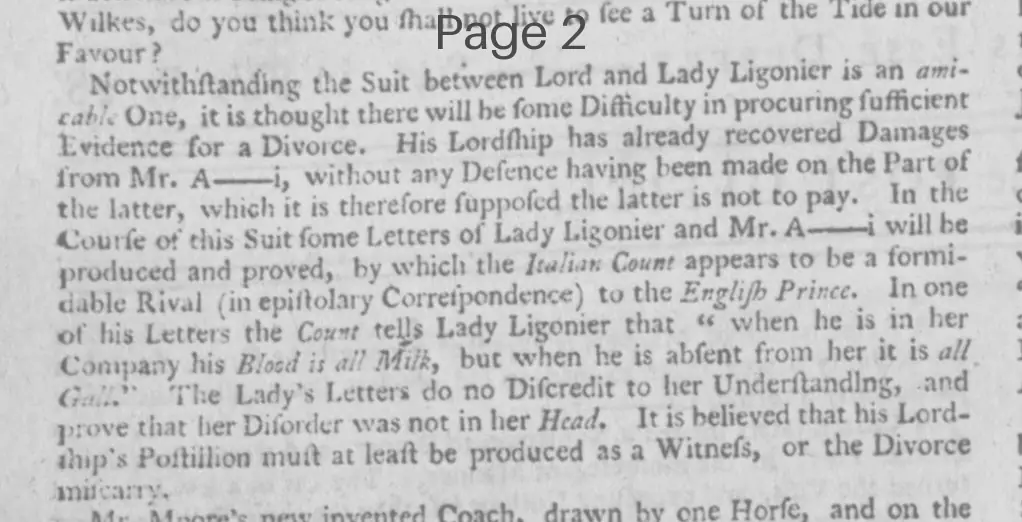
Notwithstanding the Suit between Lord and Lady Ligonier is an amicable One, it is thought there will be some Difficulty in procuring sufficient Evidence for a Divorce. His Lordship has already recovered Damages from Mr. A—i, without any Defence having been made on the Part of the latter, which it is therefore supposed the latter is not to pay. In the Course of this Suit some Letters of Lady Ligonier and Mr. A—i will be produced and proved, by which the Italian Count appears to be a formidable Rival (in epistolary Correspondence) to the English Prince. In one of his Letters the Count tells Lady Ligonier that "when he is in her Company his Blood is all Milk, but when he is absent from her it is all Ga—." The Lady's Letters do no Discredit to her Understanding, and prove that her Disorder was not in her Head. It is believed that his Lordship's Postilion must at least be produced as a Witness, or the Divorce cannot be obtained.
What sub-type of article is it?
Family Drama
Deception Fraud
What themes does it cover?
Betrayal
Deception
Family
What keywords are associated?
Divorce Suit
Adultery Scandal
Nobility Affair
Love Letters
Court Evidence
What entities or persons were involved?
Lord Ligonier
Lady Ligonier
Mr. A—I
Italian Count
Story Details
Key Persons
Lord Ligonier
Lady Ligonier
Mr. A—I
Italian Count
Story Details
Amicable divorce suit between Lord and Lady Ligonier faces evidence challenges; Lord recovered undefended damages from Mr. A—i; letters show Italian Count as epistolary rival with vivid expressions; Lady's letters show sound mind; postilion witness likely required.