Thank you for visiting SNEWPapers!
Sign up free
Literary
September 27, 1934
The Frontier
O'neill, O'neill City, Holt County, Nebraska
What is this article about?
Philo Vance and District Attorney Markham investigate the locked-room death of collector Archer Coe, initially appearing as suicide but suspected as murder due to inconsistencies like his attire and positioning. The scene details the room and body, with dialogue revealing doubts. Chapter II introduces Hilda Lake discovering the body.
Clipping
OCR Quality
95%
Excellent
Full Text
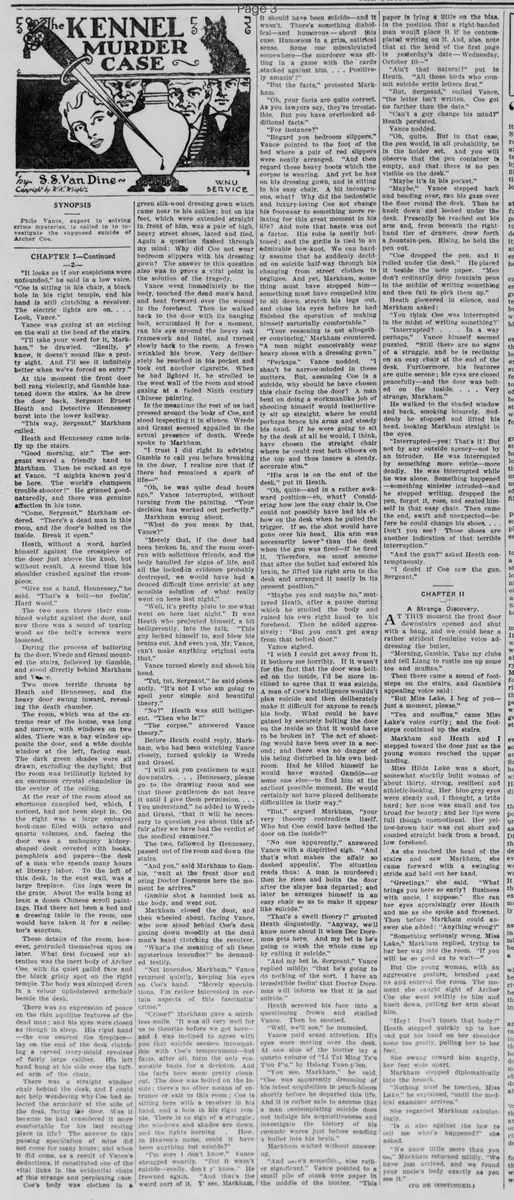
SYNOPSIS
Philo Vance, expert in solving crime mysteries, is called in to investigate the supposed suicide of Archer Coe.
CHAPTER I—Continued
2
"It looks as if our suspicions were unfounded," he said in a low voice. "Coe is sitting in his chair, a black hole in his right temple, and his hand is still clutching a revolver. The electric lights are on.... Look, Vance."
Vance was gazing at an etching on the wall at the head of the stairs.
"I'll take your word for it, Markham," he drawled. "Really, y'know, it doesn't sound like a pretty sight. And I'll see it infinitely better when we've forced an entry."
At this moment the front door bell rang violently, and Gamble hastened down the stairs. As he drew the door back, Sergeant Ernest Heath and Detective Hennessey burst into the lower hallway.
"This way, Sergeant," Markham called.
Heath and Hennessey came noisily up the stairs.
"Good morning, sir."
The sergeant waved a friendly hand to Markham. Then he cocked an eye at Vance. "I mighta known you'd be here. The world's champeen trouble-shooter!" He grinned good-naturedly, and there was genuine affection in his tone.
"Come, Sergeant," Markham ordered. "There's a dead man in this room, and the door's bolted on the inside. Break it open."
Heath, without a word, hurled himself against the crosspiece of the door just above the knob, but without result. A second time his shoulder crashed against the crosspiece.
"Give me a hand, Hennessey," he said. "That's a bolt—no foolin'. Hard wood."
The two men threw their combined weight against the door, and now there was a sound of tearing wood as the bolt's screws were loosened.
During the process of battering in the door, Wrede and Grassi mounted the stairs, followed by Gamble, and stood directly behind Markham and Vance.
Two more terrific thrusts by Heath and Hennessey, and the heavy door swung inward, revealing the death chamber.
The room, which was at the extreme rear of the house, was long and narrow, with windows on two sides. There was a bay window opposite the door, and a wide double window at the left, facing east. The dark green shades were all drawn, excluding the daylight. But the room was brilliantly lighted by an enormous crystal chandelier in the center of the ceiling.
At the rear of the room stood an enormous canopied bed, which, I noticed, had not been slept in. On the right was a large embayed book-case filled with octavo and quarto volumes, and, facing the door was a mahogany kidney-shaped desk covered with books, pamphlets and papers—the desk of a man who spends many hours at literary labor. To the left of this desk, in the east wall, was a large fireplace. Gas logs were in the grate. About the walls hung at least a dozen Chinese scroll paintings. Had there not been a bed and a dressing table in the room, one would have taken it for a collector's sanctum.
These details of the room, however, protruded themselves upon us later. What first focused our attention was the inert body of Archer Coe, with its quiet pallid face and the black grisly spot on the right temple. The body was slumped down in a velour upholstered armchair beside the desk.
There was an expression of peace on the thin aquiline features of the dead man; and his eyes were closed as though in sleep. His right hand—the one nearest the fireplace—lay on the end of the desk clutching a carved ivory-inlaid revolver of fairly large caliber. His left hand hung at his side over the tufted arm of the chair.
There was a straight Windsor chair behind the desk, and I could not help wondering why Coe had selected the armchair at the side of the desk, facing the door. Was it because he had considered it more comfortable for his last resting place in life? The answer to this passing speculation of mine did not come for many hours; and when it did come, as a result of Vance's deductions, it constituted one of the vital links in the evidential chain of this strange and perplexing case.
Coe was clad in a green silk-wool dressing gown which came near to his ankles; but on his feet, which were extended straight in front of him, was a pair of high, heavy street shoes, laced and tied.
Again a question flashed through my mind: Why did Coe not wear bedroom slippers with his dressing gown? The answer to this question also was to prove a vital point in the solution of the tragedy.
Vance went immediately to the body, touched the dead man's hand, and bent forward over the wound in the forehead. Then he walked back to the door with its hanging bolt, scrutinized it for a moment, ran his eye around the heavy oak framework and lintel, and turned slowly back to the room. A frown wrinkled his brow. Very deliberately he reached in his pocket and took out another cigarette. When he had lighted it, he strolled to the west wall of the room and stood gazing at a faded Ninth century Chinese painting.
In the meantime the rest of us had pressed around the body of Coe, and stood inspecting it in silence. Wrede and Grassi seemed appalled in the actual presence of death. Wrede spoke to Markham.
"I trust I did right in advising Gamble to call you before breaking in the door. I realize now that if there had remained a spark of life—"
"Oh, he was quite dead hours ago," Vance interrupted, without turning from the painting. "Your decision has worked out perfectly."
Markham swung about.
"What do you mean by that, Vance?"
"Merely that, if the door had been broken in, and the room overrun with solicitous friends, and the body handled for signs of life, and all the locked-in evidence probably destroyed, we would have had a deuced difficult time arrivin' at any sensible solution of what really went on here last night."
"Well, it's pretty plain to me what went on here last night." It was Heath who projected himself, a bit belligerently, into the talk. "This guy locked himself in, and blew his brains out. And even you, Mr. Vance, can't make anything original outa that."
Vance turned slowly and shook his head.
"Tut, tut, Sergeant," he said pleasantly. "It's not I who am going to spoil your simple and beautiful theory."
"No?"
Heath was still belligerent. "Then who is?"
"The corpse," answered Vance.
Before Heath could reply, Markham, who had been watching Vance closely, turned quickly to Wrede and Grassi.
"I will ask you gentlemen to wait downstairs.... Hennessey, please go to the drawing room and see that these gentlemen do not leave it until I give them permission.... You understand," he added to Wrede and Grassi, "that it will be necessary to question you about this affair after we have had the verdict of the medical examiner."
The two, followed by Hennessey, passed out of the room and down the stairs.
"And you," said Markham to Gamble, "wait at the front door and bring Doctor Doremus here the moment he arrives."
Gamble shot a haunted look at the body, and went out.
Markham closed the door, and then wheeled about, facing Vance, who now stood behind Coe's desk gazing down moodily at the dead man's hand clutching the revolver.
"What's the meaning of all these mysterious innuendos?" he demanded testily.
"Not innuendos, Markham," Vance returned quietly, keeping his eyes on Coe's hand. "Merely speculations. I'm rather interested in certain aspects of this fascinatin' crime."
"Crime?" Markham gave a mirthless smile. "It was all very well for us to theorize before we got here—and I was inclined to agree with you that suicide seemed incompatible with Coe's temperament—but facts, after all, form the only reasonable basis for a decision. And the facts here seem pretty clean cut. The door was bolted on the inside; there's no other means of entrance or exit to this room; Coe is sitting here with a revolver in his hand, and a hole in his right temple. There is no sign of a struggle; the windows and shades are down, and the lights burning. How, in Heaven's name, could it have been anything but suicide?"
"I'm sure I don't know." Vance shrugged wearily. "But it wasn't suicide—really, don't y'know." He frowned again. "And that's the weird part of it. Y'see, Markham, it should have been suicide and it wasn't. There's something diabolical—and humorous—about this case. Humorous in a grim, satirical sense. Some one miscalculated somewhere—the murderer was sitting in a game with the cards stacked against him.... Positively amazin'!"
"But the facts," protested Markham.
"Oh, your facts are quite correct. As you lawyers say, they're irresistible. But you have overlooked additional facts."
"For instance?"
"Regard yon bedroom slippers."
Vance pointed to the foot of the bed where a pair of red slippers were neatly arranged. "And then regard these heavy boots which the corpse is wearing. And yet he has on his dressing gown, and is sitting in his easy chair. A bit incongruous, what? Why did the hedonistic and luxury-loving Coe not change his footwear to something more relaxing for this great moment in his life? And note that haste was not a factor. His robe is neatly buttoned; and the girdle is tied in an admirable bow-knot. We can hardly assume that he suddenly decided on suicide half-way through his changing from street clothes to negligee. And yet, Markham, something must have stopped him—something must have compelled him to sit down, stretch his legs out, and close his eyes before he had finished the operation of making himself sartorially comfortable."
"Your reasoning is not altogether convincing," Markham countered. "A man might conceivably wear heavy shoes with a dressing gown."
"Perhaps." Vance nodded. "I shan't be narrow-minded in these matters. But, assuming Coe is a suicide, why should he have chosen this chair facing the door? A man bent on doing a workmanlike job of shooting himself would instinctively sit up straight, where he could perhaps brace his arms and steady his hand. If he were going to sit by the desk at all he would, I think, have chosen the straight chair where he could rest both elbows on the top and thus insure a steady, accurate aim."
"His arm is on the end of the desk," put in Heath.
"Oh, quite—and in a rather awkward position—eh, what? Considering how low the easy chair is, Coe could not possibly have had his elbow on the desk when he pulled the trigger. If so, the shot would have gone over his head. His arm was necessarily lower than the desk when the gun was fired—if he fired it. Therefore, we must assume that after the bullet had entered his brain, he lifted his right arm to the desk and arranged it neatly in its present position."
"Maybe yes and maybe no," muttered Heath, after a pause during which he studied the body and raised his own right hand to his forehead. Then he added aggressively: "But you can't get away from that bolted door."
Vance sighed.
"I wish I could get away from it. It bothers me horribly. If it wasn't for the fact that the door was bolted on the inside, I'd be more inclined to agree that it was suicide. A man of Coe's intelligence wouldn't plan suicide and then deliberately make it difficult for anyone to reach his body. What could he have gained by securely bolting the door on the inside so that it would have to be broken in? The act of shooting would have been over in a second; and there was no danger of his being disturbed in his own bedroom. Had he killed himself he would have wanted Gamble or some one else to find him at the earliest possible moment. He would certainly not have placed deliberate difficulties in their way."
"But," argued Markham, "your very theory contradicts itself. Who but Coe could have bolted the door on the inside?"
"No one apparently," answered Vance with a dispirited sigh. "And that's what makes the affair so dashed appealin'. The situation reads thus: A man is murdered; then he rises and bolts the door after the slayer has departed; and later he arranges himself in an easy chair so as to make it appear like suicide."
"That's a swell theory!" grunted Heath disgustedly. "Anyway, we'll know more about it when Doc Doremus gets here. And my bet is he's going to wash the whole case up by calling it suicide."
"And my bet is, Sergeant," Vance replied mildly; "that he's going to do nothing of the sort. I have an irresistible feelin' that Doctor Doremus will inform us that it is not suicide."
Heath screwed his face into a questioning frown and studied Vance. Then he snorted.
"Well, we'll see," he mumbled.
Vance paid scant attention. His eyes were moving over the desk. At one side of the blotter lay a quarto volume of "Li Tai Ming Ts'u T'ou P'u," by Hsiung Yuan-p'ien.
"You see, Markham," he said. "Coe was apparently dreaming of his latest acquisition in peach-bloom shortly before he departed this life. And it is rather safe to assume that a man contemplating suicide does not indulge his acquisitiveness and investigate the history of his ceramic wares just before sending a bullet into his brain."
Markham waited without answering.
"And there's something else rather significant." Vance pointed to a small pile of blank note paper in the middle of the blotter. "This paper is lying a little on the bias, in the position that a right-handed man would place it if he contemplated writing on it. And, also, note that at the head of the first page is yesterday's date—Wednesday, October 10."
"Ain't that natural?" put in Heath. "All these birds who commit suicide write letters first."
"But, Sergeant," smiled Vance, "the letter isn't written. Coe got no farther than the date."
"Can't a guy change his mind?" Heath persisted.
Vance nodded.
"Oh, quite. But in that case, the pen would, in all probability, be in the holder set. And you will observe that the pen container is empty, and that there is no pen visible on the desk."
"Maybe it's in his pocket."
"Maybe." Vance stepped back and bending over, ran his gaze over the floor round the desk. Then he knelt down and looked under the desk. Presently he reached out his arm and, from beneath the right-hand tier of drawers, drew forth a fountain-pen. Rising, he held the pen out.
"Coe dropped the pen, and it rolled under the desk." He placed it beside the note paper. "Men don't ordinarily drop fountain pens in the middle of writing something and then fail to pick them up."
Heath glowered in silence, and Markham asked:
"You think Coe was interrupted in the midst of writing something?"
"Interrupted?... In a way perhaps." Vance himself seemed puzzled. "Still there are no signs of a struggle, and he is reclining on an easy chair at the end of the desk. Furthermore, his features are quite serene; his eyes are closed peacefully—and the door was bolted on the inside.... Very strange, Markham."
He walked to the shaded window and back, smoking leisurely. Suddenly he stopped and lifted his head, looking Markham straight in the eyes.
"Interrupted—yes! That's it! But not by any outside agency—not by an intruder. He was interrupted by something more subtle—more deadly. He was interrupted while he was alone. Something happened—something sinister intruded—and he stopped writing, dropped the pen, forgot it, rose, and seated himself in that easy chair. Then came the end, swift and unexpected—before he could change his shoes.... Don't you see? Those shoes are another indication of that terrible interruption."
"And the gun?" asked Heath contemptuously.
"I doubt if Coe saw the gun, Sergeant."
CHAPTER II
A Strange Discovery.
At this moment the front door downstairs opened and shut with a bang, and we could hear a rather strident feminine voice addressing the butler.
"Morning, Gamble. Take my clubs and tell Liang to rustle me up some tea and muffins."
Then there came a sound of footsteps on the stairs, and Gamble's appealing voice said:
"But Miss Lake, I beg of you—just a moment, please."
"Tea and muffins," came Miss Lake's voice curtly; and the footsteps continued up the stairs.
Markham and Heath and I stepped toward the door just as the young woman reached the upper landing.
Miss Hilda Lake was a short, somewhat stockily built woman of about thirty, strong, resilient and athletic-looking. Her blue-gray eyes were steady and, I thought, a trifle hard; her nose was small and too broad for beauty; and her lips were full though unemotional. Her yellow-brown hair was cut short and combed straight back from a broad low forehead.
As she reached the head of the stairs and saw Markham, she came forward with a swinging stride and held out her hand.
"Greetings," she said. "What brings you here so early? Business with uncle, I suppose."
She ran her eyes appraisingly over Heath and me as she spoke and frowned. Then before Markham could answer she added: "Anything wrong?"
"Something seriously wrong, Miss Lake," Markham replied, trying to bar her way into the room. "If you will be so good as to wait—"
But the young woman, with an aggressive gesture, brushed past us and entered the room. The moment she caught sight of Archer Coe she went swiftly to him and knelt down, putting her arm about him.
"Hey! Don't touch that body!" Heath stepped quickly up to her and put his hand on her shoulder none too gently, pulling her to her feet.
She swung toward him angrily, her feet wide apart.
Markham stepped diplomatically into the breach.
"Nothing must be touched, Miss Lake," he explained, "until the medical examiner arrives."
She regarded Markham calculatingly.
"Is it also against the law to tell me what's happened?" she asked.
"We know little more than you do," Markham returned mildly. "We have just arrived, and we found your uncle's body exactly as you see it."
Philo Vance, expert in solving crime mysteries, is called in to investigate the supposed suicide of Archer Coe.
CHAPTER I—Continued
2
"It looks as if our suspicions were unfounded," he said in a low voice. "Coe is sitting in his chair, a black hole in his right temple, and his hand is still clutching a revolver. The electric lights are on.... Look, Vance."
Vance was gazing at an etching on the wall at the head of the stairs.
"I'll take your word for it, Markham," he drawled. "Really, y'know, it doesn't sound like a pretty sight. And I'll see it infinitely better when we've forced an entry."
At this moment the front door bell rang violently, and Gamble hastened down the stairs. As he drew the door back, Sergeant Ernest Heath and Detective Hennessey burst into the lower hallway.
"This way, Sergeant," Markham called.
Heath and Hennessey came noisily up the stairs.
"Good morning, sir."
The sergeant waved a friendly hand to Markham. Then he cocked an eye at Vance. "I mighta known you'd be here. The world's champeen trouble-shooter!" He grinned good-naturedly, and there was genuine affection in his tone.
"Come, Sergeant," Markham ordered. "There's a dead man in this room, and the door's bolted on the inside. Break it open."
Heath, without a word, hurled himself against the crosspiece of the door just above the knob, but without result. A second time his shoulder crashed against the crosspiece.
"Give me a hand, Hennessey," he said. "That's a bolt—no foolin'. Hard wood."
The two men threw their combined weight against the door, and now there was a sound of tearing wood as the bolt's screws were loosened.
During the process of battering in the door, Wrede and Grassi mounted the stairs, followed by Gamble, and stood directly behind Markham and Vance.
Two more terrific thrusts by Heath and Hennessey, and the heavy door swung inward, revealing the death chamber.
The room, which was at the extreme rear of the house, was long and narrow, with windows on two sides. There was a bay window opposite the door, and a wide double window at the left, facing east. The dark green shades were all drawn, excluding the daylight. But the room was brilliantly lighted by an enormous crystal chandelier in the center of the ceiling.
At the rear of the room stood an enormous canopied bed, which, I noticed, had not been slept in. On the right was a large embayed book-case filled with octavo and quarto volumes, and, facing the door was a mahogany kidney-shaped desk covered with books, pamphlets and papers—the desk of a man who spends many hours at literary labor. To the left of this desk, in the east wall, was a large fireplace. Gas logs were in the grate. About the walls hung at least a dozen Chinese scroll paintings. Had there not been a bed and a dressing table in the room, one would have taken it for a collector's sanctum.
These details of the room, however, protruded themselves upon us later. What first focused our attention was the inert body of Archer Coe, with its quiet pallid face and the black grisly spot on the right temple. The body was slumped down in a velour upholstered armchair beside the desk.
There was an expression of peace on the thin aquiline features of the dead man; and his eyes were closed as though in sleep. His right hand—the one nearest the fireplace—lay on the end of the desk clutching a carved ivory-inlaid revolver of fairly large caliber. His left hand hung at his side over the tufted arm of the chair.
There was a straight Windsor chair behind the desk, and I could not help wondering why Coe had selected the armchair at the side of the desk, facing the door. Was it because he had considered it more comfortable for his last resting place in life? The answer to this passing speculation of mine did not come for many hours; and when it did come, as a result of Vance's deductions, it constituted one of the vital links in the evidential chain of this strange and perplexing case.
Coe was clad in a green silk-wool dressing gown which came near to his ankles; but on his feet, which were extended straight in front of him, was a pair of high, heavy street shoes, laced and tied.
Again a question flashed through my mind: Why did Coe not wear bedroom slippers with his dressing gown? The answer to this question also was to prove a vital point in the solution of the tragedy.
Vance went immediately to the body, touched the dead man's hand, and bent forward over the wound in the forehead. Then he walked back to the door with its hanging bolt, scrutinized it for a moment, ran his eye around the heavy oak framework and lintel, and turned slowly back to the room. A frown wrinkled his brow. Very deliberately he reached in his pocket and took out another cigarette. When he had lighted it, he strolled to the west wall of the room and stood gazing at a faded Ninth century Chinese painting.
In the meantime the rest of us had pressed around the body of Coe, and stood inspecting it in silence. Wrede and Grassi seemed appalled in the actual presence of death. Wrede spoke to Markham.
"I trust I did right in advising Gamble to call you before breaking in the door. I realize now that if there had remained a spark of life—"
"Oh, he was quite dead hours ago," Vance interrupted, without turning from the painting. "Your decision has worked out perfectly."
Markham swung about.
"What do you mean by that, Vance?"
"Merely that, if the door had been broken in, and the room overrun with solicitous friends, and the body handled for signs of life, and all the locked-in evidence probably destroyed, we would have had a deuced difficult time arrivin' at any sensible solution of what really went on here last night."
"Well, it's pretty plain to me what went on here last night." It was Heath who projected himself, a bit belligerently, into the talk. "This guy locked himself in, and blew his brains out. And even you, Mr. Vance, can't make anything original outa that."
Vance turned slowly and shook his head.
"Tut, tut, Sergeant," he said pleasantly. "It's not I who am going to spoil your simple and beautiful theory."
"No?"
Heath was still belligerent. "Then who is?"
"The corpse," answered Vance.
Before Heath could reply, Markham, who had been watching Vance closely, turned quickly to Wrede and Grassi.
"I will ask you gentlemen to wait downstairs.... Hennessey, please go to the drawing room and see that these gentlemen do not leave it until I give them permission.... You understand," he added to Wrede and Grassi, "that it will be necessary to question you about this affair after we have had the verdict of the medical examiner."
The two, followed by Hennessey, passed out of the room and down the stairs.
"And you," said Markham to Gamble, "wait at the front door and bring Doctor Doremus here the moment he arrives."
Gamble shot a haunted look at the body, and went out.
Markham closed the door, and then wheeled about, facing Vance, who now stood behind Coe's desk gazing down moodily at the dead man's hand clutching the revolver.
"What's the meaning of all these mysterious innuendos?" he demanded testily.
"Not innuendos, Markham," Vance returned quietly, keeping his eyes on Coe's hand. "Merely speculations. I'm rather interested in certain aspects of this fascinatin' crime."
"Crime?" Markham gave a mirthless smile. "It was all very well for us to theorize before we got here—and I was inclined to agree with you that suicide seemed incompatible with Coe's temperament—but facts, after all, form the only reasonable basis for a decision. And the facts here seem pretty clean cut. The door was bolted on the inside; there's no other means of entrance or exit to this room; Coe is sitting here with a revolver in his hand, and a hole in his right temple. There is no sign of a struggle; the windows and shades are down, and the lights burning. How, in Heaven's name, could it have been anything but suicide?"
"I'm sure I don't know." Vance shrugged wearily. "But it wasn't suicide—really, don't y'know." He frowned again. "And that's the weird part of it. Y'see, Markham, it should have been suicide and it wasn't. There's something diabolical—and humorous—about this case. Humorous in a grim, satirical sense. Some one miscalculated somewhere—the murderer was sitting in a game with the cards stacked against him.... Positively amazin'!"
"But the facts," protested Markham.
"Oh, your facts are quite correct. As you lawyers say, they're irresistible. But you have overlooked additional facts."
"For instance?"
"Regard yon bedroom slippers."
Vance pointed to the foot of the bed where a pair of red slippers were neatly arranged. "And then regard these heavy boots which the corpse is wearing. And yet he has on his dressing gown, and is sitting in his easy chair. A bit incongruous, what? Why did the hedonistic and luxury-loving Coe not change his footwear to something more relaxing for this great moment in his life? And note that haste was not a factor. His robe is neatly buttoned; and the girdle is tied in an admirable bow-knot. We can hardly assume that he suddenly decided on suicide half-way through his changing from street clothes to negligee. And yet, Markham, something must have stopped him—something must have compelled him to sit down, stretch his legs out, and close his eyes before he had finished the operation of making himself sartorially comfortable."
"Your reasoning is not altogether convincing," Markham countered. "A man might conceivably wear heavy shoes with a dressing gown."
"Perhaps." Vance nodded. "I shan't be narrow-minded in these matters. But, assuming Coe is a suicide, why should he have chosen this chair facing the door? A man bent on doing a workmanlike job of shooting himself would instinctively sit up straight, where he could perhaps brace his arms and steady his hand. If he were going to sit by the desk at all he would, I think, have chosen the straight chair where he could rest both elbows on the top and thus insure a steady, accurate aim."
"His arm is on the end of the desk," put in Heath.
"Oh, quite—and in a rather awkward position—eh, what? Considering how low the easy chair is, Coe could not possibly have had his elbow on the desk when he pulled the trigger. If so, the shot would have gone over his head. His arm was necessarily lower than the desk when the gun was fired—if he fired it. Therefore, we must assume that after the bullet had entered his brain, he lifted his right arm to the desk and arranged it neatly in its present position."
"Maybe yes and maybe no," muttered Heath, after a pause during which he studied the body and raised his own right hand to his forehead. Then he added aggressively: "But you can't get away from that bolted door."
Vance sighed.
"I wish I could get away from it. It bothers me horribly. If it wasn't for the fact that the door was bolted on the inside, I'd be more inclined to agree that it was suicide. A man of Coe's intelligence wouldn't plan suicide and then deliberately make it difficult for anyone to reach his body. What could he have gained by securely bolting the door on the inside so that it would have to be broken in? The act of shooting would have been over in a second; and there was no danger of his being disturbed in his own bedroom. Had he killed himself he would have wanted Gamble or some one else to find him at the earliest possible moment. He would certainly not have placed deliberate difficulties in their way."
"But," argued Markham, "your very theory contradicts itself. Who but Coe could have bolted the door on the inside?"
"No one apparently," answered Vance with a dispirited sigh. "And that's what makes the affair so dashed appealin'. The situation reads thus: A man is murdered; then he rises and bolts the door after the slayer has departed; and later he arranges himself in an easy chair so as to make it appear like suicide."
"That's a swell theory!" grunted Heath disgustedly. "Anyway, we'll know more about it when Doc Doremus gets here. And my bet is he's going to wash the whole case up by calling it suicide."
"And my bet is, Sergeant," Vance replied mildly; "that he's going to do nothing of the sort. I have an irresistible feelin' that Doctor Doremus will inform us that it is not suicide."
Heath screwed his face into a questioning frown and studied Vance. Then he snorted.
"Well, we'll see," he mumbled.
Vance paid scant attention. His eyes were moving over the desk. At one side of the blotter lay a quarto volume of "Li Tai Ming Ts'u T'ou P'u," by Hsiung Yuan-p'ien.
"You see, Markham," he said. "Coe was apparently dreaming of his latest acquisition in peach-bloom shortly before he departed this life. And it is rather safe to assume that a man contemplating suicide does not indulge his acquisitiveness and investigate the history of his ceramic wares just before sending a bullet into his brain."
Markham waited without answering.
"And there's something else rather significant." Vance pointed to a small pile of blank note paper in the middle of the blotter. "This paper is lying a little on the bias, in the position that a right-handed man would place it if he contemplated writing on it. And, also, note that at the head of the first page is yesterday's date—Wednesday, October 10."
"Ain't that natural?" put in Heath. "All these birds who commit suicide write letters first."
"But, Sergeant," smiled Vance, "the letter isn't written. Coe got no farther than the date."
"Can't a guy change his mind?" Heath persisted.
Vance nodded.
"Oh, quite. But in that case, the pen would, in all probability, be in the holder set. And you will observe that the pen container is empty, and that there is no pen visible on the desk."
"Maybe it's in his pocket."
"Maybe." Vance stepped back and bending over, ran his gaze over the floor round the desk. Then he knelt down and looked under the desk. Presently he reached out his arm and, from beneath the right-hand tier of drawers, drew forth a fountain-pen. Rising, he held the pen out.
"Coe dropped the pen, and it rolled under the desk." He placed it beside the note paper. "Men don't ordinarily drop fountain pens in the middle of writing something and then fail to pick them up."
Heath glowered in silence, and Markham asked:
"You think Coe was interrupted in the midst of writing something?"
"Interrupted?... In a way perhaps." Vance himself seemed puzzled. "Still there are no signs of a struggle, and he is reclining on an easy chair at the end of the desk. Furthermore, his features are quite serene; his eyes are closed peacefully—and the door was bolted on the inside.... Very strange, Markham."
He walked to the shaded window and back, smoking leisurely. Suddenly he stopped and lifted his head, looking Markham straight in the eyes.
"Interrupted—yes! That's it! But not by any outside agency—not by an intruder. He was interrupted by something more subtle—more deadly. He was interrupted while he was alone. Something happened—something sinister intruded—and he stopped writing, dropped the pen, forgot it, rose, and seated himself in that easy chair. Then came the end, swift and unexpected—before he could change his shoes.... Don't you see? Those shoes are another indication of that terrible interruption."
"And the gun?" asked Heath contemptuously.
"I doubt if Coe saw the gun, Sergeant."
CHAPTER II
A Strange Discovery.
At this moment the front door downstairs opened and shut with a bang, and we could hear a rather strident feminine voice addressing the butler.
"Morning, Gamble. Take my clubs and tell Liang to rustle me up some tea and muffins."
Then there came a sound of footsteps on the stairs, and Gamble's appealing voice said:
"But Miss Lake, I beg of you—just a moment, please."
"Tea and muffins," came Miss Lake's voice curtly; and the footsteps continued up the stairs.
Markham and Heath and I stepped toward the door just as the young woman reached the upper landing.
Miss Hilda Lake was a short, somewhat stockily built woman of about thirty, strong, resilient and athletic-looking. Her blue-gray eyes were steady and, I thought, a trifle hard; her nose was small and too broad for beauty; and her lips were full though unemotional. Her yellow-brown hair was cut short and combed straight back from a broad low forehead.
As she reached the head of the stairs and saw Markham, she came forward with a swinging stride and held out her hand.
"Greetings," she said. "What brings you here so early? Business with uncle, I suppose."
She ran her eyes appraisingly over Heath and me as she spoke and frowned. Then before Markham could answer she added: "Anything wrong?"
"Something seriously wrong, Miss Lake," Markham replied, trying to bar her way into the room. "If you will be so good as to wait—"
But the young woman, with an aggressive gesture, brushed past us and entered the room. The moment she caught sight of Archer Coe she went swiftly to him and knelt down, putting her arm about him.
"Hey! Don't touch that body!" Heath stepped quickly up to her and put his hand on her shoulder none too gently, pulling her to her feet.
She swung toward him angrily, her feet wide apart.
Markham stepped diplomatically into the breach.
"Nothing must be touched, Miss Lake," he explained, "until the medical examiner arrives."
She regarded Markham calculatingly.
"Is it also against the law to tell me what's happened?" she asked.
"We know little more than you do," Markham returned mildly. "We have just arrived, and we found your uncle's body exactly as you see it."
What sub-type of article is it?
Prose Fiction
Dialogue
What themes does it cover?
Death Mortality
Political
What keywords are associated?
Philo Vance
Archer Coe
Murder Investigation
Locked Room
Suicide Suspicion
Literary Details
Title
Chapter I—Continued And Chapter Ii: A Strange Discovery
Subject
Investigation Of Archer Coe's Apparent Suicide
Form / Style
Detective Mystery Narrative With Dialogue
Key Lines
"The Corpse," Answered Vance.
"I'm Sure I Don't Know." Vance Shrugged Wearily. "But It Wasn't Suicide—Really, Don't Y'know."
"Interrupted—Yes! That's It! But Not By Any Outside Agency—Not By An Intruder. He Was Interrupted By Something More Subtle—More Deadly."