Thank you for visiting SNEWPapers!
Sign up free
The People's Advocate
Concord, Merrimack County, New Hampshire
What is this article about?
At the New York Historical Society's October meeting, Vice President Mr. Lawrence refutes a libelous English preface accusing George Washington of hypocrisy for leaving slaves to his heirs. He cites Washington's letters expressing anti-slavery views and his will freeing slaves after his wife's death.
Clipping
OCR Quality
Full Text
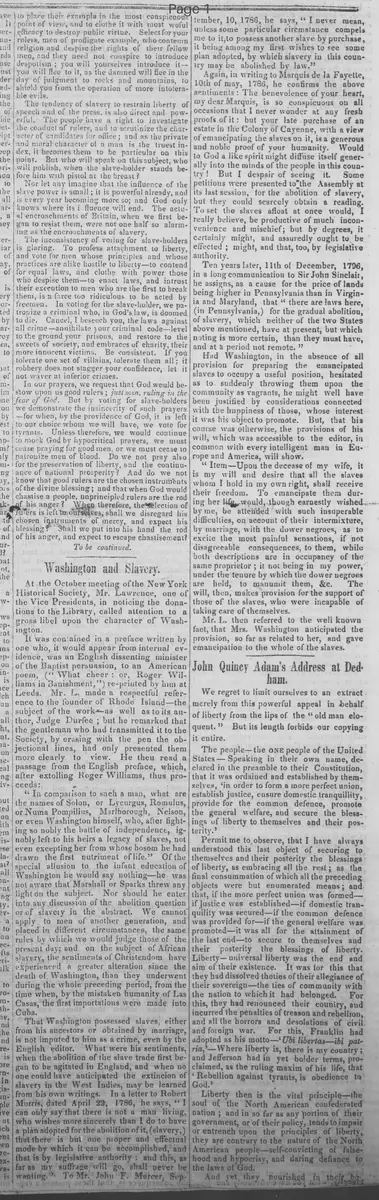
At the October meeting of the New York Historical Society, Mr. Lawrence, one of the Vice Presidents, in noticing the donations to the Library, called attention to a gross libel upon the character of Washington.
It was contained in a preface written by one who, it would appear from internal evidence, was an English dissenting minister of the Baptist persuasion, to an American poem, ("What cheer; or, Roger Williams in Banishment," ) re-printed by him at Leeds. Mr. L. made a respectful reference to the founder of Rhode Island-the subject of the work-as well as to its author, Judge Durfee; but he remarked that the gentleman who had transmitted it to the Society, by erasing with the pen the objectionable lines, had only presented them more clearly to view. He then read a passage from the English preface, which, after extolling Roger Williams, thus proceeds:
"In comparison to such a man, what are the names of Solon, or Lycurgus, Romulus, or Numa Pompilius, Marlborough, Nelson, or even Washington himself, who, after fighting so nobly the battle of independence, ignobly left to his heirs a legacy of slaves, not even excepting her from whose bosom he had drawn the first nutriment of life."
Of the special allusion to the infant education of Washington he would say nothing-he was not aware that Marshall or Sparks threw any light on the subject. Nor should he enter into any discussion of the abolition question or of slavery in the abstract. We cannot apply to men of another generation, and placed in different circumstances, the same rules by which we would judge those of the present day; and on the subject of African slavery, the sentiments of Christendom have experienced a greater alteration since the death of Washington, than they underwent during the whole preceding period, from the time when, by the mistaken humanity of Las Casas, the first importations were made into Cuba.
That Washington possessed slaves, either from his ancestors or obtained by marriage, is not imputed to him as a crime, even by the English editor. What were his sentiments, when the abolition of the slave trade first began to be agitated in England, and when no one could have anticipated the extinction of slavery in the West Indies, may be learned from his own writings. In a letter to Robert Morris, dated April 22, 1786, he says, "I can only say that there is not a man living, who wishes more sincerely than I do to have a plan adopted for the abolition of it, (slavery,) that there is but one proper and effectual mode by which it can be accomplished, and that is by legislative authority: and this, as far as my suffrage will go, shall never be wanting. To Mr. John F. Mercer, September 10, 1786, he says, "I never mean, unless some particular circumstance compels me to it, to possess another slave by purchase, it being among my first wishes to see some plan adopted, by which slavery in this country may be abolished by law."
Again, in writing to Marquis de la Fayette, 10th of April, 1786, he confirms the above sentiments: The benevolence of your heart, my dear Marquis, is so conspicuous on all occasions that I never wonder at any fresh proofs of it: but your late purchase of an estate in the Colony of Cayenne, with a view of emancipating the slaves on it, is a generous and noble proof of your humanity. Would to God a like spirit might diffuse itself generally into the minds of the people in this country! But I despair of seeing it. Some petitions were presented to the Assembly at its last session, for the abolition of slavery, but they could scarcely obtain a reading. To set the slaves afloat at once would, I really believe, be productive of much inconvenience and mischief; but by degrees, it certainly might, and assuredly ought to be effected; might, and that, too, by legislative authority.
Ten years later, 11th of December, 1796, in a long communication to Sir John Sinclair, he assigns, as a cause for the price of lands being higher in Pennsylvania than in Virginia and Maryland, that "there are laws here, (in Pennsylvania,) for the gradual abolition, of slavery, which neither of the two States above mentioned, have at present, but which nothing is more certain, than they must have, and at a period not remote."
Had Washington, in the absence of all provision for preparing the emancipated slaves to occupy a useful position, hesitated as to suddenly throwing them upon the community as vagrants, he might well have been justified by considerations connected with the happiness of those, whose interest it was his object to promote. But, that his course was otherwise, the provisions of his will, which was accessible to the editor, in common with every intelligent man in Europe and America, will show.
"Item--Upon the decease of my wife, it is my will and desire that all the slaves whom I hold in my own right, shall receive their freedom. To emancipate them during her life, would, though earnestly wished, by me, be attended with such insuperable difficulties, on account of their intermixture, by marriage, with the dower negroes, as to excite the most painful sensations, if not disagreeable consequences, to them, while both descriptions are in occupancy of the same proprietor; it not being in my power, under the tenure by which the dower negroes are held, to manumit them, &c. The will, then, makes provision for the support of those of the slaves, who were incapable of taking care of themselves."
Mr. L. then referred to the well known fact, that Mrs. Washington anticipated the provision, so far as related to her, and gave emancipation to the whole of the slaves.
What sub-type of article is it?
What themes does it cover?
What keywords are associated?
What entities or persons were involved?
Where did it happen?
Story Details
Key Persons
Location
New York Historical Society
Event Date
October Meeting
Story Details
Mr. Lawrence addresses a libel in an English preface to a poem about Roger Williams, which criticizes Washington for owning slaves. He defends Washington by quoting letters from 1786 and 1796 expressing wishes for abolition and detailing his will to free slaves after his wife's death, noting Mrs. Washington freed them earlier.