Thank you for visiting SNEWPapers!
Sign up free
Literary
January 8, 1928
Douglas Daily Dispatch
Douglas, Cochise County, Arizona
What is this article about?
Paul Rayburn, a chemist at Grannett Company, keeps his world-startling invention secret after past exploitation. He encounters Eleanor Grannett, who inquires about his covered machine. Company head James G. Grannett suspects Rayburn's work on communicating with stars, deems him crazy, and after publicity ridicule, fires him. Rayburn moves his device amid annoyances.
Clipping
OCR Quality
95%
Excellent
Full Text
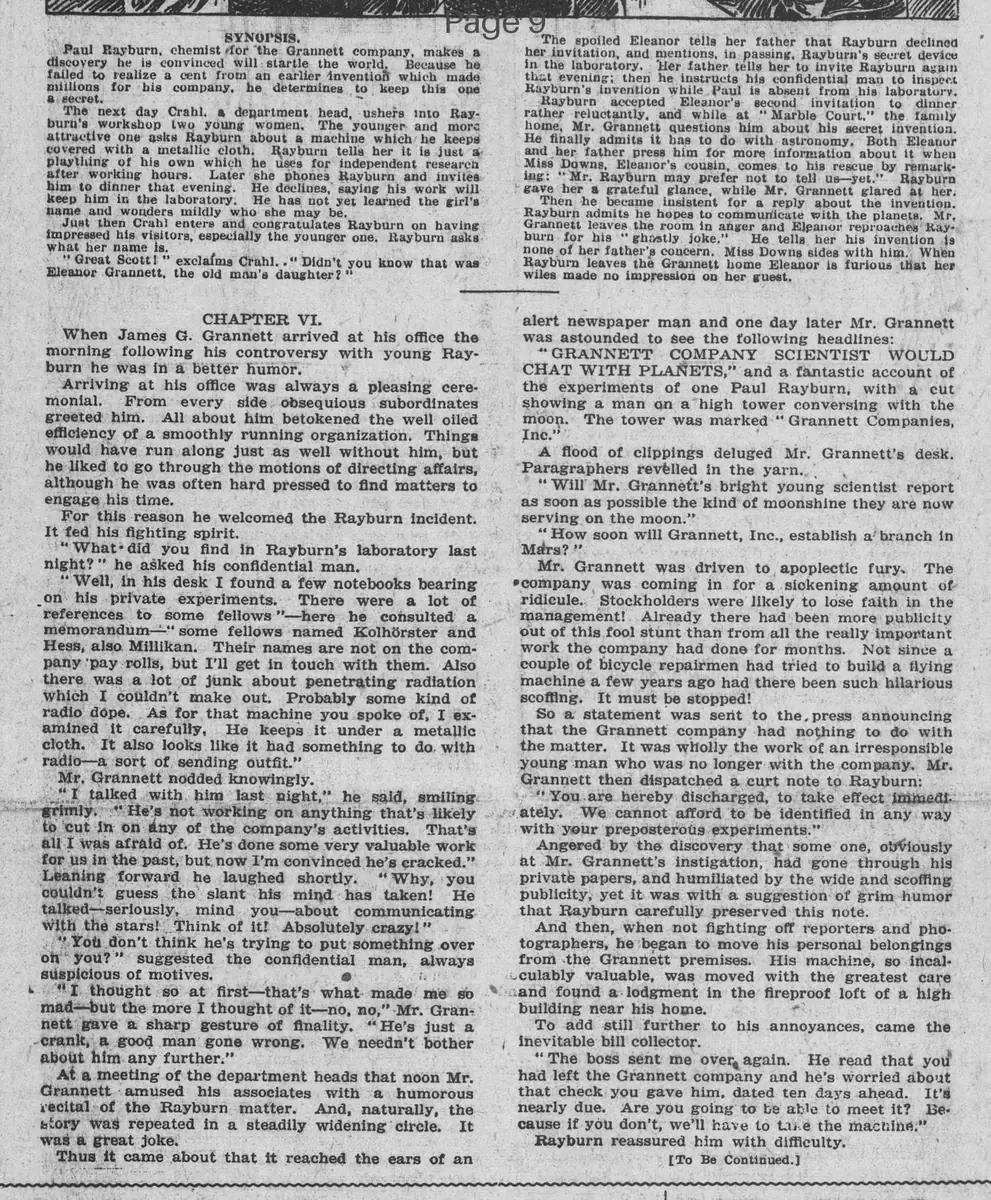
Paul Rayburn, chemist for the Grannett company, makes a discovery he is convinced will startle the world. Because he failed to realize a cent from an earlier invention which made millions for his company, he determines to keep this one a secret.
The next day Crahl, a department head, ushers into Rayburn's workshop two young women. The younger and more attractive one asks Rayburn about a machine which he keeps covered with a metallic cloth. Rayburn tells her it is just a plaything of his own which he uses for independent research after working hours. Later she phones Rayburn and invites him to dinner that evening. He declines, saying his work will keep him in the laboratory. He has not yet learned the girl's name and wonders mildly who she may be.
Just then Crahl enters and congratulates Rayburn on having impressed his visitors, especially the younger one. Rayburn asks what her name is.
Great Scott! exclaims Crahl. Didn't you know that was Eleanor Grannett, the old man's daughter?
CHAPTER VI.
When James G. Grannett arrived at his office the morning following his controversy with young Rayburn he was in a better humor.
Arriving at his office was always a pleasing ceremonial. From every side obsequious subordinates greeted him. All about him betokened the well oiled efficiency of a smoothly running organization. Things would have run along just as well without him, but he liked to go through the motions of directing affairs, although he was often hard pressed to find matters to engage his time.
For this reason he welcomed the Rayburn incident. It fed his fighting spirit.
"What did you find in Rayburn's laboratory last night?" he asked his confidential man.
"Well, in his desk I found a few notebooks bearing on his private experiments. There were a lot of references to some fellows"—here he consulted a memorandum—"some fellows named Kolhörster and Hess, also Millikan. Their names are not on the company pay rolls, but I'll get in touch with them. Also there was a lot of junk about penetrating radiation which I couldn't make out. Probably some kind of radio dope. As for that machine you spoke of, I examined it carefully. He keeps it under a metallic cloth. It also looks like it had something to do with radio—a sort of sending outfit."
Mr. Grannett nodded knowingly.
"I talked with him last night," he said, smiling grimly. "He's not working on anything that's likely to 'cut in' on any of the company's activities. That's all I was afraid of. He's done some very valuable work for us in the past, but now I'm convinced he's cracked."
Leaning forward he laughed shortly. "Why, you couldn't guess the slant his mind has taken! He talked—seriously, mind you—about communicating with the stars! Think of it! Absolutely crazy!"
"You don't think he's trying to put something over on you?" suggested the confidential man, always suspicious of motives.
"I thought so at first—that's what made me so mad—but the more I thought of it—no, no." Mr. Grannett gave a sharp gesture of finality. "He's just a crank, a good man gone wrong. We needn't bother about him any further."
At a meeting of the department heads that noon Mr. Grannett amused his associates with a humorous recital of the Rayburn matter. And, naturally, the story was repeated in a steadily widening circle.
It was a great joke.
The spoiled Eleanor tells her father that Rayburn declined her invitation, and mentions, in passing, Rayburn's secret device in the laboratory. Her father tells her to invite Rayburn again that evening; then he instructs his confidential man to inspect Rayburn's invention while Paul is absent from his laboratory.
Rayburn accepted Eleanor's second invitation to dinner rather reluctantly, and while at "Marble Court," the family home, Mr. Grannett questions him about his secret invention. He finally admits it has to do with astronomy. Both Eleanor and her father press him for more information about it when Miss Downs, Eleanor's cousin, comes to his rescue by remarking: "Mr. Rayburn may prefer not to tell us—yet." Rayburn gave her a grateful glance, while Mr. Grannett glared at her.
Then he became insistent for a reply about the invention. Rayburn admits he hopes to communicate with the planets. Mr. Grannett leaves the room in anger and Eleanor reproaches Rayburn for his "ghastly joke." He tells her his invention is none of her father's concern. Miss Downs sides with him. When Rayburn leaves the Grannett home Eleanor is furious that her wiles made no impression on her guest.
Alert newspaper man and one day later Mr. Grannett was astounded to see the following headlines:
GRANNETT COMPANY SCIENTIST WOULD CHAT WITH PLANETS," and a fantastic account of the experiments of one Paul Rayburn, with a cut showing a man on a high tower conversing with the moon. The tower was marked "Grannett Companies, Inc."
A flood of clippings deluged Mr. Grannett's desk. Paragraphers revelled in the yarn.
"Will Mr. Grannett's bright young scientist report as soon as possible the kind of moonshine they are now serving on the moon."
"How soon will Grannett, Inc., establish a branch in Mars?"
Mr. Grannett was driven to apoplectic fury. The company was coming in for a sickening amount of ridicule. Stockholders were likely to lose faith in the management. Already there had been more publicity out of this fool stunt than from all the really important work the company had done for months. Not since a couple of bicycle repairmen had tried to build a flying machine a few years ago had there been such hilarious scoffing. It must be stopped!
So a statement was sent to the press announcing that the Grannett company had nothing to do with the matter. It was wholly the work of an irresponsible young man who was no longer with the company. Mr. Grannett then dispatched a curt note to Rayburn:
"You are hereby discharged, to take effect immediately. We cannot afford to be identified in any way with your preposterous experiments."
Angered by the discovery that some one, obviously at Mr. Grannett's instigation, had gone through his private papers, and humiliated by the wide and scoffing publicity, yet it was with a suggestion of grim humor that Rayburn carefully preserved this note.
And then, when not fighting off reporters and photographers, he began to move his personal belongings from the Grannett premises. His machine, so incalculably valuable, was moved with the greatest care and found a lodgment in the fireproof loft of a high building near his home.
To add still further to his annoyances, came the inevitable bill collector.
"The boss sent me over again. He read that you had left the Grannett company and he's worried about that check you gave him, dated ten days ahead. It's nearly due. Are you going to be able to meet it? Because if you don't, we'll have to tie the machine."
Rayburn reassured him with difficulty
Thus it came about that it reached the ears of an
The next day Crahl, a department head, ushers into Rayburn's workshop two young women. The younger and more attractive one asks Rayburn about a machine which he keeps covered with a metallic cloth. Rayburn tells her it is just a plaything of his own which he uses for independent research after working hours. Later she phones Rayburn and invites him to dinner that evening. He declines, saying his work will keep him in the laboratory. He has not yet learned the girl's name and wonders mildly who she may be.
Just then Crahl enters and congratulates Rayburn on having impressed his visitors, especially the younger one. Rayburn asks what her name is.
Great Scott! exclaims Crahl. Didn't you know that was Eleanor Grannett, the old man's daughter?
CHAPTER VI.
When James G. Grannett arrived at his office the morning following his controversy with young Rayburn he was in a better humor.
Arriving at his office was always a pleasing ceremonial. From every side obsequious subordinates greeted him. All about him betokened the well oiled efficiency of a smoothly running organization. Things would have run along just as well without him, but he liked to go through the motions of directing affairs, although he was often hard pressed to find matters to engage his time.
For this reason he welcomed the Rayburn incident. It fed his fighting spirit.
"What did you find in Rayburn's laboratory last night?" he asked his confidential man.
"Well, in his desk I found a few notebooks bearing on his private experiments. There were a lot of references to some fellows"—here he consulted a memorandum—"some fellows named Kolhörster and Hess, also Millikan. Their names are not on the company pay rolls, but I'll get in touch with them. Also there was a lot of junk about penetrating radiation which I couldn't make out. Probably some kind of radio dope. As for that machine you spoke of, I examined it carefully. He keeps it under a metallic cloth. It also looks like it had something to do with radio—a sort of sending outfit."
Mr. Grannett nodded knowingly.
"I talked with him last night," he said, smiling grimly. "He's not working on anything that's likely to 'cut in' on any of the company's activities. That's all I was afraid of. He's done some very valuable work for us in the past, but now I'm convinced he's cracked."
Leaning forward he laughed shortly. "Why, you couldn't guess the slant his mind has taken! He talked—seriously, mind you—about communicating with the stars! Think of it! Absolutely crazy!"
"You don't think he's trying to put something over on you?" suggested the confidential man, always suspicious of motives.
"I thought so at first—that's what made me so mad—but the more I thought of it—no, no." Mr. Grannett gave a sharp gesture of finality. "He's just a crank, a good man gone wrong. We needn't bother about him any further."
At a meeting of the department heads that noon Mr. Grannett amused his associates with a humorous recital of the Rayburn matter. And, naturally, the story was repeated in a steadily widening circle.
It was a great joke.
The spoiled Eleanor tells her father that Rayburn declined her invitation, and mentions, in passing, Rayburn's secret device in the laboratory. Her father tells her to invite Rayburn again that evening; then he instructs his confidential man to inspect Rayburn's invention while Paul is absent from his laboratory.
Rayburn accepted Eleanor's second invitation to dinner rather reluctantly, and while at "Marble Court," the family home, Mr. Grannett questions him about his secret invention. He finally admits it has to do with astronomy. Both Eleanor and her father press him for more information about it when Miss Downs, Eleanor's cousin, comes to his rescue by remarking: "Mr. Rayburn may prefer not to tell us—yet." Rayburn gave her a grateful glance, while Mr. Grannett glared at her.
Then he became insistent for a reply about the invention. Rayburn admits he hopes to communicate with the planets. Mr. Grannett leaves the room in anger and Eleanor reproaches Rayburn for his "ghastly joke." He tells her his invention is none of her father's concern. Miss Downs sides with him. When Rayburn leaves the Grannett home Eleanor is furious that her wiles made no impression on her guest.
Alert newspaper man and one day later Mr. Grannett was astounded to see the following headlines:
GRANNETT COMPANY SCIENTIST WOULD CHAT WITH PLANETS," and a fantastic account of the experiments of one Paul Rayburn, with a cut showing a man on a high tower conversing with the moon. The tower was marked "Grannett Companies, Inc."
A flood of clippings deluged Mr. Grannett's desk. Paragraphers revelled in the yarn.
"Will Mr. Grannett's bright young scientist report as soon as possible the kind of moonshine they are now serving on the moon."
"How soon will Grannett, Inc., establish a branch in Mars?"
Mr. Grannett was driven to apoplectic fury. The company was coming in for a sickening amount of ridicule. Stockholders were likely to lose faith in the management. Already there had been more publicity out of this fool stunt than from all the really important work the company had done for months. Not since a couple of bicycle repairmen had tried to build a flying machine a few years ago had there been such hilarious scoffing. It must be stopped!
So a statement was sent to the press announcing that the Grannett company had nothing to do with the matter. It was wholly the work of an irresponsible young man who was no longer with the company. Mr. Grannett then dispatched a curt note to Rayburn:
"You are hereby discharged, to take effect immediately. We cannot afford to be identified in any way with your preposterous experiments."
Angered by the discovery that some one, obviously at Mr. Grannett's instigation, had gone through his private papers, and humiliated by the wide and scoffing publicity, yet it was with a suggestion of grim humor that Rayburn carefully preserved this note.
And then, when not fighting off reporters and photographers, he began to move his personal belongings from the Grannett premises. His machine, so incalculably valuable, was moved with the greatest care and found a lodgment in the fireproof loft of a high building near his home.
To add still further to his annoyances, came the inevitable bill collector.
"The boss sent me over again. He read that you had left the Grannett company and he's worried about that check you gave him, dated ten days ahead. It's nearly due. Are you going to be able to meet it? Because if you don't, we'll have to tie the machine."
Rayburn reassured him with difficulty
Thus it came about that it reached the ears of an
What sub-type of article is it?
Prose Fiction
What themes does it cover?
Commerce Trade
Moral Virtue
What keywords are associated?
Scientific Invention
Corporate Intrigue
Communication With Planets
Public Ridicule
Employee Discharge
Literary Details
Title
Chapter Vi.
Key Lines
"He's Just A Crank, A Good Man Gone Wrong. We Needn't Bother About Him Any Further."
"You Are Hereby Discharged, To Take Effect Immediately. We Cannot Afford To Be Identified In Any Way With Your Preposterous Experiments."
Grannett Company Scientist Would Chat With Planets