Thank you for visiting SNEWPapers!
Sign up free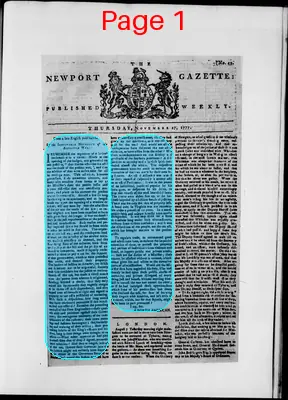
Editorial
November 27, 1777
The Newport Gazette
Newport, Newport County, Rhode Island
What is this article about?
An editorial defending the inevitability of the American War, arguing that colonial rebellion predated the Tea Act, which merely ignited existing unrest. It justifies British taxation as necessary for governance and criticizes colonial leaders for ingratitude and anarchy.
Clipping
OCR Quality
95%
Excellent
Full Text
From a late English publication.
Of the Inevitable Necessity of the American War.
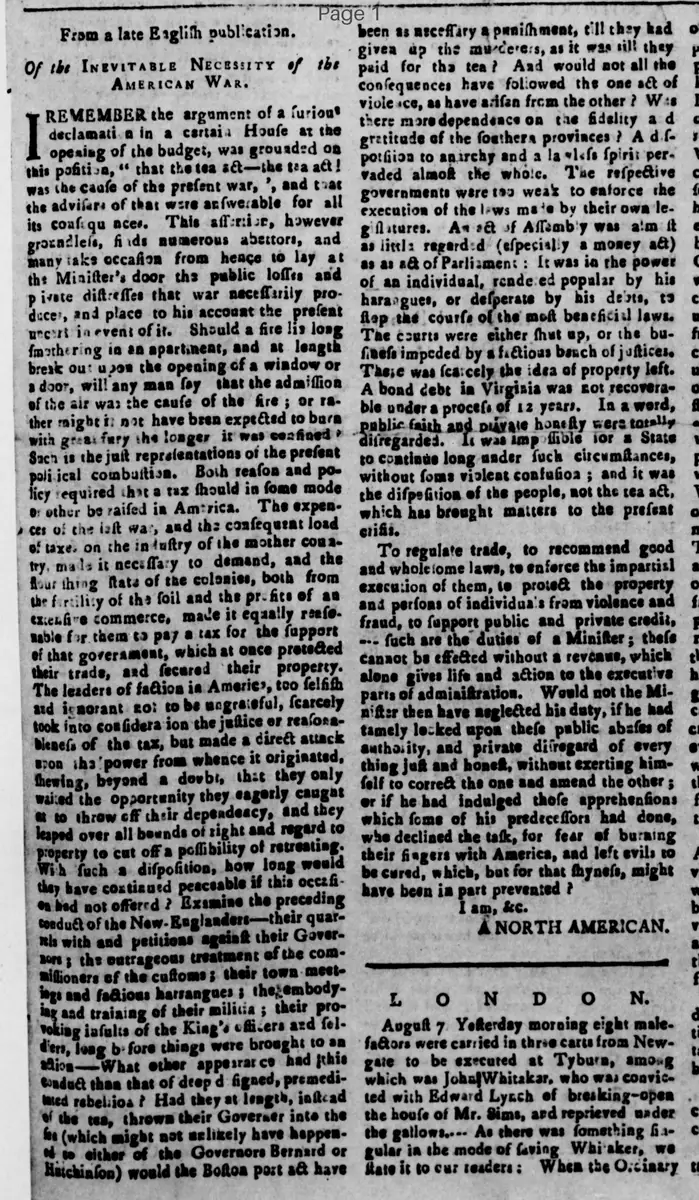
REMEMBER the argument of a furious declamation in a certain House at the opening of the budget, was grounded on this position, "that the tea act! was the cause of the present war," and that the advisers of that were answerable for all its consequences. This assertion, however groundless, finds numerous abettors, and many take occasion from hence to lay at the Minister's door the public losses and private distresses that war necessarily produced, and place to his account the present unfortunate event of it. Should a fire lie long smothering in an apartment, and at length break out upon the opening of a window or a door, will any man say that the admission of the air was the cause of the fire: or rather might it not have been expected to burn with greater fury the longer it was confined? Such is the just representation of the present political combustion. Both reason and policy required that a tax should in some mode or other be raised in America. The expenses of the last war, and the consequent load of taxes on the industry of the mother country, made it necessary to demand, and the flourishing State of the colonies, both from the fertility of the soil and the profits of an extensive commerce, made it equally reasonable for them to pay a tax for the support of that government, which at once protected their trade, and secured their property. The leaders of faction in America, too selfish and ignorant not to be ungrateful, scarcely took into consideration the justice or reasonableness of the tax, but made a direct attack upon that power from whence it originated, showing, beyond a doubt, that they only waited the opportunity they eagerly caught at to throw off their dependency, and they leaped over all bounds of right and regard to property to cut off a possibility of retreating: With such a disposition, how long would they have continued peaceable if this occasion had not offered? Examine the preceding conduct of the New Englanders---their quarrels with and petitions against their Governor; the outrageous treatment of the commissioners of the customs; their town meetings and factious harangues; the embodying and training of their militia; their provoking insults of the King's officers and soldiers, long before things were brought to an issue---What other appearance had this conduct than that of deep designed, premeditated rebellion? Had they at length, instead of the tea, thrown their Governor into the harbor (which might not unlikely have happened to either of the Governors Bernard or Hutchinson) would the Boston port act have been as necessary a punishment, till they had given up the murderers, as it was still they paid for the tea? And would not all the consequences have followed the one act of violence, as have arisen from the other? Was there more dependence on the fidelity and gratitude of the southern provinces? A disposition to anarchy and a lawless spirit pervaded almost the whole. The respective governments were too weak to enforce the execution of the laws made by their own legislatures. An act of Assembly was almost as little regarded (especially a money act) as an act of Parliament: It was in the power of an individual, rendered popular by his harangues, or desperate by his deeds, to stop the course of the most beneficial laws. The courts were either shut up, or the business impeded by a factious bench of justices. There was scarcely the idea of property left. A bond debt in Virginia was not recoverable under a process of 12 years. In a word, public faith and private honesty were totally disregarded. It was impossible for a State to continue long under such circumstances, without some violent confusion; and it was the disposition of the people, not the tea act, which has brought matters to the present crisis. To regulate trade, to recommend good and wholesome laws, to enforce the impartial execution of them, to protect the property and persons of individuals from violence and fraud, to support public and private credit, --- such are the duties of a Minister: these cannot be effected without a revenue, which alone gives life and action to the executive parts of administration. Would not the Minister then have neglected his duty, if he had tamely looked upon these public abuses of authority, and private disregard of every thing just and honest, without exerting himself to correct the one and amend the other; or if he had indulged those apprehensions which some of his predecessors had done, who declined the task, for fear of burning their fingers with America, and left evils to be cured, which, but for that timidity, might have been in part prevented?
I am, &c.
A NORTH AMERICAN.
Of the Inevitable Necessity of the American War.
REMEMBER the argument of a furious declamation in a certain House at the opening of the budget, was grounded on this position, "that the tea act! was the cause of the present war," and that the advisers of that were answerable for all its consequences. This assertion, however groundless, finds numerous abettors, and many take occasion from hence to lay at the Minister's door the public losses and private distresses that war necessarily produced, and place to his account the present unfortunate event of it. Should a fire lie long smothering in an apartment, and at length break out upon the opening of a window or a door, will any man say that the admission of the air was the cause of the fire: or rather might it not have been expected to burn with greater fury the longer it was confined? Such is the just representation of the present political combustion. Both reason and policy required that a tax should in some mode or other be raised in America. The expenses of the last war, and the consequent load of taxes on the industry of the mother country, made it necessary to demand, and the flourishing State of the colonies, both from the fertility of the soil and the profits of an extensive commerce, made it equally reasonable for them to pay a tax for the support of that government, which at once protected their trade, and secured their property. The leaders of faction in America, too selfish and ignorant not to be ungrateful, scarcely took into consideration the justice or reasonableness of the tax, but made a direct attack upon that power from whence it originated, showing, beyond a doubt, that they only waited the opportunity they eagerly caught at to throw off their dependency, and they leaped over all bounds of right and regard to property to cut off a possibility of retreating: With such a disposition, how long would they have continued peaceable if this occasion had not offered? Examine the preceding conduct of the New Englanders---their quarrels with and petitions against their Governor; the outrageous treatment of the commissioners of the customs; their town meetings and factious harangues; the embodying and training of their militia; their provoking insults of the King's officers and soldiers, long before things were brought to an issue---What other appearance had this conduct than that of deep designed, premeditated rebellion? Had they at length, instead of the tea, thrown their Governor into the harbor (which might not unlikely have happened to either of the Governors Bernard or Hutchinson) would the Boston port act have been as necessary a punishment, till they had given up the murderers, as it was still they paid for the tea? And would not all the consequences have followed the one act of violence, as have arisen from the other? Was there more dependence on the fidelity and gratitude of the southern provinces? A disposition to anarchy and a lawless spirit pervaded almost the whole. The respective governments were too weak to enforce the execution of the laws made by their own legislatures. An act of Assembly was almost as little regarded (especially a money act) as an act of Parliament: It was in the power of an individual, rendered popular by his harangues, or desperate by his deeds, to stop the course of the most beneficial laws. The courts were either shut up, or the business impeded by a factious bench of justices. There was scarcely the idea of property left. A bond debt in Virginia was not recoverable under a process of 12 years. In a word, public faith and private honesty were totally disregarded. It was impossible for a State to continue long under such circumstances, without some violent confusion; and it was the disposition of the people, not the tea act, which has brought matters to the present crisis. To regulate trade, to recommend good and wholesome laws, to enforce the impartial execution of them, to protect the property and persons of individuals from violence and fraud, to support public and private credit, --- such are the duties of a Minister: these cannot be effected without a revenue, which alone gives life and action to the executive parts of administration. Would not the Minister then have neglected his duty, if he had tamely looked upon these public abuses of authority, and private disregard of every thing just and honest, without exerting himself to correct the one and amend the other; or if he had indulged those apprehensions which some of his predecessors had done, who declined the task, for fear of burning their fingers with America, and left evils to be cured, which, but for that timidity, might have been in part prevented?
I am, &c.
A NORTH AMERICAN.
What sub-type of article is it?
War Or Peace
Economic Policy
Constitutional
What keywords are associated?
American War
Tea Act
Colonial Rebellion
British Taxation
Minister Duty
New England Conduct
Boston Port Act
What entities or persons were involved?
Minister
Parliament
New Englanders
Governors Bernard And Hutchinson
Commissioners Of The Customs
Southern Provinces
Editorial Details
Primary Topic
Inevitable Necessity Of The American War Due To Colonial Rebellion
Stance / Tone
Defending British Policy And Minister Against Blame For War
Key Figures
Minister
Parliament
New Englanders
Governors Bernard And Hutchinson
Commissioners Of The Customs
Southern Provinces
Key Arguments
Tea Act Was Not The Cause But A Spark For Pre Existing Colonial Rebellion
Taxation On Colonies Was Necessary Due To War Expenses And Their Prosperity
Colonial Leaders Were Ungrateful And Aimed To Throw Off Dependency
Preceding Conduct Showed Premeditated Rebellion In New England
Anarchy And Disregard For Law Pervaded Colonies, Making Crisis Inevitable
Minister's Duty Required Action To Enforce Laws And Raise Revenue