Thank you for visiting SNEWPapers!
Sign up free
Letter to Editor
October 30, 1877
Daily Kennebec Journal
Augusta, Kennebec County, Maine
What is this article about?
Washington correspondence to Kennebec Journal editor details Congress's minimal work due to Baltimore races and focus on Louisiana Senatorship dispute between Kellogg and Spofford, highlighting arguments on election fraud and violence by the White League, and anticipates a continued session with intense lobbying.
Clipping
OCR Quality
98%
Excellent
Full Text
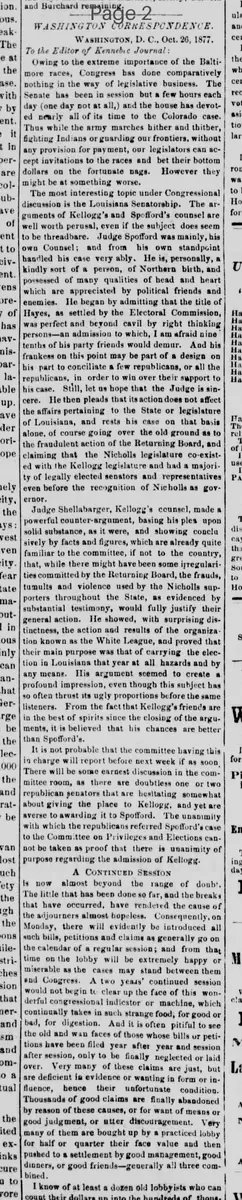
WASHINGTON CORRESPONDENCE.
WASHINGTON, D. C., Oct. 26, 1877.
To the Editor of Kennebec Journal:
Owing to the extreme importance of the Baltimore races, Congress has done comparatively nothing in the way of legislative business. The Senate has been in session but a few hours each day (one day not at all,) and the house has devoted nearly all of its time to the Colorado case. Thus while the army marches hither and thither, fighting Indians or guarding our frontiers, without any provision for payment, our legislators can accept invitations to the races and bet their bottom dollars on the fortunate nags. However they might be at something worse.
The most interesting topic under Congressional discussion is the Louisiana Senatorship. The arguments of Kellogg's and Spofford's counsel are well worth perusal, even if the subject does seem to be threadbare. Judge Spofford was mainly, his own Counsel; and from his own standpoint handled his case very ably. He is, personally, a kindly sort of a person, of Northern birth, and possessed of many qualities of head and heart which are appreciated by political friends and enemies. He began by admitting that the title of Hayes, as settled by the Electoral Commission, was perfect and beyond cavil by right thinking persons-an admission to which, I am afraid nine tenths of his party friends would demur. And his frankness on this point may be part of a design on his part to conciliate a few republicans, or all the republicans, in order to win over their support to his case. Still, let us hope that the Judge is sincere. He then pleads that its action does not affect the affairs pertaining to the State or legislature of Louisiana, and rests his case on that basis alone, of course going over the old ground as to the fraudulent action of the Returning Board, and claiming that the Nicholls legislature co-existed with the Kellogg legislature and had a majority of legally elected senators and representatives even before the recognition of Nicholls as governor.
Judge Shellabarger, Kellogg's counsel, made a powerful counter-argument, basing his plea upon solid substance, as it were, and showing conclusively by facts and figures, which are already quite familiar to the committee, if not to the country, that, while there might have been some irregularities committed by the Returning Board, the frauds, tumults and violence used by the Nicholls supporters throughout the State, as evidenced by substantial testimony, would fully justify their general action. He showed, with surprising distinctness, the action and results of the organization known as the White League, and proved that their main purpose was that of carrying the election in Louisiana that year at all hazards and by any means. His argument seemed to create a profound impression, even though this subject has so often thrust its ugly proportions before the same listeners. From the fact that Kellogg's friends are in the best of spirits since the closing of the arguments, it is believed that his chances are better than Spofford's.
It is not probable that the committee having this in charge will report before next week if as soon. There will be some earnest discussion in the committee room, as there are doubtless one or two republican senators that are hesitating somewhat about giving the place to Kellogg, and yet are averse to awarding it to Spofford. The unanimity with which the republicans referred Spofford's case to the Committee on Privileges and Elections cannot be taken as proof that there is unanimity of purpose regarding the admission of Kellogg.
A CONTINUED SESSION is now almost beyond the range of doubt. The little that has been done so far, and the breaks that have occurred, have rendered the cause of the adjourners almost hopeless. Consequently, on Monday, there will evidently be introduced all such bills, petitions and claims as generally go on the calendar of a regular session; and from that time on the lobby will be extremely happy or miserable as the cases may stand between them and Congress. A two years' continued session would not begin to clear up the face of this wonderful congressional indicator or machine, which continually takes in such strange food, for good or bad, for digestion. And it is often pitiful to see the old and wan faces of those whose bills or petitions have been filed year after year and session after session, only to be finally neglected or laid over. Very many of these claims are just, but are deficient in evidence or wanting in form or influence, hence their unfortunate condition. Thousands of good claims are finally abandoned by reason of these causes, or for want of means or good judgment, or utter discouragement. Very many of them are bought up by a practiced lobby for half or quarter their face value and then pushed to a settlement by good management, good dinners, or good friends-generally all three combined.
I know of at least a dozen old lobbyists who can count their dollars up into the hundreds of thousands; and yet lobbying generally is a precarious method of getting a living, to say nothing of the bad reputation which the business generally gives one.
WASHINGTON, D. C., Oct. 26, 1877.
To the Editor of Kennebec Journal:
Owing to the extreme importance of the Baltimore races, Congress has done comparatively nothing in the way of legislative business. The Senate has been in session but a few hours each day (one day not at all,) and the house has devoted nearly all of its time to the Colorado case. Thus while the army marches hither and thither, fighting Indians or guarding our frontiers, without any provision for payment, our legislators can accept invitations to the races and bet their bottom dollars on the fortunate nags. However they might be at something worse.
The most interesting topic under Congressional discussion is the Louisiana Senatorship. The arguments of Kellogg's and Spofford's counsel are well worth perusal, even if the subject does seem to be threadbare. Judge Spofford was mainly, his own Counsel; and from his own standpoint handled his case very ably. He is, personally, a kindly sort of a person, of Northern birth, and possessed of many qualities of head and heart which are appreciated by political friends and enemies. He began by admitting that the title of Hayes, as settled by the Electoral Commission, was perfect and beyond cavil by right thinking persons-an admission to which, I am afraid nine tenths of his party friends would demur. And his frankness on this point may be part of a design on his part to conciliate a few republicans, or all the republicans, in order to win over their support to his case. Still, let us hope that the Judge is sincere. He then pleads that its action does not affect the affairs pertaining to the State or legislature of Louisiana, and rests his case on that basis alone, of course going over the old ground as to the fraudulent action of the Returning Board, and claiming that the Nicholls legislature co-existed with the Kellogg legislature and had a majority of legally elected senators and representatives even before the recognition of Nicholls as governor.
Judge Shellabarger, Kellogg's counsel, made a powerful counter-argument, basing his plea upon solid substance, as it were, and showing conclusively by facts and figures, which are already quite familiar to the committee, if not to the country, that, while there might have been some irregularities committed by the Returning Board, the frauds, tumults and violence used by the Nicholls supporters throughout the State, as evidenced by substantial testimony, would fully justify their general action. He showed, with surprising distinctness, the action and results of the organization known as the White League, and proved that their main purpose was that of carrying the election in Louisiana that year at all hazards and by any means. His argument seemed to create a profound impression, even though this subject has so often thrust its ugly proportions before the same listeners. From the fact that Kellogg's friends are in the best of spirits since the closing of the arguments, it is believed that his chances are better than Spofford's.
It is not probable that the committee having this in charge will report before next week if as soon. There will be some earnest discussion in the committee room, as there are doubtless one or two republican senators that are hesitating somewhat about giving the place to Kellogg, and yet are averse to awarding it to Spofford. The unanimity with which the republicans referred Spofford's case to the Committee on Privileges and Elections cannot be taken as proof that there is unanimity of purpose regarding the admission of Kellogg.
A CONTINUED SESSION is now almost beyond the range of doubt. The little that has been done so far, and the breaks that have occurred, have rendered the cause of the adjourners almost hopeless. Consequently, on Monday, there will evidently be introduced all such bills, petitions and claims as generally go on the calendar of a regular session; and from that time on the lobby will be extremely happy or miserable as the cases may stand between them and Congress. A two years' continued session would not begin to clear up the face of this wonderful congressional indicator or machine, which continually takes in such strange food, for good or bad, for digestion. And it is often pitiful to see the old and wan faces of those whose bills or petitions have been filed year after year and session after session, only to be finally neglected or laid over. Very many of these claims are just, but are deficient in evidence or wanting in form or influence, hence their unfortunate condition. Thousands of good claims are finally abandoned by reason of these causes, or for want of means or good judgment, or utter discouragement. Very many of them are bought up by a practiced lobby for half or quarter their face value and then pushed to a settlement by good management, good dinners, or good friends-generally all three combined.
I know of at least a dozen old lobbyists who can count their dollars up into the hundreds of thousands; and yet lobbying generally is a precarious method of getting a living, to say nothing of the bad reputation which the business generally gives one.
What sub-type of article is it?
Informative
Political
What themes does it cover?
Politics
What keywords are associated?
Louisiana Senatorship
Kellogg
Spofford
Congressional Session
Lobbying
Baltimore Races
White League
Returning Board
What entities or persons were involved?
To The Editor Of Kennebec Journal
Letter to Editor Details
Recipient
To The Editor Of Kennebec Journal
Main Argument
reports on congressional discussions regarding the louisiana senatorship dispute between kellogg and spofford, limited legislative progress due to distractions like the baltimore races, and the near certainty of a continued session amid lobbying pressures.
Notable Details
Arguments By Judge Spofford And Judge Shellabarger On The Validity Of Legislatures In Louisiana
References To The White League's Role In Election Violence
Admission Of Hayes's Title As Perfect
Fraudulent Actions Of The Returning Board