Thank you for visiting SNEWPapers!
Sign up free
Editorial
August 11, 1868
The New York Herald
New York, New York County, New York
What is this article about?
Chief Justice Chase emphasizes the Fourteenth Amendment's protection of public debt in a grand jury charge, rebuking repudiation. The editorial warns of revolutionary threats and political chaos from the 1868 presidential election, where Grant or Seymour may prevail, endangering constitutional guarantees amid factional strife.
Clipping
OCR Quality
95%
Excellent
Full Text
The Fourteenth Amendment and the Revolution.
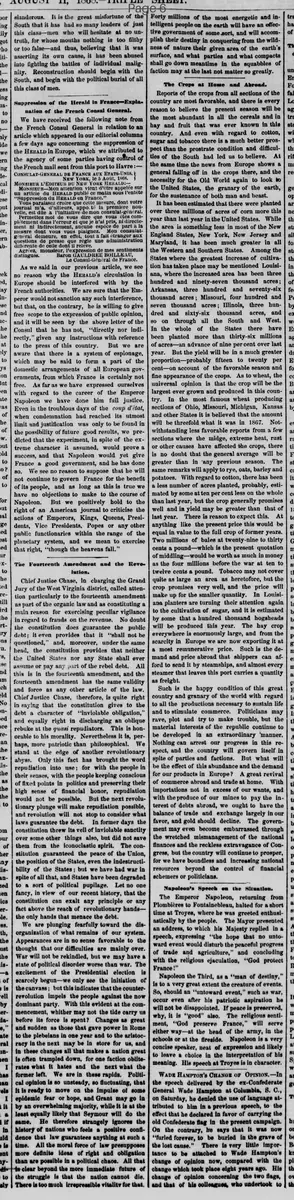
Chief Justice Chase, in charging the Grand Jury of the West Virginia district, called attention particularly to the fourteenth amendment as part of the organic law and as constituting a main reason for exercising peculiar vigilance in regard to frauds on the revenue. No doubt the constitution does guarantee the public debt; it even provides that it shall not be "questioned," and, moreover, under the same head, the constitution provides that neither the United States nor any State shall ever assume or pay any part of the rebel debt. All this is in the fourteenth amendment, and the fourteenth amendment has the same validity and force as any other article of the law. Chief Justice Chase, therefore, is quite right in saying that the constitution gives to the debt a character of "inviolable obligation," and equally right in discharging an oblique rebuke at the quasi repudiators. This is honorable to his morality. Nevertheless it is, perhaps, more patriotic than philosophical.
We stand at the edge of another revolutionary abyss. Only this fact has brought the word repudiation into use; for with the people in their senses, with the people keeping conscious of fixed points in politics and preserving their high sense of financial honor, repudiation would not be possible. But the next revolutionary plunge will make repudiation possible, and revolution will not stop to consider what laws guarantee the debt. In former days the constitution threw its veil of inviolable sanctity over some other things also, but did not save them from the iconoclastic spirit. The constitution guaranteed the peace of the Union, the position of the States, even the indestructibility of the States; but we have had war in spite of all that, and States have been degraded to a sort of political pupilage. Let no one fancy, in view of our recent history, that the constitution can exalt any principle or any fact above the reach of revolutionary hands—the only hands that menace the debt.
We are plunging fearfully toward the disorganization of what remains of our system. Appearances are in no sense favorable to the thought that our difficulties are mainly over. War will not be rekindled, but we may have a state of political disorder worse than war. The excitement of the Presidential election is scarcely begun—we only see the initiation of the canvass; but this indicates that the counter-revolution impels the people against the now dominant party. With this evident at the commencement, whither may not the tide carry us before its force is spent? Changes as great and sudden as those that gave power in Rome to the plebeians in one year and to the aristocracy in the next may be in store for us, and in these changes all that makes a nation great is often trampled down, for one faction obliterates what it hates and the next what the former left. We are in these rapids. Political opinion is so unsteady, so fluctuating, that it is ready to move on the impulse of some epidemic fear or hope, and Grant may go in by an overwhelming majority, while it is at the least equally likely that Seymour will do the same. He therefore strangely ignores the history of nations who feels a positive confidence that law guarantees anything at such a time. All the moral force of law presupposes more definite ideas of right and obligation than are possible in a political chaos. All that is clear beyond the more immediate future of the struggle is that the nation cannot die. There is too much irrepressible vitality for that. Forty millions of the most energetic and intelligent people on the earth will have an effective government of some sort, and will accomplish their destiny in conquering from the wilderness of nature their given area of the earth's surface, and what parties and what compacts shall go down meantime in the squabbles of faction may at the last not matter so greatly.
Chief Justice Chase, in charging the Grand Jury of the West Virginia district, called attention particularly to the fourteenth amendment as part of the organic law and as constituting a main reason for exercising peculiar vigilance in regard to frauds on the revenue. No doubt the constitution does guarantee the public debt; it even provides that it shall not be "questioned," and, moreover, under the same head, the constitution provides that neither the United States nor any State shall ever assume or pay any part of the rebel debt. All this is in the fourteenth amendment, and the fourteenth amendment has the same validity and force as any other article of the law. Chief Justice Chase, therefore, is quite right in saying that the constitution gives to the debt a character of "inviolable obligation," and equally right in discharging an oblique rebuke at the quasi repudiators. This is honorable to his morality. Nevertheless it is, perhaps, more patriotic than philosophical.
We stand at the edge of another revolutionary abyss. Only this fact has brought the word repudiation into use; for with the people in their senses, with the people keeping conscious of fixed points in politics and preserving their high sense of financial honor, repudiation would not be possible. But the next revolutionary plunge will make repudiation possible, and revolution will not stop to consider what laws guarantee the debt. In former days the constitution threw its veil of inviolable sanctity over some other things also, but did not save them from the iconoclastic spirit. The constitution guaranteed the peace of the Union, the position of the States, even the indestructibility of the States; but we have had war in spite of all that, and States have been degraded to a sort of political pupilage. Let no one fancy, in view of our recent history, that the constitution can exalt any principle or any fact above the reach of revolutionary hands—the only hands that menace the debt.
We are plunging fearfully toward the disorganization of what remains of our system. Appearances are in no sense favorable to the thought that our difficulties are mainly over. War will not be rekindled, but we may have a state of political disorder worse than war. The excitement of the Presidential election is scarcely begun—we only see the initiation of the canvass; but this indicates that the counter-revolution impels the people against the now dominant party. With this evident at the commencement, whither may not the tide carry us before its force is spent? Changes as great and sudden as those that gave power in Rome to the plebeians in one year and to the aristocracy in the next may be in store for us, and in these changes all that makes a nation great is often trampled down, for one faction obliterates what it hates and the next what the former left. We are in these rapids. Political opinion is so unsteady, so fluctuating, that it is ready to move on the impulse of some epidemic fear or hope, and Grant may go in by an overwhelming majority, while it is at the least equally likely that Seymour will do the same. He therefore strangely ignores the history of nations who feels a positive confidence that law guarantees anything at such a time. All the moral force of law presupposes more definite ideas of right and obligation than are possible in a political chaos. All that is clear beyond the more immediate future of the struggle is that the nation cannot die. There is too much irrepressible vitality for that. Forty millions of the most energetic and intelligent people on the earth will have an effective government of some sort, and will accomplish their destiny in conquering from the wilderness of nature their given area of the earth's surface, and what parties and what compacts shall go down meantime in the squabbles of faction may at the last not matter so greatly.
What sub-type of article is it?
Constitutional
Economic Policy
Partisan Politics
What keywords are associated?
Fourteenth Amendment
Public Debt
Repudiation
Revolution
Political Disorder
Presidential Election
Grant
Seymour
What entities or persons were involved?
Chief Justice Chase
Fourteenth Amendment
Grant
Seymour
Editorial Details
Primary Topic
Sanctity Of Public Debt Under Fourteenth Amendment Amid Threats Of Revolution And Political Disorder
Stance / Tone
Cautionary And Patriotic Warning Against Repudiation And Instability
Key Figures
Chief Justice Chase
Fourteenth Amendment
Grant
Seymour
Key Arguments
The Fourteenth Amendment Guarantees The Public Debt And Prohibits Assuming Rebel Debt, Making It Inviolable
Chief Justice Chase Rightly Rebukes Quasi Repudiators For Moral Reasons
Revolutionary Forces Threaten Constitutional Guarantees, As Seen In Past Disruptions Like War And State Degradation
The Nation Faces Potential Political Disorder Worse Than War Due To The Ongoing Presidential Election And Counter Revolution
Political Opinion Is Unsteady, Allowing Sudden Shifts That Could Endanger The Debt And National Stability
The Nation's Vitality Ensures Survival, But Factional Squabbles May Destroy Much In The Meantime