Thank you for visiting SNEWPapers!
Sign up free
Editorial
October 16, 1917
Ottumwa Semi Weekly Courier
Ottumwa, Wapello County, Iowa
What is this article about?
Editorial argues the Hindenburg Line's strength crumbles due to its human nature and declining German morale, influenced by a U.S. message on tyranny. Allies, led by Haig, gain from just cause, proving right prevails over might in WWI.
Clipping
OCR Quality
95%
Excellent
Full Text
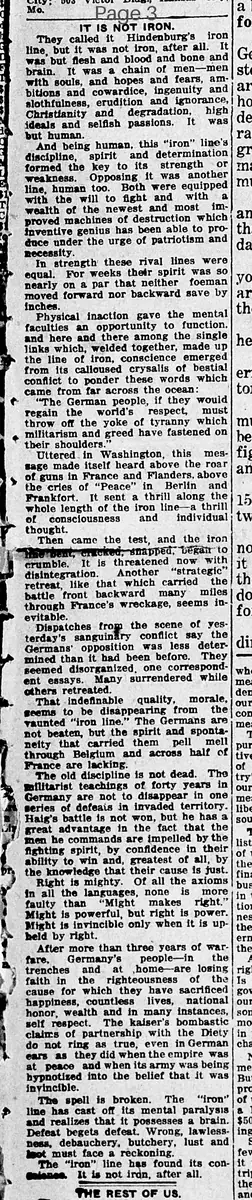
It is not iron.
They called it Hindenburg's iron line, but it was not iron, after all. It was but flesh and blood and bone and brain. It was a chain of men—men with souls, and hopes and fears, ambitions and cowardice, ingenuity and slothfulness, erudition and ignorance, Christianity and degradation, high ideals and selfish passions.
It was but human.
And being human, this "iron" line's discipline, spirit and determination formed the key to its strength or weakness. Opposing it was another line, human too. Both were equipped with the will to fight and with a proved machines of destruction which wealth of the newest and most inventive genius has been able to produce under the urge of patriotism and necessity.
In strength these rival lines were equal. For weeks their spirit was so nearly on a par that neither foeman moved forward nor backward save by inches.
Physical inaction gave the mental faculties an opportunity to function, and here and there among the single links which, welded together, made up the line of iron, conscience emerged from its calloused chrysalis of bestial conflict to ponder these words which came from far across the ocean:
"The German people, if they would regain the world's respect, must throw off the yoke of tyranny which militarism and greed have fastened on their shoulders."
Uttered in Washington, this message made itself heard above the roar of guns in France and Flanders, above the cries of "Peace" in Berlin and Frankfort. It sent a thrill along the whole length of the iron line—a thrill of consciousness and individual thought.
Then came the test, and the iron chain, cracked, snapped, began to crumble. It is threatened now with retreat, like that which carried the disintegration. Another "strategic" battle front backward many miles through France's wreckage, seems inevitable.
Dispatches from the scene of yesterday's sanguinary conflict say the Germans' opposition was less determined than it had been before. They seemed disorganized, one correspondent essays. Many surrendered while others retreated.
That indefinable quality, morale, seems to be disappearing from the vaunted "iron line." The Germans are not beaten, but the spirit and spontaneity that carried them pell mell through Belgium and across half of France are lacking.
The old discipline is not dead. The militarist teachings of forty years in Germany are not to disappear in one series of defeats in invaded territory.
Haig's battle is not won, but he has a great advantage in the fact that the men he commands are impelled by the fighting spirit, by confidence in their ability to win and, greatest of all, by the knowledge that their cause is just.
Right is mighty. Of all the axioms in all the languages, none is more faulty than "Might makes right."
Might is powerful, but right is power. Might is invincible only when it is upheld by right.
After more than three years of warfare, Germany's people—in the trenches and at home—are losing faith in the righteousness of the cause for which they have sacrificed happiness, countless lives, national honor, wealth and in many instances, self respect. The kaiser's bombastic claims of partnership with the Deity do not ring as true, even in German ears as they did when the empire was at peace and when its army was being hypnotized into the belief that it was invincible.
The spell is broken. The "iron" line has cast off its mental paralysis and realizes that it possesses a brain.
Defeat begets defeat. Wrong, lawlessness, debauchery, butchery, lust and rot must face a reckoning.
The "iron" line has found its con—
It is not iron, after all.
They called it Hindenburg's iron line, but it was not iron, after all. It was but flesh and blood and bone and brain. It was a chain of men—men with souls, and hopes and fears, ambitions and cowardice, ingenuity and slothfulness, erudition and ignorance, Christianity and degradation, high ideals and selfish passions.
It was but human.
And being human, this "iron" line's discipline, spirit and determination formed the key to its strength or weakness. Opposing it was another line, human too. Both were equipped with the will to fight and with a proved machines of destruction which wealth of the newest and most inventive genius has been able to produce under the urge of patriotism and necessity.
In strength these rival lines were equal. For weeks their spirit was so nearly on a par that neither foeman moved forward nor backward save by inches.
Physical inaction gave the mental faculties an opportunity to function, and here and there among the single links which, welded together, made up the line of iron, conscience emerged from its calloused chrysalis of bestial conflict to ponder these words which came from far across the ocean:
"The German people, if they would regain the world's respect, must throw off the yoke of tyranny which militarism and greed have fastened on their shoulders."
Uttered in Washington, this message made itself heard above the roar of guns in France and Flanders, above the cries of "Peace" in Berlin and Frankfort. It sent a thrill along the whole length of the iron line—a thrill of consciousness and individual thought.
Then came the test, and the iron chain, cracked, snapped, began to crumble. It is threatened now with retreat, like that which carried the disintegration. Another "strategic" battle front backward many miles through France's wreckage, seems inevitable.
Dispatches from the scene of yesterday's sanguinary conflict say the Germans' opposition was less determined than it had been before. They seemed disorganized, one correspondent essays. Many surrendered while others retreated.
That indefinable quality, morale, seems to be disappearing from the vaunted "iron line." The Germans are not beaten, but the spirit and spontaneity that carried them pell mell through Belgium and across half of France are lacking.
The old discipline is not dead. The militarist teachings of forty years in Germany are not to disappear in one series of defeats in invaded territory.
Haig's battle is not won, but he has a great advantage in the fact that the men he commands are impelled by the fighting spirit, by confidence in their ability to win and, greatest of all, by the knowledge that their cause is just.
Right is mighty. Of all the axioms in all the languages, none is more faulty than "Might makes right."
Might is powerful, but right is power. Might is invincible only when it is upheld by right.
After more than three years of warfare, Germany's people—in the trenches and at home—are losing faith in the righteousness of the cause for which they have sacrificed happiness, countless lives, national honor, wealth and in many instances, self respect. The kaiser's bombastic claims of partnership with the Deity do not ring as true, even in German ears as they did when the empire was at peace and when its army was being hypnotized into the belief that it was invincible.
The spell is broken. The "iron" line has cast off its mental paralysis and realizes that it possesses a brain.
Defeat begets defeat. Wrong, lawlessness, debauchery, butchery, lust and rot must face a reckoning.
The "iron" line has found its con—
It is not iron, after all.
What sub-type of article is it?
War Or Peace
Moral Or Religious
Military Affairs
What keywords are associated?
Hindenburg Line
German Morale
World War I
Justice In War
Military Discipline
Allied Advantage
Kaiser Claims
Tyranny Yoke
What entities or persons were involved?
Hindenburg
Haig
Germans
Kaiser
Washington
Editorial Details
Primary Topic
Decline Of The Hindenburg Line Due To Human Morale And Justice
Stance / Tone
Supportive Of Allied Cause Emphasizing Righteousness Over Militarism
Key Figures
Hindenburg
Haig
Germans
Kaiser
Washington
Key Arguments
The Hindenburg Line Is Human, Not Iron, Composed Of Men With Souls And Flaws
Discipline And Spirit Determine The Line's Strength
A Message From Washington Urging Germans To Throw Off Tyranny Affects Morale
German Opposition Is Less Determined, With Disorganization And Surrenders
Allied Troops Are Motivated By Justice And Confidence
Right Is Might; Might Alone Is Not Invincible
Germans Are Losing Faith In Their Cause After Years Of War
The Spell Of Invincibility Is Broken; Defeat Begets Defeat