Thank you for visiting SNEWPapers!
Sign up free
Fowle's New Hampshire Gazette And General Advertiser
Portsmouth, Rockingham County, New Hampshire
What is this article about?
The officers express surprise at a notice excluding strangers from the assembly dance, attribute it to a few individuals, and intend to attend the next event despite the rules to show politeness.
Merged-components note: These components form a single public exchange of letters: the French officers' complaint and the scholars' reply, split across pages but continuous in topic and flow.
Clippings
1 of 2
OCR Quality
Full Text
This is Event 1 of 2. The full text below covers all events in this component.
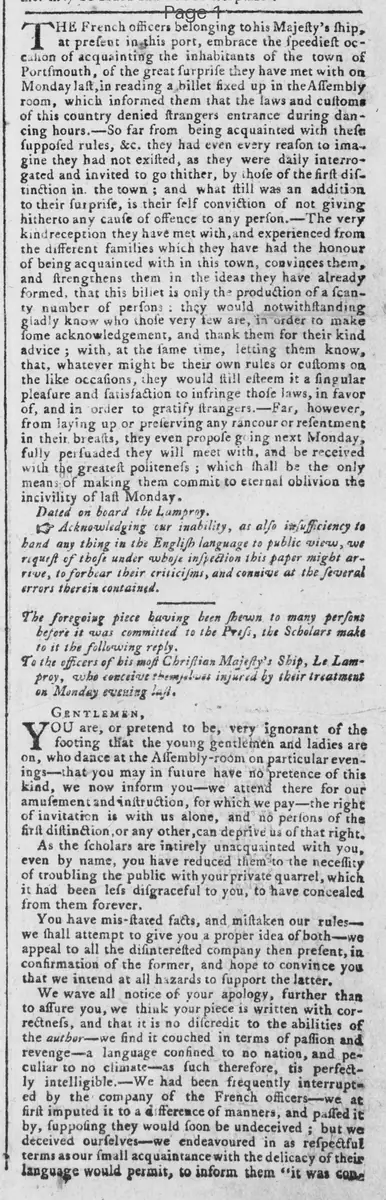
Dated on board the Lamproie.
Acknowledging our inability, as also insufficiency to hand any thing in the English language to public view, we request of those under whose inspection this paper might arise, to forbear their criticisms, and connive at the several errors therein contained.
The foregoing piece having been shown to many persons before it was committed to the Press, the Scholars make to it the following reply.
To the officers of his most Christian Majesty's Ship, Le Lamproie, who conceive themselves injured by their treatment on Monday evening last.
GENTLEMEN,
YOU are, or pretend to be, very ignorant of the footing that the young gentlemen and ladies are on, who dance at the Assembly-room on particular evenings--that you may in future have no pretence of this kind, we now inform you--we attend there for our amusement and instruction, for which we pay-the right of invitation is with us alone. and no persons of the first distinction, or any other, can deprive us of that right.
As the scholars are entirely unacquainted with you, even by name, you have reduced them to the necessity of troubling the public with your private quarrel, which it had been less disgraceful to you, to have concealed from them forever.
You have mis-stated facts, and mistaken our rules-- we shall attempt to give you a proper idea of both-we appeal to all the disinterested company then present, in confirmation of the former, and hope to convince you that we intend at all hazards to uphold the latter.
We waive all notice of your apology, further than to assure you, we think your piece is written with correctness, and that it is no discredit to the abilities of the author-we find it couched in terms of passion and revenge-a language confined to no nation, and peculiar to no climate--as such therefore, it is perfectly intelligible.--We had been frequently interrupted by the company of the French officers-we at first imputed it to a difference of manners, and passed it by, supposing they would soon be undeceived; but we deceived ourselves--we endeavoured in as respectful terms as our small acquaintance with the delicacy of their language would permit, to inform them "it was not done"
Contrary to the rules of the school to admit the company of gentlemen, unless by particular invitation of the scholars: that the French officers had, through inattention, repeatedly broken those rules, and laid the school under the disagreeable necessity of informing them of it" -- what intention you have, or had in misconstruing so palpably this billet is very surprising.
You tell us you imagined no such rules had existed -- pray what right had you to imagine any such thing? -- 'tis enough for you to know they do exist, and 'tis our will they shall exist -- you have violated them in the most flagrant manner -- you have more than once prevented some of our scholars, (who, to speak in flattery, were of the sex) from dancing. This rule and this billet originate solely in us, and the families in this town by whom you have been noticed, have no concern in the matter.
The public and the company then present will determine, from which side comes with justice the charge of incivility -- from the scholars, who after repeated intrusions, had written you the aforegoing polite card, and finding to their astonishment that was of no effect, had intimated to you by the master, that your company was not expected -- or you, who neglected with disdain, both the master and the intimation; who defaced and treated with sovereign contempt the rules; who prevented the scholars from dancing; who did insult the company, and throw the school into the greatest confusion -- which of these characters discovered the best pretensions to civility, we conceive it does not require a moment's hesitation to pronounce.
To those who are unconscious of the foregoing conduct we do not address ourselves -- your commander and his other officers have a claim to politeness as strangers, and as gentlemen, and had you supported that character you would not have been undeserving our attentions.
Thus then in one word you have our answer -- we shall as usual visit the Assembly-room on Monday evening next -- if you have hitherto been in ignorance, we now assure you upon our honor, that our rules are impartial, and that you will be unasked and unexpected -- your past conduct induces us to believe you will "enjoy a singular pleasure" in disturbing an amusement, which till your late rudeness had been agreeable -- but you may depend upon it, we will support our rules without 'rancour' or malice, but with determined resolution.
Portsmouth, June, 1785.
You should have had a translation of our answer, had there been time.
What sub-type of article is it?
What themes does it cover?
What keywords are associated?
What entities or persons were involved?
Letter to Editor Details
Author
French Officers On Board The Lamproie
Recipient
Inhabitants Of The Town Of Portsmouth
Main Argument
the officers express surprise at a notice excluding strangers from the assembly dance, attribute it to a few individuals, and intend to attend the next event despite the rules to show politeness.
Notable Details