Thank you for visiting SNEWPapers!
Sign up free
Nogales International
Nogales, Santa Cruz County, Arizona
What is this article about?
On July 1, 1932, in Phoenix, Arizona, Governor George W. P. Hunt announces his candidacy for re-election, highlighting his experience, policies for economic relief, government efficiency, taxation reform, and defense of state interests like the copper industry and Colorado River issues amid the Great Depression.
Merged-components note: Merged across pages (1,6,7) for the continued Governor Hunt candidacy announcement and included accompanying image (photo of Hunt).
Clippings
1 of 3
OCR Quality
Full Text
Hunt
Candidate
For
Re-Election
GOVERNOR
THROWS HAT
INTO RING
Issues
An
Interesting
Statement
To
Voters
In announcing yesterday as a candidate for reelection Governor George W. P. Hunt issued the following interesting statement:
"Phoenix, Arizona
July 1, 1932
"To the Democracy of Arizona:
"After mature and thoughtful consideration, I have decided to become a candidate for reelection as Chief Executive of the State of Arizona, subject to the will of the electors at the Democratic primaries.
"In arriving at this decision I have tried entirely to subordinate personal motives. I believe I have been successful in doing so. I have been honored by reelection as Governor by the people of Arizona to a greater extent than has befallen other chief executives of American commonwealths. This long service has brought to me an intimate knowledge of Arizona, its government, its institutions, its people, and their problems and aspirations. No reasonable man could expect a fuller demonstration of confidence from the electorate of his State, nor desire greater political rewards at their hands from a personal viewpoint. I am motivated in my decision solely by an earnest desire to be of further service to the people of Arizona in carrying forward to fulfillment vital and important plans policies of administration for which I have long striven, and which are now generally recognized as logical, correct and timely.
"My views and policies on public matters are well known to the people of Arizona. Those who have been indifferent or neutral to questions of public policy in the past, those who have actively opposed policies I have advocated, and a majority of our informed citizens, now concede the necessity for the incorporation into law, at the earliest possible moment, of the policies which I have long advocated. I believe my experience with such matters of public policy will be helpful in securing their enactment into law.
I have read with care the platform enunciations of the several citizens, both Democratic and Republican, who have recently announced their candidacies for Governor of Arizona. I was pleased to note that the basic statements of position included in their platforms are policies which I have worked for during many years: as, for instance, the reduction of the cost of government through the elimination and consolidation of many functions, boards and commissions.
While I am grateful for their late conversion, I cannot but express regret that their valuable and important aid in the establishment of these policies was not forthcoming in the past, when frequent opportunities were presented for their legal enactment. Promises of support for political programs during a campaign are not entirely convincing, when they come from the lips of men who but recently were indifferent to the subject, if not entirely opposed, notwithstanding that they held political positions of power and prestige wherein they could have done much to help the cause they now espouse.
The State Legislature
The urgent need in Arizona at this time is a State Legislature composed of men and women with intelligence, integrity and courage to do those things needful for the public welfare. The times are critical. The necessity was never greater for the people of Arizona to use discrimination in selecting the highest type of citizens for this service.
I am of the opinion that on the whole the larger the constituency a member represents, the broader and deeper is the experience and training possessed by the member. On this account, I believe the legislative districts of the members of the Legislature could be greatly enlarged, and the membership much reduced, at material saving to the taxpayers, at the same time safeguarding every strictly local interest.
I have long urged a reduction in the membership of the Legislature in the interests of both efficiency and economy. I am glad to observe the growing recognition of the worth of this policy. I am more firmly convinced than ever, by recent experience, of the merit of my recommendation that such a reduced legislative membership be paid an annual salary, or that the split session plan be adopted in order to avoid the evils of hasty legislation.
I warned the last session of the Legislature against the dangers of too speedy law making. This was unheeded, and a special session was required to correct mistakes in the motor vehicle law.
The Chief Executive can only exercise the powers authorized in the Constitution or conferred by the legislature. If he is hampered and restricted by unwise legislation, his powers to promote and protect the public interest are weakened.
Economic Depression
The social and economic wounds inflicted by the cruelties of this depression are deep and painful. Like a great scourge, this panic has settled down upon our State. It has destroyed our prosperity, thrown thousands of our bread winners out of employment, stifled our business institutions and even menaced the very operation of state government. Poverty has come to our people through no fault of their own, and in its wake have followed hunger, deprivation, worry, and fear concerning the near and ultimate future.
When I came into office after a campaign in which the thought of restoring our lost prosperity had been uppermost in the minds of our people, I found the depression well advanced. State affairs had been permitted to drift without plan or direction. There was not even a suggestion as to cause or effect. I found the conditions appalling. The staggering fact was borne home to me that not only had thousands of our fellow citizens already lost their means of making a living, but a menace stalked through the State striking at the means of livelihood of every person within her borders.
My first act was to furnish as much immediate relief as possible by increasing work upon the state highway system and other public works.
I called the Tenth Legislature of Arizona in Special Session to act upon the question of unemployment. I realized, then as now, that there were two horns to the dilemma. On the one hand we have great unemployment with consequent suffering; on the other hand the serious situation of the taxpayers. It was and is evident that public funds for the relief of unemployment must not increase the burden of taxation on property.
I advocated to the Special Session a program of unemployment relief based on public works to be financed by taxes on so-called luxuries. This plan provided that the surplus of proceeds from the luxury taxes should go into the general fund for the lowering of taxes on property. I advised the Legislature that in case my plan was not acceptable, I would sympathetically consider any program which it might adopt for the purpose. It is a matter of keen regret to me that the State Legislature neither adopted my program nor presented one of its own.
Since that time, the National Congress has adopted a similar program in order to balance the budget and relieve the financial stringency of the Federal Government.
Copper Tariff
Arizona, in common with other states, has been confronted with rapidly declining valuations of all classes of property. Our situation has been more acute and distressing by the deplorable conditions existing in our great copper industry. The copper properties in the past have contributed as high as one half the total of State taxes.
Thousands of citizens had lost their employment in our copper industry due to the disappearing market for copper. The situation indicated that the time was not far distant when this industry would be completely closed. Inasmuch as two out of every three dollars of Arizona income were derived from copper mining, the loss of this industry to the state would injure every Arizona citizen.
I created and organized a commission of five men to serve as the Arizona Tariff Commission with an advisory council of two hundred of the best informed citizens of our State. Our problem was to arouse Congress and the nation to the necessity of stopping a foreign combination from capturing the American copper market, thereby destroying the second largest metal industry in America and the largest means of livelihood in Arizona.
An organization was perfected throughout all the copper producing states and extended to every state in the Union. The fight was carried on against powerful interests. With the invaluable aid of the Arizona delegation in Congress, we have obtained a measure of temporary relief through the enactment of a four cent tariff on copper in the Finance Bill. The fight is but half won. If normal conditions in our great copper industry, with all that they imply to our people, are to be permanently assured, then it is vitally important that the fight be continued for fixed and higher tariff rates by the National Congress. The importance of continuing the organization which has been perfected for this purpose cannot be overstressed. Restoration of our copper industry is one of the essential factors in the solution of our present problems of taxation and unemployment.
Economy
Economy in administration is an absolute requirement. Notwithstanding the depressed financial conditions existing in this State, the last State Legislature passed the largest appropriation bill in our history. As Governor, I vetoed approximately half a million dollars of items in the general appropriation bill. I was severely criticized by many at that time, for my veto actions. That criticism no longer is heard. It is regrettable that the Chief Executive cannot veto items in the general appropriation bill except in their entirety. Where there are appropriations which he considers excessive for vital functions of the State Government, he is faced with the alternative of accepting an excessive appropriation or crippling a department by vetoing all its funds. Constitutionally, all state expenditures must be authorized by the Legislature, but our laws should be amended to permit the Governor to reduce appropriations, as well as to exercise the power to veto them.
The previous Republican administration surrendered its constitutional authority and mandate of preparing the budget to a legislative agent. This mistake was obvious. I corrected it by veto as nearly as possible.
The executive budget which we are preparing for submission to the next legislature will provide fearless and intelligent curtailment of State expenses to meet reduced income.
The interlocking questions of public expenditures and taxation will not be solved through the dissemination of false information and half truths. They will be solved by men who approach the subject honestly, intelligently and without bias, in an earnest desire to ascertain facts as a basis for remedial procedure.
Reorganization Of Government
Through my successive terms of office as Chief Executive of Arizona, I have repeatedly urged upon the State Legislature the need for simplification of the various branches and departments of our State Government. I have advocated the abolition of unnecessary departments and the consolidation of others where their functions were overlapping, or where economy could be achieved.
I have consistently resisted the creation by our Legislature of new commissions, boards, bureaus and departments in our State Government which would add to the general tax burden. I am very glad to see that now there is a general demand for such reorganization and simplification, even from those who in the past have opposed all steps in that direction.
I have steadfastly opposed the commission form of government as being inefficient, wasteful and unresponsive to public opinion. I have particularly advocated the abolition of the State Highway Commission.
Human nature cannot be changed by legislative enactment. The political element is not removed from any department of government by placing it in the hands of a commission, as advocates of the commission form of government have earnestly urged and fondly believed. On the contrary, the political factor is multiplied by the number of members on a commission.
The fault is not with the individuals, but with the system.
"In connection with the work of preparing the executive budget my office is conducting exhaustive investigations into the operations of the various State departments and institutions. I am having prepared for presentation to the next State Legislature a detailed plan for reorganization of the State Government along practical lines which has been brought up to date as a result of experience. In view of the public awakening to the importance of this program and the apparent receptiveness of members of the present Legislature and candidates for the Legislature to the same, I believe there is good prospect of its enactment into law. I am confident that higher efficiency and greatly decreased cost of government will result.
Taxation
"I advocated and the last Legislature enacted a law providing for a Tax Survey, both physical and economic, for the State of Arizona. The provisions of this law were to supply correct information concerning our resources and to provide a fair and equitable distribution of the tax burden. Portions of this law have been subjected to the referendum and are as yet not operative.
"While reduction in expenditures of the State Government can reduce taxation, it does not provide a complete answer to the question. Under our present system, large valuations escape taxation altogether. Considerable elements of our population owning no real property, pay no taxes whatever. In order to bring relief to payers of property taxes, there must be a more equitable distribution of the tax burden, so that owners of intangibles and non-property owners will share the burden.
Banks And Building & Loan Associations
"I recommended to the last Legislature changes in the banking laws to correct present defects and insure the depositors greater protection for their funds. My office drafted the bills to carry these recommendations into effect. None of the bills became law.
"Similarly I recommended to the Legislature that the laws governing building and loan associations be amended and strengthened. Nothing was done by the Legislature. Had the bills prepared in my office been adopted, it is my belief that at least one disastrous failure, resulting in great loss to Arizona depositors, would have been averted.
Old Age Pensions
"Long observation of the operation of our eleemosynary institutions has convinced me that, both from the standpoints of State economy and practical help to the beneficiaries, our State should adopt a limited form of Old Age Pensions. A modest pension strictly limited to pioneer citizens with honorable records in the building of our Commonwealth, and who are in need in their declining years, should be made available.
"Arizona has recognized this obligation by the establishment of the State Pioneers' Home and the Miners' Hospital. These channels do not meet the situation satisfactorily. Experience has shown that in most cases both the interests of the taxpayers and of the beneficiaries would be best served by allowing direct financial assistance from the State, which would permit them to remain in their own homes or in the care of friends or relatives. In drafting such legislation, great care would have to be exercised to see that only deserving and actually needy, aged citizens would receive such State assistance. The one dollar a day maximum that I suggested to the Legislature is much less than the cost of keeping a pioneer at the Home.
"My office prepared and submitted to the last Legislature a bill to carry out these ideas. It passed the House, but failed of final passage in the Senate.
Colorado River
"Federal legislation concerning the Colorado River controls over ninety-five per cent of the streams, and even the ground waters of Arizona. The constitutionality of this legislation is not determined. The Supreme Court decided the Colorado River was navigable, that Congress could improve such navigation, and nothing more. The question of what lands are to be irrigated, who will get the water power developed, and what taxes can be levied by Arizona on potential power plants exceeding in value all the present assessed property in the State, are undecided.
"A water treaty with Mexico is yet to be negotiated and approved by the Senate. Temporary Federal withdrawals of millions of acres of land in Arizona are still unconfirmed by Congress.
"These questions determine the value of every city lot and the fate of thousands of homesteaders and land holders in our State. Communities destitute of natural resources can never recover prosperity.
"I am of the firm belief that the public opinion pendulum, which has swung towards nationalism for sixty years, is stopped by the ponderous and incompetent weight of the Federal Bureaus, and that with the next national administration pledged to state rights and local self government, the Colorado river controversy can be settled and settled right.
"Arizona has nothing to fear from impartial and non-provincial outside officials. As usual, our danger comes from those of our own citizens who are last to fight and first to quit.
"During the past two years, by courageous endeavor on the part of her citizens volunteering their services in her defense, my hands have been upheld in the securing of needed national legislation for the welfare of our people.
"The victories so far achieved are merely an index of what can be accomplished if we all stand united in common bond defending our homes, our families, and our civilization. Our work is not finished, but it is well begun.
"Geo. W. P. Hunt."
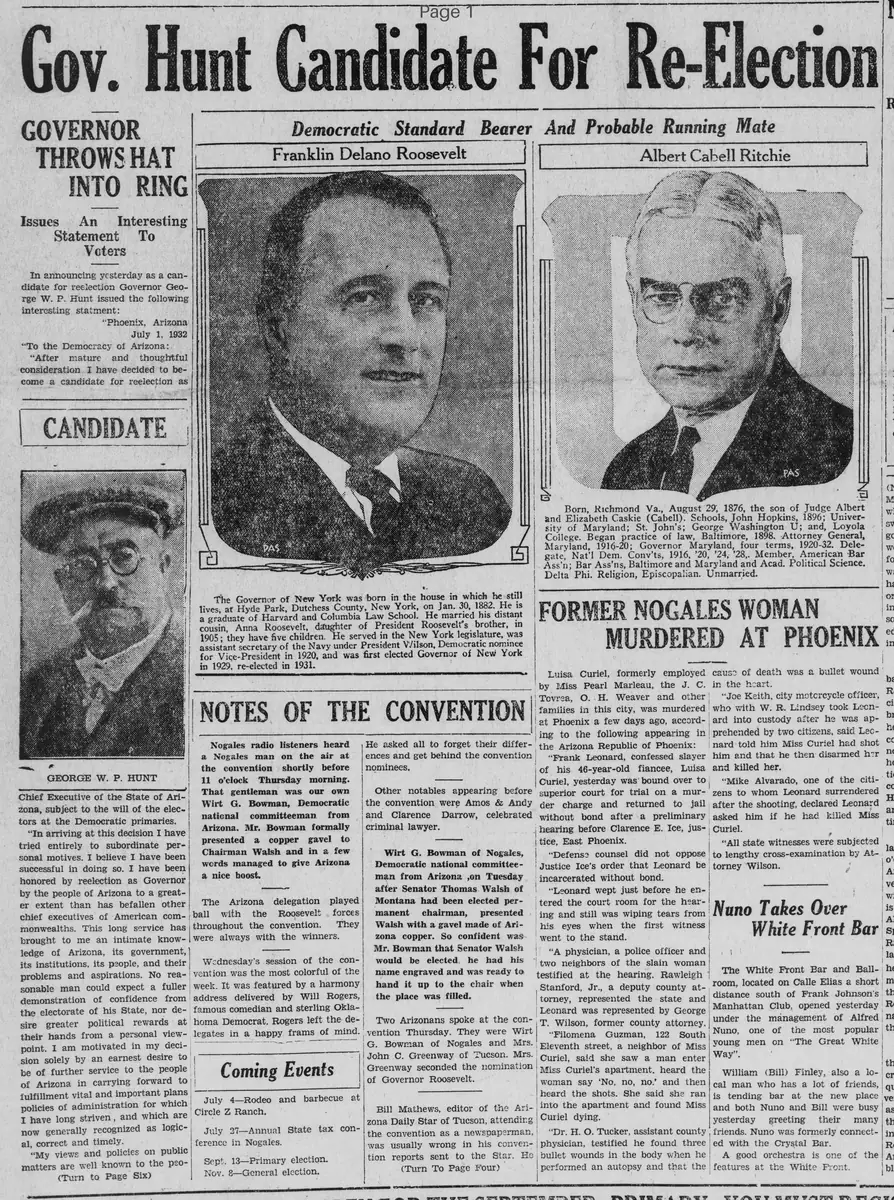
CANDIDATE
GEORGE W. P. HUNT
What sub-type of article is it?
What themes does it cover?
What keywords are associated?
What entities or persons were involved?
Where did it happen?
Story Details
Key Persons
Location
Arizona, Phoenix
Event Date
July 1, 1932
Story Details
Governor George W. P. Hunt announces his candidacy for re-election, emphasizing his long service, policies on government economy, legislative reform, unemployment relief, copper industry protection, and state reorganization to serve Arizona's people amid economic depression.