Thank you for visiting SNEWPapers!
Sign up free
The Enquirer
Richmond, Henrico County, Virginia
What is this article about?
The London Examiner on Oct. 2, 1814, publishes a correspondent's theory that Napoleon's abdication to Elba and the Bourbon restoration are a deliberate hoax by Bonaparte and his allies to rebuild French power for his eventual return, warning of renewed European conflict.
Merged-components note: Merged introductory miscellaneous with the hoax article on political prediction about Bonaparte; relabeled to foreign_news.
Clipping
OCR Quality
Full Text
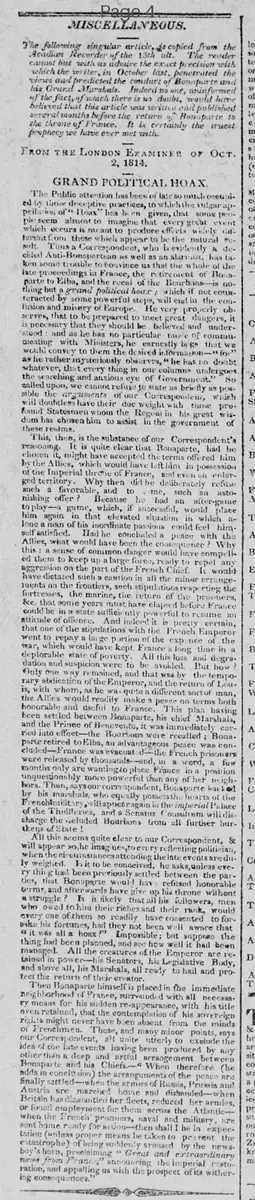
The following singular article, is copied from the Acadian Recorder of the 13th ult. The reader cannot but with us admire the exact precision with which the writer, in October last, penetrated the future and predicted the conduct of Bonaparte and his Grand Marshals. Indeed no one, uninformed of the fact, of which there is no doubt, would have believed that this article was written and published several months before the return of Bonaparte to the throne of France. It is certainly the truest prophecy we have ever met with.
From The London Examiner of Oct. 2. 1814.
GRAND POLITICAL HOAX.
The Public attention has been of late so much occupied by those deceptive practices, to which the vulgar appellation of "Hoax" has been given, that some people seem almost to imagine that every great event which occurs is meant to produce effects widely different from those which appear to be the natural result. Thus a Correspondent, who is evidently a decided Anti-Bonapartean as well as an alarmist, has taken some trouble to convince us that the whole of the late proceedings in France, the retirement of Bonaparte to Elba, and the recall of the Bourbons is nothing but a grand political hoax; which if not counteracted by some powerful steps, will end in the confusion and misery of Europe. He very properly observes, that to be prepared to meet great dangers, it is necessary that they should be believed and understood: and as he has no particular mode of communicating with Ministers, he earnestly begs that we would convey to them the desired information- "for" as he rather mysteriously observes, "he has no doubt whatever that every thing in our columns undergoes the searching and anxious eye of Government." So called upon, we cannot refuse to state as briefly as possible the arguments of our Correspondent, which will doubtless have their due weight with those profound Statesmen whom the Regent in his great wisdom has chosen to assist in the government of these realms.
This, then, is the substance of our Correspondent's reasoning. It is quite clear that Bonaparte, had he chosen it, might have accepted the terms offered him by the Allies, which would have left him in possession of the Imperial throne of France, and even an enlarged territory. Why then did he deliberately refuse such a favorable, and to me, such an astonishing offer? Because he had an after-game to play--a game, which, if successful, would place him again in that elevated situation in which alone a man of his inordinate passions could feel himself satisfied. Had he concluded a peace with the Allies, what would have been the consequence? Why this: a sense of common danger would have compelled them to keep up a large force ready to repel any aggression on the part of the French Chief. It would have dictated such a caution in all the minor arrangements on the frontiers, such stipulations respecting the fortresses, the marine, the return of the prisoners, &c. that some years must have elapsed before France could be in a state sufficiently powerful to resume an attitude of offence. And indeed it is pretty certain, that one of the stipulations with the French Emperor went to repay a large portion of the expense of the war, which would have kept France a long time in a deplorable state of poverty. All this loss and degradation and suspicion were to be avoided. But how? Only one way remained, and that was by the temporary abdication of the Emperor, and the return of Louis, with whom, as he was quite a different sort of man, the Allies would readily make a peace on terms both honorable and useful to France. This plan having been settled between Bonaparte, his chief Marshals, and the Prince of Benevento, it was immediately carried into effect the Bourbons were recalled: Bonaparte retired to Elba, an advantageous peace was concluded--France was evacuated the French prisoners were released by thousands--and, in a word, a few months only are wanting to place France in a position unquestionably more powerful than any of her neighbors. Then, says our correspondent, Bonaparte backed by his marshals, who equally possess the hearts of the French military will appear again in the imperial Palace of the Tuilleries, and a Senatus Consultum will discharge the deluded Bourbons from all further burdens of State!
All this seems quite clear to our Correspondent, & will appear so, he imagines, to every reflecting politician, when the circumstances attending the late events are duly weighed. Is it to be conceived, he asks, unless every thing had been previously settled between the parties. that Bonaparte would have refused honorable terms, and afterwards have given up his throne without a struggle? Is it likely that all his followers, men who owed to him their riches and their rank, would every one of them so readily have consented to forsake his fortunes, had they not been well aware that "it was all a hoax?" Impossible; but suppose the thing had been planned, and see how well it had been managed. All the creatures of the Emperor are retained in power--his Senators, his Legislative Body, and above all, his Marshals, all ready to hail and protect the return of their creator. Then Bonaparte himself is placed in the immediate neighborhood of France, surrounded with all necessary means for his sudden re-appearance, with his title even retained, that the contemplation of his sovereign rights might never have been absent from the minds of Frenchmen. These, and many minor points, says our Correspondent, all unite utterly to exclude the idea of the late events having been produced by any other than a deep and artful arrangement between Bonaparte and his Chiefs.- When therefore (he adds in conclusion) the arrangements of the peace are finally settled--when the armies of Russia, Prussia and Austria are marched home and disbanded when Britain has dismantled her fleets, reduced her armies, or found employment for them across the Atlantic--- when the French prisoners, naval and military, are sent home ready for action-then shall I be in expectation (unless proper means be taken to prevent the catastrophe) of being suddenly aroused by the news-boy's horn, proclaiming "Great and extraordinary news from France," announcing the imperial restoration, and appalling us with the prospect of its withering consequences.
What sub-type of article is it?
What keywords are associated?
What entities or persons were involved?
Where did it happen?
Foreign News Details
Primary Location
France
Event Date
Oct. 2, 1814
Key Persons
Outcome
predicted return of bonaparte to power after france rebuilds strength, leading to potential confusion and misery in europe
Event Details
A correspondent in the London Examiner argues that Bonaparte's abdication, the recall of the Bourbons, and the peace with Allies are a hoax planned by Bonaparte, his Marshals, and the Prince of Benevento to allow France to recover and enable Bonaparte's restoration to the throne.