Thank you for visiting SNEWPapers!
Sign up free
Literary
April 11, 1799
Gazette Of The United States, & Philadelphia Daily Advertiser
Philadelphia, Philadelphia County, Pennsylvania
What is this article about?
An essay from Thomas's Massachusetts Spy, under 'The Neighbor' series, explores the physical, mental, and social inconveniences of old age. It discusses declining health, loss of friends and faculties, peevishness, and neglect, quoting Cowper, Rochefoucauld, Hunter, Goldsmith, Johnson, and Blair to highlight the miseries and regrets of prolonged life.
Clipping
OCR Quality
95%
Excellent
Full Text
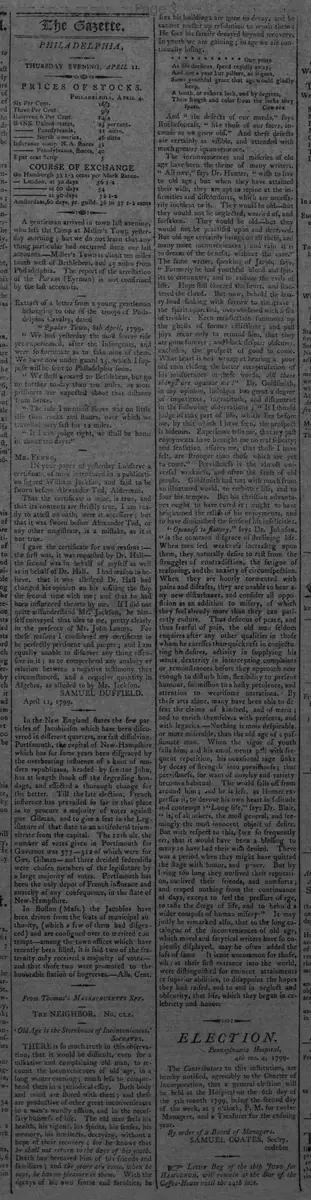
From Thomas's Massachusetts Spy.
THE NEIGHBOR. No. CLX.
Old Age is the Storehouse of Inconveniences.
SOCRATES.
THERE is so much truth in this observation, that it would be difficult, even for a talkative and complaining old man, to recount the inconveniences of old age, in a long winter evening; much less to comprehend them in a periodical essay. Both body and mind are stored with them; and these are productive of other great inconveniences in a man's worldly affairs, and in the necessary business of life. The old man feels his health, his vigour, his spirits, his senses, his memory, his intellects, decaying, without a hope of their recovery ; for he knows that he shall not return to the days of his youth. Death has bereaved him of his friends and familiars; and the years are come, when he says, he has no pleasure in them. With the decays of his own frame and faculties, he sees his buildings are gone to decay, and he cannot muster up resolution to repair them: He sees his family decayed beyond recovery. In youth we are gaining ; in age we are continually losing.
* Our years
As life declines, speed rapidly away,
And not a year but pilfers, as it goes,
Some youthful grace that age would gladly keep,
A tooth, or auburn lock, and by degrees,
Their length and color from the locks they pare.
COWPER
And " the defects of our minds," says Rochefoucauld, " like those of our faces, increase as we grow old." And these defects are certainly as visible, and attended with much greater inconvenience.
The inconveniences and miseries of old age have been the theme of many writers. " All men," says Dr. Hunter, " wish to live to old age; but when they have attained their wish, they are apt to repine at the infirmities and discomforts, which are necessarily incident to it. They would be old _but they would not be neglected, wearied of, and forsaken. They would be old but they would not be practiced upon and deceived. But old age certainly brings on all these, and many more inconveniences ; and vain it is to dream of the benefit, without the care."
The same writer, speaking of Jacob, says, " Formerly he had youthful blood and spirits to encounter, and to endure the evils of life. Hope still cheered the heart, and scattered the cloud. But now, behold the hoary head sinking with sorrow to the grave ; the spirit oppressed, overwhelmed with a sea of trouble. Keen recollection summons up the ghosts of former afflictions; and past joys recur only to remind him, that they are gone forever; and black despair obscures, excludes, the prospect of good to come. What heart is not wrung at hearing a poor old man closing the bitter recapitulation of his misfortunes in these words, All these things are against me!" Dr. Goldsmith.
in my opinion, indulges too great a degree of impatience, ingratitude, and discontent in the following observations ; " If I should judge of that part of life, which lies before me, by that which I have seen, the prospect is hideous. Experience tells me, that my past enjoyments have brought me no real felicity; and sensation assures me, that those I have felt, are stronger than those which are yet to-come." Peevishness is the almost universal weakness, and often the fault of old people. Goldsmith had met with much from an illnatured world, to embitter life, and to sour his temper. But his christian advantages ought to have cured it; ought to have heightened the relish of his enjoyments, and to have diminished the sense of his infelicities.
" Openness to flattery," says Dr. Johnson, " is the common disgrace of declining life. When men feel weakness increasing upon them, they naturally desire to rest from the struggles of contradiction, the fatigue of reasoning, and the anxiety of circumspection. When they are hourly tormented with pains and diseases, they are unable to bear any new disturbance, and consider all opposition as an addition to misery, of which they feel already more than they can patiently endure. Thus desirous of peace, and thus fearful of pain, the old man seldom enquires after any other qualities in those whom he caresses than quickness in conjecturing his desires, activity in supplying his wants dexterity in intercepting complaints or remonstrances before they approach near enough to disturb him, flexibility to present humour, submission to a hasty petulence, and attention to wearisome narrations. By these arts alone, many have been able to defeat the claims of kindred, and of merit; and to enrich themselves with presents, and with legacies. --Nothing is more despicable, or more miserable, than the old age of a passionate man. When the vigor of youth fails him, and his amusements pall with frequent repetition, his occasional rage sinks by decay of strength into peevishness; that peevishness. for want of novelty and variety becomes habitual. The world falls off from around him; and he is left, as Homer expresses it, to devour his own heart in solitude and contempt :"Long life," says Dr. Blair, " is, of all others, the most general, and seemingly the most innocent object of desire. But with respect to this, we so frequently err, that it would have been a blessing to many to have had their wish denied. There was a period when they might have quitted the stage with honor, and peace. But by living too long they outlived their reputation, outlived their friends, and comforts; and reaped nothing from the continuance of days, except to feel the pressure of age, to taste the dregs of life, and to behold a wider compass of human misery." It may justly be remarked also, that to the long catalogue of the inconveniences of old age, which moral and satirical writers have so copiously displayed, may be often added the loss of fame It is not uncommon for those, who, at their first entrance into the world, were distinguished for eminent attainments or superior abilities, to disappoint the hopes they had raised, and to end in neglect and obscurity, that life, which they began in celebrity and honor.
THE NEIGHBOR. No. CLX.
Old Age is the Storehouse of Inconveniences.
SOCRATES.
THERE is so much truth in this observation, that it would be difficult, even for a talkative and complaining old man, to recount the inconveniences of old age, in a long winter evening; much less to comprehend them in a periodical essay. Both body and mind are stored with them; and these are productive of other great inconveniences in a man's worldly affairs, and in the necessary business of life. The old man feels his health, his vigour, his spirits, his senses, his memory, his intellects, decaying, without a hope of their recovery ; for he knows that he shall not return to the days of his youth. Death has bereaved him of his friends and familiars; and the years are come, when he says, he has no pleasure in them. With the decays of his own frame and faculties, he sees his buildings are gone to decay, and he cannot muster up resolution to repair them: He sees his family decayed beyond recovery. In youth we are gaining ; in age we are continually losing.
* Our years
As life declines, speed rapidly away,
And not a year but pilfers, as it goes,
Some youthful grace that age would gladly keep,
A tooth, or auburn lock, and by degrees,
Their length and color from the locks they pare.
COWPER
And " the defects of our minds," says Rochefoucauld, " like those of our faces, increase as we grow old." And these defects are certainly as visible, and attended with much greater inconvenience.
The inconveniences and miseries of old age have been the theme of many writers. " All men," says Dr. Hunter, " wish to live to old age; but when they have attained their wish, they are apt to repine at the infirmities and discomforts, which are necessarily incident to it. They would be old _but they would not be neglected, wearied of, and forsaken. They would be old but they would not be practiced upon and deceived. But old age certainly brings on all these, and many more inconveniences ; and vain it is to dream of the benefit, without the care."
The same writer, speaking of Jacob, says, " Formerly he had youthful blood and spirits to encounter, and to endure the evils of life. Hope still cheered the heart, and scattered the cloud. But now, behold the hoary head sinking with sorrow to the grave ; the spirit oppressed, overwhelmed with a sea of trouble. Keen recollection summons up the ghosts of former afflictions; and past joys recur only to remind him, that they are gone forever; and black despair obscures, excludes, the prospect of good to come. What heart is not wrung at hearing a poor old man closing the bitter recapitulation of his misfortunes in these words, All these things are against me!" Dr. Goldsmith.
in my opinion, indulges too great a degree of impatience, ingratitude, and discontent in the following observations ; " If I should judge of that part of life, which lies before me, by that which I have seen, the prospect is hideous. Experience tells me, that my past enjoyments have brought me no real felicity; and sensation assures me, that those I have felt, are stronger than those which are yet to-come." Peevishness is the almost universal weakness, and often the fault of old people. Goldsmith had met with much from an illnatured world, to embitter life, and to sour his temper. But his christian advantages ought to have cured it; ought to have heightened the relish of his enjoyments, and to have diminished the sense of his infelicities.
" Openness to flattery," says Dr. Johnson, " is the common disgrace of declining life. When men feel weakness increasing upon them, they naturally desire to rest from the struggles of contradiction, the fatigue of reasoning, and the anxiety of circumspection. When they are hourly tormented with pains and diseases, they are unable to bear any new disturbance, and consider all opposition as an addition to misery, of which they feel already more than they can patiently endure. Thus desirous of peace, and thus fearful of pain, the old man seldom enquires after any other qualities in those whom he caresses than quickness in conjecturing his desires, activity in supplying his wants dexterity in intercepting complaints or remonstrances before they approach near enough to disturb him, flexibility to present humour, submission to a hasty petulence, and attention to wearisome narrations. By these arts alone, many have been able to defeat the claims of kindred, and of merit; and to enrich themselves with presents, and with legacies. --Nothing is more despicable, or more miserable, than the old age of a passionate man. When the vigor of youth fails him, and his amusements pall with frequent repetition, his occasional rage sinks by decay of strength into peevishness; that peevishness. for want of novelty and variety becomes habitual. The world falls off from around him; and he is left, as Homer expresses it, to devour his own heart in solitude and contempt :"Long life," says Dr. Blair, " is, of all others, the most general, and seemingly the most innocent object of desire. But with respect to this, we so frequently err, that it would have been a blessing to many to have had their wish denied. There was a period when they might have quitted the stage with honor, and peace. But by living too long they outlived their reputation, outlived their friends, and comforts; and reaped nothing from the continuance of days, except to feel the pressure of age, to taste the dregs of life, and to behold a wider compass of human misery." It may justly be remarked also, that to the long catalogue of the inconveniences of old age, which moral and satirical writers have so copiously displayed, may be often added the loss of fame It is not uncommon for those, who, at their first entrance into the world, were distinguished for eminent attainments or superior abilities, to disappoint the hopes they had raised, and to end in neglect and obscurity, that life, which they began in celebrity and honor.
What sub-type of article is it?
Essay
What themes does it cover?
Death Mortality
Moral Virtue
Social Manners
What keywords are associated?
Old Age
Inconveniences
Infirmities
Peevishness
Mortality
Decline
Loss Of Fame
What entities or persons were involved?
From Thomas's Massachusetts Spy
Literary Details
Title
The Neighbor. No. Clx. Old Age Is The Storehouse Of Inconveniences.
Author
From Thomas's Massachusetts Spy
Subject
Socrates
Key Lines
Our Years As Life Declines, Speed Rapidly Away, And Not A Year But Pilfers, As It Goes, Some Youthful Grace That Age Would Gladly Keep, A Tooth, Or Auburn Lock, And By Degrees, Their Length And Color From The Locks They Pare.
" All Men," Says Dr. Hunter, " Wish To Live To Old Age; But When They Have Attained Their Wish, They Are Apt To Repine At The Infirmities And Discomforts, Which Are Necessarily Incident To It."
" Openness To Flattery," Says Dr. Johnson, " Is The Common Disgrace Of Declining Life."
"Long Life," Says Dr. Blair, " Is, Of All Others, The Most General, And Seemingly The Most Innocent Object Of Desire."