Thank you for visiting SNEWPapers!
Sign up free
The Virginia Gazette
Williamsburg, Virginia
What is this article about?
Mr. Day, a mechanic, invents a submersible vessel to sink underwater with him inside for 12 hours. After successful small-scale tests, he attempts the feat in Plymouth with backing from Mr. Blake, but the vessel fails to resurface, leading to Day's death.
Merged-components note: Continuation of the detailed story about Mr. Day's ill-fated submarine experiment at Plymouth.
Clipping
OCR Quality
Full Text
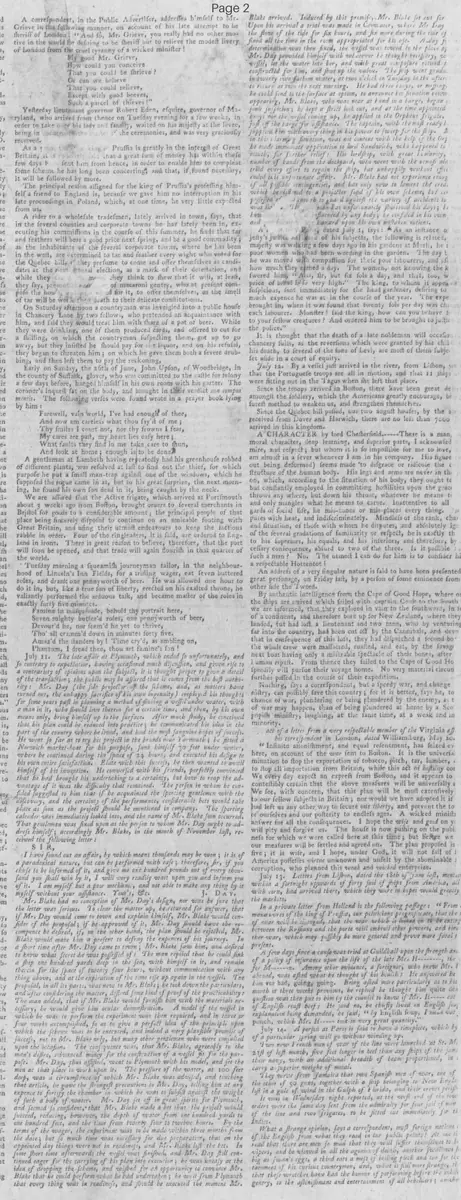
SIR,
I have found out an affair, by which means thousands may be won; it is of a paradoxical nature, but can be performed with ease; therefore, sir, if you chuse to be informed of it, and give me one hundred pounds out of every thousand you shall win by it, I will very readily wait upon you and inform you of it. I am myself but a poor mechanic, and not able to make any thing by it myself without your assistance. Your's, &c.
J. DAY.
Mr. Blake had no conception of Mr. Day's design, nor was he sure that the letter was serious. To clear the matter up, he returned for answer, that if Mr. Day would come to town and explain himself, Mr. Blake would consider of the proposal; if he approved of it, Mr. Day should have the recompence he desired, if, on the other hand, the plan should be rejected, Mr. Blake would make him a present to defray the expences of his journey. In a short time after Mr. Day came to town; Mr. Blake saw him, and desired to know what secret he was possessed of: The man replied that he could sink a ship one hundred yards deep in the sea, with himself in it, and remain therein for the space of twenty four hours, without communication with any thing above, and at the expiration of the time rise up again in the vessel. The proposal, in all its parts, was new to Mr. Blake; he took down the particulars, and after considering the matter, desired some kind of proof of the practicability: The man added, that if Mr. Blake would furnish him with the materials necessary, he would give him ocular demonstration. A model of the vessel in which he was to perform the experiment was then required, and in three or four weeks accomplished, so as to give a perfect idea of the principle upon which the scheme was to be executed, and indeed a very plausible promise of success, not to Mr. Blake only, but many other gentlemen who were consulted upon the occasion. The consequence was, that Mr. Blake, agreeably to the man's desire, advanced money for the construction of a vessel fit for the purpose. Mr. Day, thus assisted, went to Plymouth with his model, and set the men at that place to work upon it. The pressure of the water, at 100 feet deep, was a circumstance of which Mr. Blake was advised, and touching that article, he gave the strongest precautions to Mr. Day, telling him at any expence to fortify the chamber in which he was to subsist against the weight of such a body of water. Mr. Day set off in great spirits for Plymouth, and seemed so confident, that Mr. Blake made a bet that the project would succeed, reducing, however, the depth of water from one hundred yards to one hundred feet, and the time from twenty four to twelve hours. By the terms of the wager, the experiment was to be made within three months from the date; but so much time was necessary for due preparation, that on the appointed day things were not in readiness, and Mr. Blake lost the bet. In some short time afterwards the vessel was finished, and Mr. Day still continued eager for the carrying of his plan into execution; he was uneasy at the idea of dropping the scheme, and wished for an opportunity to convince Mr. Blake that he could perform that he had undertaken; he writ from Plymouth that every thing was in readiness, and should be executed the moment Mr. Blake arrived.
Upon his arrival a trial was made in Cattedwater, where Mr. Day endured the flow of the tide for six hours, and six more during the tide of ebb, confined all the time in the room appropriated for his use. A day or two after this determination was then fixed, the vessel was removed to the place appointed. Mr. Day provided himself with such matters as he thought necessary, repaired to the vessel, let in the water into her, and with great composure retired to the apartment constructed for him, and shut up the valve. The ship went gradually down in twenty two fathom water, at two o'clock on Tuesday in the afternoon, to return at two the next morning. He had three ivy, or messages, which he could send to the surface at option, to announce his situation before appearing, Mr. Blake, who was near at hand in a large, began some suspicion; he kept a strict look out, and at the time appointed neither the buoy nor the vessel coming up, he applied to the Orpheus frigate, just off the barge for assistance. The captain, with the most ready disposition, supplied him with every thing in his power to sweep for the ship. A number of hands from the dockyard, who went with the winch, also tried every effort to regain the ship, but unhappily without effect, which ended this unfortunate affair. Mr. Blake had not experience enough of all possible contingencies, and has only now to lament the credulity with which he listened to a projector fond of his own scheme, little aware how impossible it was to guard against the variety of accidents to which he was exposed. The man has unfortunately shortened his days; he was not influenced by any body; he persisted in his plan, and hazarded upon his own mistaken notions.
What sub-type of article is it?
What themes does it cover?
What keywords are associated?
What entities or persons were involved?
Where did it happen?
Story Details
Key Persons
Location
Plymouth
Event Date
Tuesday Afternoon, Prior To July 11
Story Details
Mr. Day develops a submersible vessel, secures funding from Mr. Blake for a wager, successfully tests in shallow water, but during the deep-water trial in Plymouth, the vessel sinks to 22 fathoms and fails to resurface, resulting in Day's death.