Thank you for visiting SNEWPapers!
Sign up free
The Sun
New York, New York County, New York
What is this article about?
In Albany on May 14, Gov. Hughes heard arguments on three bills: opposition to Grady's tenement reforms by architects citing commissioner discretion; support for Foley-Sargent Penal Code changes to limit corporate law practice; and debate on Grattan's insurance bill, opposed by assessment societies but backed for worker affordability.
Clipping
OCR Quality
Full Text
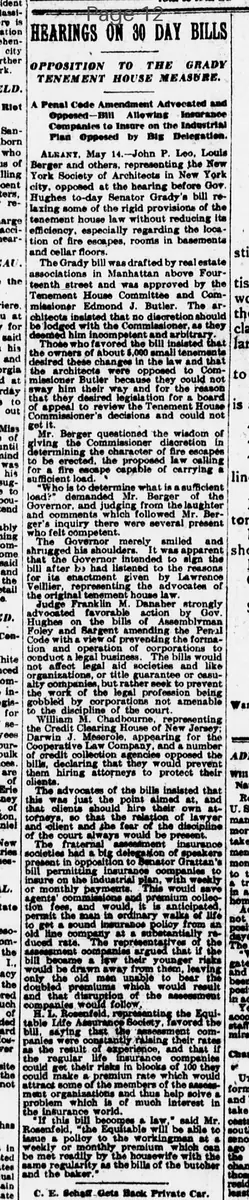
OPPOSITION TO THE GRADY TENEMENT HOUSE MEASURE.
A Penal Code Amendment Advocated and Opposed—Bill Allowing Insurance Companies to Insure on the Industrial Plan Opposed by Big Delegation.
ALBANY, May 14.—John P. Lee, Louis Berger and others, representing the New York Society of Architects in New York city, opposed at the hearing before Gov. Hughes to-day Senator Grady's bill relaxing some of the rigid provisions of the tenement house law without reducing its efficiency, especially regarding the location of fire escapes, rooms in basements and cellar floors.
The Grady bill was drafted by real estate associations in Manhattan above Fourteenth street and was approved by the Tenement House Committee and Commissioner Edmond J. Butler. The architects insisted that no discretion should be lodged with the Commissioner, as they deem him incompetent and arbitrary.
Those who favored the bill insisted that the owners of about 8,000 small tenements desired these changes in the law and that the architects were opposed to Commissioner Butler because they could not sway him their way and for the reason that they desired legislation for a board of appeal to review the Tenement House Commissioner's decisions and could not get it.
Mr. Berger questioned the wisdom of giving the Commissioner discretion in determining the character of fire escapes to be erected, the proposed law calling for a fire escape capable of carrying a sufficient load.
"Who is to determine what is a sufficient load?" demanded Mr. Berger of the Governor, and judging from the laughter and comments which followed Mr. Berger's inquiry there were several present who felt competent.
The Governor merely smiled and shrugged his shoulders. It was apparent that the Governor intended to sign the bill after he had listened to the reasons for its enactment given by Lawrence Veiller, representing the advocates of the original tenement house law.
Judge Franklin M. Danaher strongly advocated favorable action by Gov. Hughes on the bills of Assemblyman Foley and Sargent amending the Penal Code with a view of preventing the formation and operation of corporations to conduct a legal business. The bills would not affect legal aid societies and like organizations, or title guarantee or casualty companies, but rather seek to prevent the work of the legal profession being gobbled by corporations not amenable to the discipline of the court.
William M. Chadbourne, representing the Credit Clearing House of New Jersey; Darwin J. Meserole, appearing for the Cooperative Law Company, and a number of credit collection agencies opposed the bills, declaring that they would prevent them hiring attorneys to protect their clients.
The advocates of the bills insisted that this was just the point aimed at, and that clients should hire their own attorneys, so that the relation of lawyer and client and the fear of the discipline of the court always would be present.
The fraternal assessment insurance societies had a big delegation of speakers present in opposition to Senator Grattan's bill permitting insurance companies to insure on the industrial plan, with weekly or monthly payments. This would save agents' commissions and premium collection fees, and would, it is anticipated, permit the man in ordinary walks of life to get a sound insurance policy from an old line company at a substantially reduced rate. The representatives of the assessment companies argued that if the bill became a law their younger risks would be drawn away from them, leaving only the old men unable to bear the doubled premiums which would result and that disruption of the assessment companies would follow.
H. L. Rosenfeld, representing the Equitable Life Assurance Society, favored the bill, saying that the assessment companies were constantly raising their rates as the result of experience, and that if the regular life insurance companies could get their risks in blocks of 100 they could make a premium rate which would attract some of the members of the assessment organizations and thus help solve a problem which is of much interest in the insurance world.
"If this bill becomes a law," said Mr. Rosenfeld, "the Equitable will be able to issue a policy to the workingman at a weekly or monthly premium which can be met readily by the housewife with the same regularity as the bills of the butcher and the baker."
What sub-type of article is it?
What themes does it cover?
What keywords are associated?
What entities or persons were involved?
Where did it happen?
Story Details
Key Persons
Location
Albany
Event Date
May 14
Story Details
Hearings before Gov. Hughes on multiple bills: Architects opposed Senator Grady's tenement house bill for giving discretion to Commissioner Butler on fire escapes and basements; supporters argued it aids small tenement owners. Judge Danaher advocated Penal Code amendments by Foley and Sargent to bar corporations from legal business, opposed by credit agencies. Fraternal insurance societies opposed Senator Grattan's bill allowing industrial plan insurance, favored by Equitable's Rosenfeld for affordable policies.