Thank you for visiting SNEWPapers!
Sign up free
Editorial
September 6, 1833
Phenix Gazette
Alexandria, Virginia
What is this article about?
Editorial advocating for merchants, mechanics, and tradesmen to advertise in newspapers to increase sales, gain notoriety, and benefit the town and press, emphasizing widespread reach and mutual gains.
Clipping
OCR Quality
98%
Excellent
Full Text
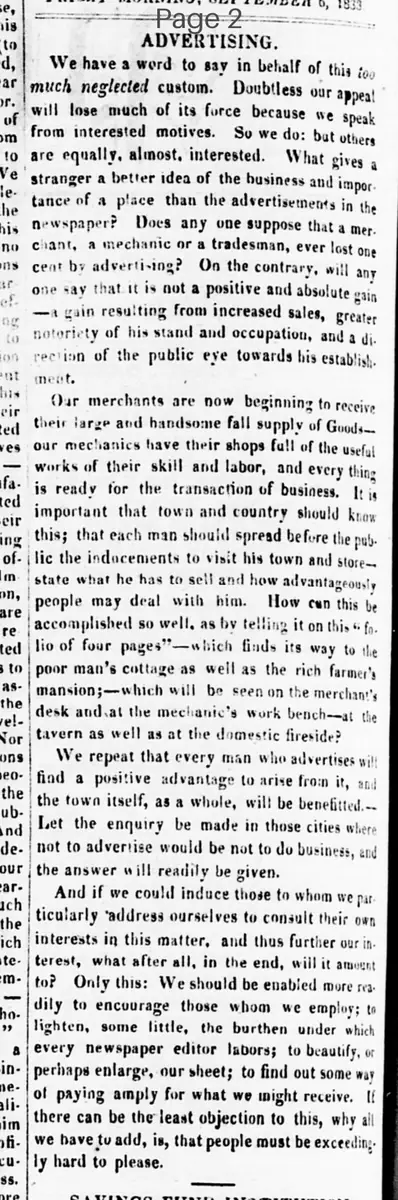
ADVERTISING.
We have a word to say in behalf of this too much neglected custom. Doubtless our appeal will lose much of its force because we speak from interested motives.
So we do: but others are equally, almost, interested.
What gives a stranger a better idea of the business and importance of a place than the advertisements in the newspaper? Does any one suppose that a merchant, a mechanic or a tradesman, ever lost one cent by advertising?
On the contrary, will any one say that it is not a positive and absolute gain—a gain resulting from increased sales, greater notoriety of his stand and occupation, and a direction of the public eye towards his establishment.
Our merchants are now beginning to receive their large and handsome fall supply of Goods—our mechanics have their shops full of the useful works of their skill and labor, and every thing is ready for the transaction of business. It is important that town and country should know this; that each man should spread before the public the inducements to visit his town and store—state what he has to sell and how advantageously people may deal with him. How can this be accomplished so well, as by telling it on this "folio of four pages"—which finds its way to the poor man's cottage as well as the rich farmer's mansion;—which will be seen on the merchant's desk and at the mechanic's work bench—at the tavern as well as at the domestic fireside?
We repeat that every man who advertises will find a positive advantage to arise from it, and the town itself, as a whole, will be benefitted.—Let the enquiry be made in those cities where not to advertise would be not to do business, and the answer will readily be given.
And if we could induce those to whom we particularly address ourselves to consult their own interests in this matter, and thus further our interest, what after all, in the end, will it amount to? Only this: We should be enabled more readily to encourage those whom we employ; to lighten, some little, the burthen under which every newspaper editor labors; to beautify, or perhaps enlarge, our sheet; to find out some way of paying amply for what we might receive. If there can be the least objection to this, why all we have to add, is, that people must be exceedingly hard to please.
We have a word to say in behalf of this too much neglected custom. Doubtless our appeal will lose much of its force because we speak from interested motives.
So we do: but others are equally, almost, interested.
What gives a stranger a better idea of the business and importance of a place than the advertisements in the newspaper? Does any one suppose that a merchant, a mechanic or a tradesman, ever lost one cent by advertising?
On the contrary, will any one say that it is not a positive and absolute gain—a gain resulting from increased sales, greater notoriety of his stand and occupation, and a direction of the public eye towards his establishment.
Our merchants are now beginning to receive their large and handsome fall supply of Goods—our mechanics have their shops full of the useful works of their skill and labor, and every thing is ready for the transaction of business. It is important that town and country should know this; that each man should spread before the public the inducements to visit his town and store—state what he has to sell and how advantageously people may deal with him. How can this be accomplished so well, as by telling it on this "folio of four pages"—which finds its way to the poor man's cottage as well as the rich farmer's mansion;—which will be seen on the merchant's desk and at the mechanic's work bench—at the tavern as well as at the domestic fireside?
We repeat that every man who advertises will find a positive advantage to arise from it, and the town itself, as a whole, will be benefitted.—Let the enquiry be made in those cities where not to advertise would be not to do business, and the answer will readily be given.
And if we could induce those to whom we particularly address ourselves to consult their own interests in this matter, and thus further our interest, what after all, in the end, will it amount to? Only this: We should be enabled more readily to encourage those whom we employ; to lighten, some little, the burthen under which every newspaper editor labors; to beautify, or perhaps enlarge, our sheet; to find out some way of paying amply for what we might receive. If there can be the least objection to this, why all we have to add, is, that people must be exceedingly hard to please.
What sub-type of article is it?
Trade Or Commerce
What keywords are associated?
Advertising
Newspaper Promotion
Merchants
Business Gains
Town Prosperity
Fall Goods
What entities or persons were involved?
Merchants
Mechanics
Tradesmen
Newspaper Editors
Editorial Details
Primary Topic
Promotion Of Newspaper Advertising For Business Growth
Stance / Tone
Strongly Pro Advertising And Encouraging
Key Figures
Merchants
Mechanics
Tradesmen
Newspaper Editors
Key Arguments
Advertisements Inform Strangers Of A Place's Business Importance
No Loss From Advertising, Only Gains In Sales And Notoriety
Fall Goods Arrival Requires Public Notification Via Newspapers
Newspapers Reach All Social Classes And Locations
Advertising Benefits Individuals And The Town As A Whole
Increased Ads Help Editors Improve And Sustain The Newspaper