Thank you for visiting SNEWPapers!
Sign up free
Trainman News
Indianapolis, Marion County, Indiana
What is this article about?
History of the Home for Aged and Disabled Railroad Employes of America, founded in 1890 in Chicago by Dr. Frank M. Ingalls after aiding a sick brother. Relocated to Highland Park, Ill., supported by railroad brotherhoods, with key figures like Lorenzo S. Coffin and Patrick H. Morrissey contributing to its growth and modern building by 1910. Now houses 40 destitute residents.
Merged-components note: Image (ro60) and caption (ro61) illustrate the history story (ro58) on the Railroad Men's Home.
Clipping
OCR Quality
Full Text
(The following history of the Home for Aged and Disabled Railroad Employes of America, located at Highland Park, Ill., was delivered as a speech at the recent Illinois Joint State Meeting by John L. Smedberg, secretary-treasurer and manager of the Home.)
The Home for Aged and Disabled Railroad Employes of America, one of Highland Park's oldest landmarks, began in an humble way in May, 1890 in Chicago, when Dr. Frank M. Ingalls, a member of Lodge 375, Brotherhood of Railroad Trainmen, learned of the plight of a fellow member who, ill, friendless and homeless, was confined to the Cook County Hospital in that city. The doctor felt that this was not a proper place for a Brotherhood man, went to the hospital and removed the patient to his own home where, with the help of his faithful wife, he cared for him.
This act of charity soon become known to the railroad men of the day and it aroused their interest to the extent that it was talked about in lodge halls and among individual members until it was decided to rent a flat on Walnut Street in Chicago to house such unfortunates as the one the doctor had befriended, and it was in this manner that the Railroad Men's Home was founded.
We might add here that Dr. Ingalls was born in Port Louisa, Iowa in 1860 and received his early education in the Iowa schools, later taking a course in the State University of Nebraska, and later, thru perseverance and active service as a brakeman and yardmaster, earned sufficient money to permit him to complete a medical course at Rush Medical College in Chicago. After leaving the managership of the Home he practiced medicine in Highland Park until the time of his death which occurred September 22, 1931, at the age of 71 years.)
The early years of the Home's existence were filled with discouragement and disappointments, and the pioneers of the movement met with many failures, and spent many sleepless nights planning for the maintenance and existence of the project. Contributions from individual members, interested friends outside of railroad circles, lodges and divisions were the only means of revenue, and the zealous physician wondered many times how he was going to feed the men who were seeking the Home's shelter and protection.
The Ladies' Auxiliaries to the Lodges rallied to the cause and assisted materially with their donations of bedding, linens, canned foods, silverware and furnishings.
Dr. Ingalls and his associates interested Lorenzo S. Coffin of Fort Dodge, Iowa familiarly and affectionately known to railroad men thruout the country as "Father Coffin", in their laudable work, and he was elected the first president of the society which office he held for many years; in fact, until shortly before his death.
Shortly after 1891 Mr. Lewis Ziegenfus, a member of Div. 125 Brotherhood of Locomotive Engineers came into the work, and he devoted much of his time and energy to the welfare of the Home, serving as a member of the Board of Trustees.
Patrick H. Morrissey, then Grand Master of the Brotherhood of Railroad Trainmen, was elected a member of the Home Society in January, 1895, and the movement is indebted to him for much of its prosperity, and more especially for the projection and completion of the magnificent building which replaced the old ramshackle, fire-trap houses which first domiciled our aged and disabled brothers when property was purchased in Highland Park, Ill.
George Goding, a member of the Brotherhood of Locomotive Firemen and Enginemen became interested in the Home about the same time as Brother Morrissey, and was a tower of strength in the furtherance of the movement, and after many years of misfortune and suffering Brother Goding sought its shelter, and died in it on Feb. 5th, 1919, thus bearing out the fact that no one of us knows what the future has in store for us, as he so frequently reminded railroad men when speaking to them about the Home movement.
Dr. Ingalls was succeeded as manager by Mrs. T. B. Watson, a member of the Ladies' Auxiliary to the Order of Railway Conductors, and in November, 1903, John O'Keefe, a member of Lodge 4, and also of the Home Society, took over its management. When he took charge the Home property, buildings and contents, together with cash in the bank, was appraised as that there was a cash balance of $25,248.57 in the bank. It was immediately decided to replace the old buildings with a modern fire-proof structure, and building operations began.
A shortage of money again threatened the project, and Hamilton Carhartt of Detroit, Mich. overall manufacturer from whom the majority of railroad men purchased their clothing, heard of the plight of the Home Society, and came to the rescue with a contribution of $25,000 so that work might go on and the building be finished. It was dedicated in April, 1910, and stands as a monument to the railroad men of the United States and Canada who gave so unselfishly of their meager funds.
Brother O'Keefe died at the Home in August, 1938, and Clyde V. Wirls, a member of the Brotherhood of Locomotive Engineers took charge. He was succeeded in July 1941 by Brother George M. Palmer, a member of all three supporting Brotherhoods.
Brother John L. Smedberg was elected secretary-treasurer and Manager of the Home in October, 1947 and is the present incumbent.
The Home has a capacity of 119 residents, but there was a time in the thirties when we accommodated 149 by using all double rooms, and putting two beds in reading rooms on each floor. Railroad retirement legislation has meant a great deal to our aged and disabled brothers, and has enabled them to remain at home, and due to this fact, residence in the Home has dwindled until now only 40 men are domiciled in it. However, the fact remains that those 40 are destitute except for a small pension not enough to provide them with food, friendless and homeless, and are in need of the Home.
.and there were 40 residents on the books of the Home on Oct. 9, 1951.
The Home is owned and maintained by the Brotherhood of Railroad Trainmen: the Brotherhood of Locomotive Firemen and Enginemen and the Brotherhood of Locomotive Engineers, and is one of the finest of its kind in the country. Its residents are free to come and go as they wish but we want to know where they go so that if anything happens to them we may have some idea where to look for them; they may have a furlough to visit friends and relatives, they have their own private, comfortably furnished room, a fine library for the man who likes good books, reading rooms on each floor, plenty of lounging space indoors and out, pool and billiard tables, playing cards, all types of games, all the late magazines, and we feel confident to say that no Brotherhood man has a better home than that which the Brotherhoods provide for their aged and disabled members.
These figures were compiled by our certified public accountants when they made their annual audit the latter part of September, and the figures were reached by dividing the number of members in each brotherhood and the cost of maintenance for the year, and it is gratifying to know that for just 26 cents from each member of the Brotherhoods so many blessings are provided for our aged brothers, and that a Home of the size of ours can be maintained for such a trifling amount from each of us.
Seven hundred and forty-one Brotherhood men have been admitted to the Home since its inception in 1890; there have been 396 deaths; 210 men vacated, many of whom regained their health sufficiently after being admitted to go out and fight life's battles again; 47 were expelled for flagrant and repeated violation of rules; 32 became demented and were either removed by their lodge or sent to the State Hospital for Insane; 13 members of the Order of Railway Conductors were transferred to the Home erected by that organization in Georgia in Nov., 1927; three are unaccounted for on the early records of the Home.
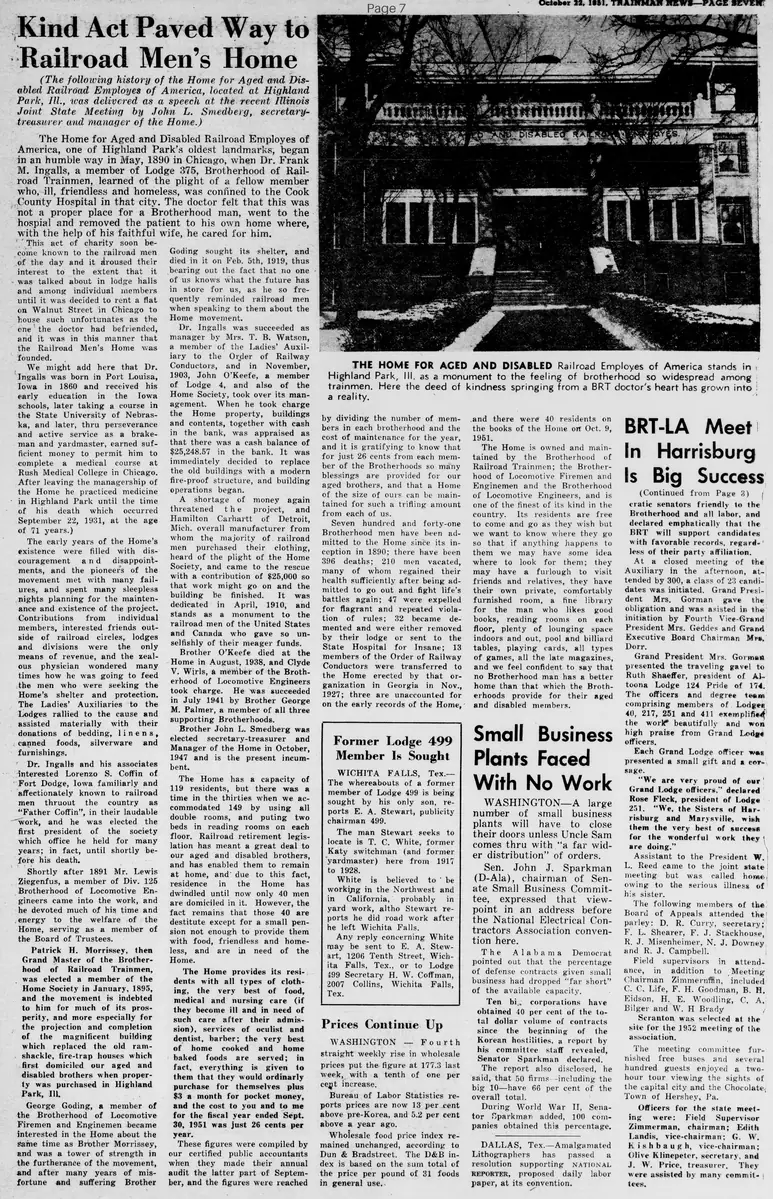
THE HOME FOR AGED AND DISABLED Railroad Employes of America stands in Highland Park, Ill. as a monument to the feeling of brotherhood so widespread among trainmen. Here the deed of kindness springing from a BRT doctor's heart has grown into a reality.
What sub-type of article is it?
What themes does it cover?
What keywords are associated?
What entities or persons were involved?
Where did it happen?
Story Details
Key Persons
Location
Highland Park, Ill.; Chicago
Event Date
May 1890 To 1951
Story Details
Dr. Ingalls founded the Home in 1890 by caring for a sick railroad brother, leading to a rented flat in Chicago. Supported by brotherhoods and key figures, it moved to Highland Park with a modern building dedicated in 1910. Manages 40 residents today, maintained by contributions from railroad organizations.