Thank you for visiting SNEWPapers!
Sign up free
Alexandria Gazette & Daily Advertiser
Alexandria, Virginia
What is this article about?
Jonathan Lambert, a Salem shipmaster, sailed in 1810 to claim and settle the uninhabited Tristan da Cunha island in the South Atlantic, issuing a manifesto in 1811. He developed agriculture and resources there, corresponding about its favorable climate and potential for supplying ships, before drowning in a boat accident circa 1816.
Merged-components note: Continuation of the historical story about Capt. John Lambert across pages 2 and 3, with sequential reading order and direct textual flow.
Clippings
1 of 2
OCR Quality
Full Text
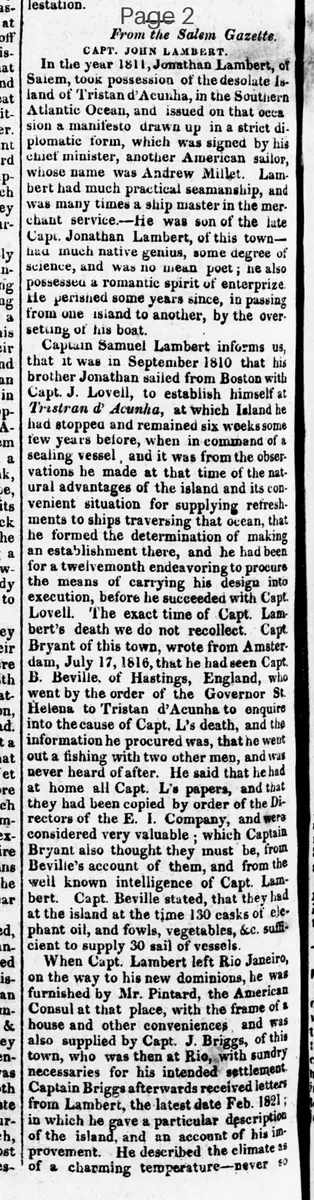
CAPT. JOHN LAMBERT
In the year 1811, Jonathan Lambert, of
Salem, took possession of the desolate Island
of Tristan d'Acunha, in the Southern
Atlantic Ocean, and issued on that occasion
a manifesto drawn up in a strict diplomatic
form, which was signed by his chief minister,
another American sailor, whose name was
Andrew Millet. Lambert had much practical
seamanship, and was many times a ship master
in the merchant service.--he was son of the
late Capt. Jonathan Lambert, of this town--
had much native genius, some degree of
science, and was no mean poet; he also
possessed a romantic spirit of enterprise.
He perished some years since, in passing
from one island to another, by the oversetting
of his boat.
Captain Samuel Lambert informs us, that it
was in September 1810 that his brother
Jonathan sailed from Boston with Capt. J.
Lovell, to establish himself at Tristan d'
Acunha, at which Island he had stopped and
remained six weeks some few years before,
when in command of a sealing vessel. and it
was from the observations he made at that
time of the natural advantages of the island
and its convenient situation for supplying
refreshments to ships traversing that ocean,
that he formed the determination of making
an establishment there, and he had been for
a twelvemonth endeavoring to procure the
means of carrying his design into execution,
before he succeeded with Capt. Lovell. The
exact time of Capt. Lambert's death we do
not recollect. Capt. Bryant of this town,
wrote from Amsterdam, July 17, 1816, that
he had seen Capt. B. Beville, of Hastings,
England, who went by the order of the
Governor St. Helena to Tristan d'Acunha to
enquire into the cause of Capt. L's death,
and the information he procured was, that he
went out a fishing with two other men, and
was never heard of after. He said that he
had at home all Capt. L's papers, and that
they had been copied by order of the Directors
of the E. I. Company. and were considered
very valuable : which Captain Bryant also
thought they must be, from Beville's account
of them. and from the well known intelligence
of Capt. Lambert. Capt. Beville stated. that
they had at the island at the time 130 casks
of elephant oil, and fowls, vegetables, &c.
sufficient to supply 30 sail of vessels
When Capt. Lambert left Rio Janeiro, on
the way to his new dominions, he was
furnished by Mr. Pintard, the American
Consul at that place, with the frame of a
house and other conveniences, and was also
supplied by Capt. J. Briggs, of this town,
who was then at Rio, with sundry necessaries
for his intended settlement. Captain Briggs
afterwards received letters from Lambert,
the latest date Feb. 1821 ; in which he gave
a particular description of the island, and an
account of his improvement. He described
the climate as of a charming temperature--
never so cold as to freeze, nor warm enough
to raise cucumbers, or any of the gourd or
melon tribe.--"there is (he says) an unceasing
stream of water which runs by my door, and
if I had but a small share of poetic genius,
it should not long remain uncelebrated." He
mentioned in his letters, that when he first
went ashore, the boat was unluckily overset,
whereby he lost all but eight potatoes which
he had received of Captain Briggs for seed,
but that from these he had then 80 bushels
in the ground, and had also an acre of barley,
and that he had 400 acres of land fit for
cultivation. He says, "An Irish brig had been
there from Rio, with mules, for water and
grass, the Captain of which left me two
Irish farmers; and they all pronounced my
potatoes to be as good as they are in their
own sweet Ireland."
We have (he says) plenty of geese, pigs,
ducks and fowls, fine fish, and among them
are mackerel peculiar to the island: and an
abundance of kitchen vegetables; so that we
can supply any ship that may stop here for
refreshments. All we now want is clothes
and bread stuff; for eight months we were
without bread, a privation not uncommon to
new settlers. From the sea elephant we could
make 10,000 gallons of oil in a year, if we
had casks to put it in; and could save 1500
skins, worth in any market, $1.50 each. We
have now 1000 gallons of oil in casks which
Capt. Lovell left me. Last December the
Admiral commanding on the Isle of France
station, learning of my being here, sent the
frigate -, Capt. More, to inquire after my
situation, the nature of the soil, climate, &c.
and the officers told me there was no doubt
he would afford me some essential aid. I sent
him some potatoes and cabbages, as a sample
of the produce."
Capt. Lambert's Manifesto. (as it is called
in the piece above alluded to) was published
in July 1811. It bears none of the dress or
titles of royalty. Capt. L. had too much sense
to trick himself out in that manner, though
he probably might with truth have said, "I
am monarch of all I survey." That instrument
is written in strong, plain, republican language;
and instead of assuming the title of Lord or
Prince, he simply denominates himself a
mariner, and a citizen of the United States.
Premising that there had been no prior claim,
he says, "I constitute my individual self the
sole proprietor of those Islands, grounding
my right and claim on the rational and sure
principles of absolute occupancy." The motive
for this enterprise he states to be "the desire
and determination of preparing for himself &
family a home, where he might enjoy life
without the embarrassments which had
hitherto constantly attended him," &c.
Andrew Miller, who signs the instrument
officially as Prime Minister, merely subjoins
his name as witness to Lambert's Signature.
What is the fate of the colony since the fate
of its founder, we do not know--"Alas poor
Yorick!"
What sub-type of article is it?
What themes does it cover?
What keywords are associated?
What entities or persons were involved?
Where did it happen?
Story Details
Key Persons
Location
Tristan Da Cunha, Southern Atlantic Ocean
Event Date
1810 1821
Story Details
Jonathan Lambert claimed Tristan da Cunha in 1811 via manifesto, established settlement with farming and oil production, described island's resources and climate in letters, aided by locals and officials, but perished in boat accident around 1816, fate of colony unknown.