Thank you for visiting SNEWPapers!
Sign up free
New Haven Daily Herald
New Haven, New Haven County, Connecticut
What is this article about?
Letter from Gen. James Hamilton to a friend, expressing admiration for Henry Clay despite past political differences. Recounts their friendship, a 1826 duel between Clay and John Randolph where Randolph deliberately missed, leading to reconciliation. Reflects on Clay's role in the 1833 tariff compromise and potential presidency in 1844.
Clipping
OCR Quality
Full Text
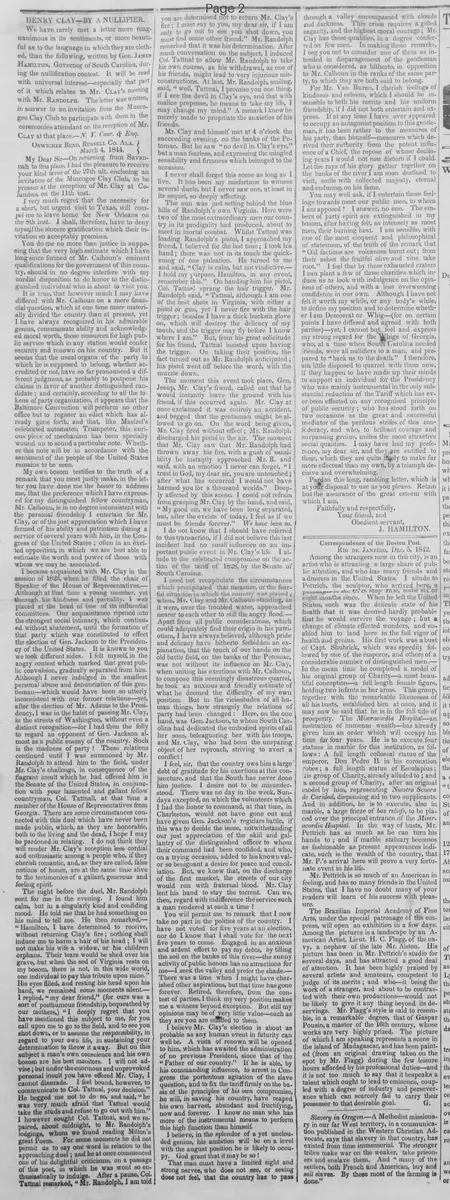
We have rarely met a letter more magnanimous in its sentiments, or more beautiful as to the language in which they are clothed, than the following, written by Gen. JAMES HAMILTON, Governor of South Carolina, during the nullification contest. It will be read with universal interest—especially that part of it which relates to Mr. CLAY's meeting with Mr. RANDOLPH. The letter was written, in answer to an invitation from the Muscogee Clay Club to participate with them in the ceremonies attendant on the reception of Mr. CLAY at that place.—N. Y. Cour. & Enq.
Oswichee Bend, Russell Co. Ala. March 4, 1844.
My Dear Sir—On returning from Savannah to this place, I had the pleasure to receive your kind favor of the 27th ult. enclosing an invitation of the Muscogee Clay Club, to be present at the reception of Mr. Clay at Columbus, on the 11th inst.
I very much regret that the necessity for a short, but urgent visit to Texas, will compel me to leave home for New Orleans on the 8th inst. I shall, therefore, have to deny myself the sincere gratification which their invitation so acceptably promises.
You do me no more than justice in supposing that the very high estimate which I have long since formed of Mr. Calhoun's eminent qualifications for the government of this country, should in no degree interfere with my cordial disposition to do honor to the distinguished individual who is about to visit you.
It is true, that however much I may have differed with Mr. Calhoun on a mere financial question, which at one time more materially divided the country than at present, yet I have always recognized in his admirable genius, consummate ability and acknowledged moral worth, those resources for high public service which in any station would confer security and renown on his country. But it seems that the usual organs of the party to which he is supposed to belong, whether accredited or not, have so far pronounced a different judgment, as probably to postpone his claims in favor of another distinguished candidate: and certainly, according to all the tokens of party organization, it appears that the Baltimore Convention will perform no other office but to register an edict which has already gone forth, and that, like Maelzel's celebrated automaton Trumpeter, this curious piece of mechanism has been specially wound up to sound a particular note. Whether this note will be in accordance with the sentiment of the people of the United States remains to be seen.
My own bosom testifies to the truth of a remark that you most justly make, in the letter you have done me the honor to address me, that the preference which I have expressed for my distinguished fellow countryman, Mr. Calhoun, is in no degree inconsistent with the personal friendship I entertain for Mr. Clay, or of the just appreciation which I have formed of his ability and patriotism during a service of several years with him, in the Congress of the United States; often in an excited opposition, in which we are best able to estimate the worth and power of those with whom we may be associated.
I became acquainted with Mr. Clay in the session of 1823, when he filled the chair of Speaker of the House of Representatives.—Although at that time a young member, yet through his kindness and partiality, I was placed at the head of one of its influential committees. Our acquaintance ripened into the strongest social intimacy, which continued without abatement, until the formation of that party which was constituted to effect the election of Gen. Jackson to the Presidency of the United States. It is known to you we took different sides. I felt myself, in the angry contest which marked that great public convulsion, gradually separated from him. Although I never indulged in the smallest personal abuse and denunciation of this gentleman—which would have been so utterly inconsistent with our former relations—yet, after the election of Mr. Adams to the Presidency, I was in the habit of passing Mr. Clay, in the streets of Washington, without even a distinct recognition—for I had then the folly to regard an opponent of Gen. Jackson almost as a public enemy of the country. Such is the madness of party! These relations continued until I was summoned by Mr. Randolph to attend him to the field, under Mr. Clay's challenge, in consequence of the flagrant insult which he had offered him in the Senate of the United States, in conjunction with your lamented and gallant fellow countryman, Col. Tattnall, at that time a member of the House of Representatives from Georgia. There are some circumstances connected with this duel which have never been made public, which, as they are honorable, both to the living and the dead, I hope I may be pardoned in relating. I do not think they will render Mr. Clay's reception less cordial and enthusiastic among a people who, if they cherish romantic, and, as they are called, false notions of honor, are at the same time alive to the testimonies of a gallant, generous and feeling spirit.
The night before the duel, Mr. Randolph sent for me in the evening. I found him calm, but in a singularly kind and confiding mood. He told me that he had something on his mind to tell me. He then remarked,—"Hamilton, I have determined to receive, without returning Clay's fire; nothing shall induce me to harm a hair of his head; I will not make his wife a widow, or his children orphans. Their tears would be shed over his grave, but when the sod of Virginia rests on my bosom, there is not, in this wide world, one individual to pay this tribute upon mine." His eyes filled, and resting his head upon his hand, we remained some moments silent.
I replied, "my dear friend," (for ours was a sort of posthumous friendship, bequeathed by our mothers,) "I deeply regret that you have mentioned this subject to me, for you call upon me to go to the field, and to see you shot down, or to assume the responsibility, in regard to your own life, in sustaining your determination to throw it away. But on this subject a man's own conscience and his own bosom are his best monitors. I will not advise; but under the enormous and unprovoked personal insult you have offered Mr. Clay, I cannot dissuade. I feel bound, however, to communicate to Col. Tattnall, your decision."
He begged me not to do so, and said, "he was very much afraid that Tattnall would take the studs and refuse to go out with him."
I however sought Col. Tattnall, and we repaired, about midnight, to Mr. Randolph's lodgings, whom we found reading Milton's great Poem. For some moments he did not permit us to say one word in relation to the approaching duel; and he at once commenced one of his delightful criticisms, on a passage of this poet, in which he was wont so enthusiastically to indulge. After a pause, Col. Tattnall remarked, "Mr. Randolph, I am told you are determined not to return Mr. Clay's fire; I must say to you, my dear sir, if I am only to go out to see you shot down, you must find some other friend." Mr. Randolph remarked that it was his determination. After much conversation on the subject, I induced Col. Tattnall to allow Mr. Randolph to take his own course, as his withdrawal, as one of his friends, might lead to very injurious mis-constructions. At last, Mr. Randolph, smiling, said, "well, Tattnall, I promise you one thing, if I see the devil in Clay's eye, and that with malice prepense, he means to take my life, I may change my mind." A remark I knew he merely made to propitiate the anxieties of his friends.
Mr. Clay and himself met at 4 o'clock the succeeding evening, on the banks of the Potomac. But he saw "no devil in Clay's eye," but a man fearless, and expressing the mingled sensibility and firmness which belonged to the occasion.
I never shall forget this scene as long as I live. It has been my misfortune to witness several duels, but I never saw one, at least in its sequel, so deeply affecting.
The sun was just setting behind the blue hills of Randolph's own Virginia. Here were two of the most extraordinary men our country in its prodigality had produced, about to meet in mortal combat. Whilst Tattnall was loading Randolph's pistol, I approached my friend, I believed for the last time; I took his hand; there was not in its touch the quickening of one pulsation. He turned to me and said, "Clay is calm, but not vindictive.—I hold my purpose, Hamilton, in any event, remember this." On handing him his pistol, Col. Tattnall sprang the hair trigger." Mr. Randolph said, "Tattnall, although I am one of the best shots in Virginia, with either a pistol or gun, yet I never fire with the hair trigger; besides I have a thick buckskin glove on, which will destroy the delicacy of my touch, and the trigger may fly before I know where I am." But, from his great solicitude for his friend, Tattnall insisted upon having the trigger. On taking their position, the fact turned out as Mr. Randolph anticipated: his pistol went off before the word, with the muzzle down.
The moment this event took place, Gen. Jesup, Mr. Clay's friend, called out that he would instantly leave the ground with his friend, if this occurred again. Mr. Clay at once exclaimed it was entirely an accident, and begged that the gentleman might be allowed to go on. On the word being given, Mr. Clay fired without effect; Mr. Randolph discharged his pistol in the air. The moment that Mr. Clay saw that Mr. Randolph had thrown away his fire, with a gush of sensibility he instantly approached Mr. R. and said, with an emotion I never can forget, "I trust in God, my dear sir, you are untouched; after what has occurred I would not have harmed you for a thousand worlds." Deeply affected by this scene, I could not refrain from grasping Mr. Clay by the hand, and said, "My good sir, we have been long separated, but, after the events of today, I feel as if we must be friends forever." We have been so.
I do not know that I should have referred to this transaction, if I did not believe this last incident had no small influence on an important public event in Mr. Clay's life. I allude to the celebrated compromise on the action of the tariff of 1828, by the Senate of South Carolina.
I need not recapitulate the circumstances which precipitated that measure, or the fearful situation in which the country was placed, when, Mr. Clay and Mr. Calhoun standing, as it were, over the troubled water, approached nearer to each other to still the angry flood.—Apart from all public considerations, which could adequately find their origin in his patriotism, I have always believed, although pride and delicacy have hitherto forbidden an explanation, that the touch of our hands on the old battle field, on the banks of the Potomac, was not without its influence on Mr. Clay, when uniting his exertions with Mr. Calhoun, to compose this seemingly disastrous quarrel, he took an anxious and friendly estimate of what he deemed the difficulty of my own position. But in the vicissitudes of all human things, how strangely the relations of party had been changed: Here, on the one hand, was Gen. Jackson, to whom South Carolina had dedicated the embodied spirits of all her sons, beleaguering her with his troops, and Mr. Clay, who had been the unsparing object of her reproach, striving to avert a conflict!
I feel, sir, that the country owes him a large debt of gratitude for his exertions at this conjuncture, and that the South has never done him justice. I desire not to be misunderstood. There was no day in the week, Sundays excepted, on which the volunteers which I had the honor to command, at that time, in Charleston, would not have gone out and have given Gen. Jackson's regulars battle, if this was to decide the issue, notwithstanding our just appreciation of the skill and gallantry of the distinguished officer to whom their command had been confided, and who, on a trying occasion, added to his known valor so benignant a desire for peace and conciliation. But, we knew that, on the discharge of the first musket, the streets of our city would run with fraternal blood. Mr. Clay lent his hand to stay the torrent. Can we, then, regard with indifference the service such a man rendered at such a time?
You will permit me to remark that I now take no part in the politics of the country. I have not voted for five years at an election, nor do I know that I shall vote for the next five years to come. Engaged in an anxious and ardent effort to pay my debts, by tilling the soil on the banks of this river—the sunny acclivity of public honors has no attractions for me. I seek the valley and prefer the shade.—There was a time when I might have cherished other aspirations, but that time has gone forever. Retired, therefore, from the contest of parties, I think my very position makes me a witness beyond exception. But still my opinions may be of very little value—such as they are you are entitled to them.
I believe Mr. Clay's election is about as probable as any human event in futurity can well be. A vista of renown will be opened to him, which has awaited the administration of no previous President, since that of the "Father of our country." If he is able, by his commanding influence, to arrest in Congress the portentous agitation of the slave question, and to fix the tariff firmly on the basis of the principles of his own compromise, he will, in saving his country, have reaped his own harvest, abundant and fructifying, now and forever. I know no man who has more of the instrumental means to perform this high function than himself.
I believe, in the splendor of a yet unclouded genius, his ambition will be on a level with the august position he is likely to occupy. God grant that it may be so!
That man must have a limited sight and strong nerves, who does not see, or seeing does not feel, that the country has to pass through a valley encompassed with clouds and darkness. This crisis requires a gifted sagacity, and the highest moral courage; Mr. Clay has these qualities, in a degree conferred on few men. In making these remarks, I beg you not to consider one of them as intended in disparagement of the gentleman who is considered, as hitherto, in opposition to Mr. Calhoun in the ranks of the same party, to which they are both said to belong.
For Mr. Van Buren, I cherish feelings of kindness and esteem, which I should be insensible to both his merits and his uniform friendship, if I did not both entertain and express. If at any time I have ever appeared to occupy an antagonist position to this gentleman, it has been rather to the measures of his party, than himself—measures which derived their authority from the potent influence of a Chief, the repose of whose declining years I would not now disturb if I could. Let the rays of his glory gather together on the banks of the river I am soon destined to visit, settle with collected majesty, eternal and enduring, on his fame.
You may well ask, if I entertain these feelings towards most our public men, to whom I am opposed? I answer, no one. The embers of party spirit are extinguished in my bosom, after having felt, as intensely as most men, their burning heat. I am sensible, with one of the most eloquent and philosophical of statesmen, of the truth of the remark that "Old factions are volcanoes burnt out; from their ashes the fruitful olive and vine take root." I feel that by these exhausted craters I can plant a few of those charities which induce us to look with indulgence on the opinions of others, and with a less overweening confidence in our own. Although I have not felt it worth my while, or any body's while, to define my position and to determine whether I am Democrat or Whig (for on certain points I have differed and agreed with both parties)—yet, I cannot but feel and express my strong regard for the Whigs of Georgia, who, at a time when South Carolina needed friends, were all nullifiers to a man, and prepared to "back us to the death." I therefore, am little disposed to quarrel with them now, if they happen to have made up their minds to support an individual for the Presidency who was mainly instrumental in the only substantial reduction of the Tariff which has ever been effected on any recognised principle of public security; who has stood forth on two occasions as the great and successful mediator of the perilous strifes of this confederacy, and who, to brilliant courage and surpassing genius, unites the most attractive social qualities. I may have had my preference, my dear sir, and they are entitled to theirs, which they are quite likely to make far more effectual than my own, by a triumph decisive and overwhelming.
Pardon this long, rambling letter, which is at your disposal to use as you please. Retain but the assurance of the great esteem with which I am,
Faithfully and respectfully,
Your friend, and
Obedient servant,
J. HAMILTON.
What sub-type of article is it?
What themes does it cover?
What keywords are associated?
What entities or persons were involved?
Where did it happen?
Story Details
Key Persons
Location
Banks Of The Potomac, Washington, South Carolina, Oswichee Bend, Russell Co. Ala.
Event Date
March 4, 1844
Story Details
Gen. James Hamilton writes a letter praising Henry Clay, recounting their friendship from 1823, political rift over Jackson's election, and reconciliation after the 1826 duel with Randolph where Randolph deliberately missed Clay's fire, leading to emotional forgiveness. Hamilton credits this for Clay's later role in the 1833 tariff compromise averting nullification crisis.