Thank you for visiting SNEWPapers!
Sign up free
The Alexandria Herald
Alexandria, Virginia
What is this article about?
Letter defends John Quincy Adams against 'Sidney's' accusations of abandoning principles by ratifying a mutual right-of-search treaty, arguing it renounces British overreach, benefits peace including for Africa via anti-slave trade, and praises Senate's wisdom. Compares to Jay's Treaty success. Signed Aristides for Alexandria Herald.
Clipping
OCR Quality
Full Text
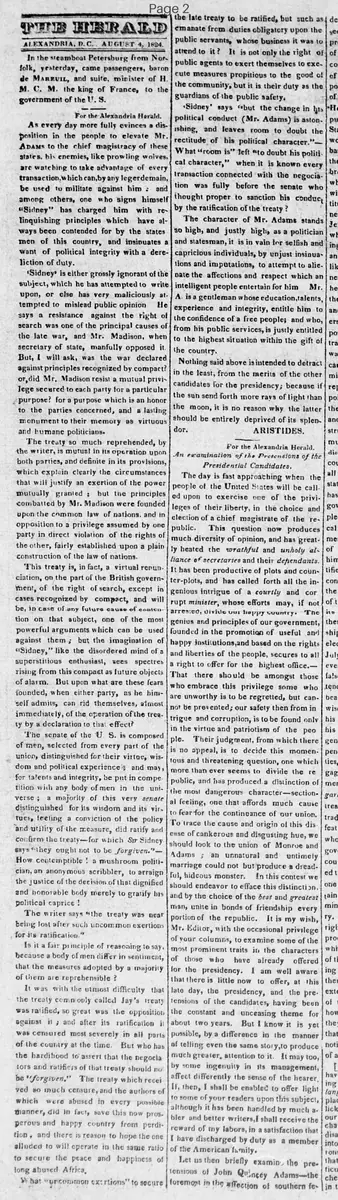
As every day more fully evinces a disposition in the people to elevate Mr. Adams to the chief magistracy of these states, his enemies, like prowling wolves, are watching to take advantage of every transaction, which can, by any legerdemain, be used to militate against him: and among others, one who signs himself "Sidney" has charged him with relinquishing principles which have always been contended for by the statesmen of this country, and insinuates a want of political integrity with a dereliction of duty.
Sidney is either grossly ignorant of the subject, which he has attempted to write upon, or else has very maliciously attempted to mislead public opinion. He says a resistance against the right of search was one of the principal causes of the late war, and Mr. Madison, when secretary of state, manfully opposed it.
But, I will ask, was the war declared against principles recognized by compact? or did Mr. Madison resist a mutual privilege secured to each party for a particular purpose? for a purpose which is an honor to the parties concerned, and a lasting monument to their memory as virtuous and humane politicians.
The treaty so much reprehended, by the writer, is mutual in its operation upon both parties, and definite in its provisions, which explain clearly the circumstances that will justify an exertion of the power mutually granted: but the principles combatted by Mr. Madison were founded upon the common law of nations, and in opposition to a privilege assumed by one party in direct violation of the rights of the other, fairly established upon a plain construction of the law of nations.
This treaty is, in fact, a virtual renunciation, on the part of the British government, of the right of search, except in cases recognized by compact, and will be, in case of any future cause of contention on that subject, one of the most powerful arguments which can be used against them; but the imagination of "Sidney," like the disordered mind of a superstitious enthusiast, sees spectres rising from this compact as future objects of alarm. But upon what are these fears founded, when either party, as he himself admits, can rid themselves, almost immediately, of the operation of the treaty by a declaration to that effect?
The senate of the U S. is composed of men, selected from every part of the union, distinguished for their virtue, wisdom and political experience and may, for talents and integrity, be put in competition with any body of men in the universe; a majority of this very senate distinguished for its wisdom and its virtues, feeling a conviction of the policy and utility of the measure, did ratify and confirm the treaty--or which Sir Sidney says "they ought not to be forgiven."
How contemptible! a mushroom politician, an anonymous scribbler, to arraign the justice of the decision of that dignified and honorable body merely to gratify his political caprice!
The writer says "the treaty was near being lost after such uncommon exertions for its ratification."
Is it a fair principle of reasoning to say, because a body of men differ in sentiment, that the measures adopted by a majority of them are reprehensible?
It was with the utmost difficulty that the treaty commonly called Jay's treaty was ratified, so great was the opposition against it; and after its ratification it was censured most severely in all parts of the country at the time. But who has the hardihood to assert that the negotiators and ratifiers of that treaty should not be "forgiven." The treaty which received so much censure, and the authors of which were abused in every possible manner, did in fact, save this now prosperous and happy country from perdition, and there is reason to hope the one alluded to will operate in the same ratio to secure the peace and happiness of long abused Africa.
What "our common exertions" to secure the late treaty to be ratified, but such as emanate from duties obligatory upon the public servants, whose business it was to attend to it? It is not only the right of public agents to exert themselves to execute measures propitious to the good of the community, but it is their duty as the guardians of the public safety.
"Sidney" says "but the change in his political conduct (Mr. Adams) is astonishing, and leaves room to doubt the rectitude of his political character."
What "room is left" to doubt his political character, when it is known every transaction connected with the negotiation was fully before the senate who thought proper to sanction his conduct by the ratification of the treaty?
The character of Mr. Adams stands so high, and justly high, as a politician and statesman, it is in vain for selfish and capricious individuals, by unjust insinuations and imputations, to attempt to alienate the affections and respect which an intelligent people entertain for him. Mr. A. is a gentleman whose education, talents, experience and integrity, entitle him to the confidence of a free people; and who, from his public services, is justly entitled to the highest situation within the gift of the country.
Nothing said above is intended to detract in the least, from the merits of the other candidates for the presidency; because if the sun send forth more rays of light than the moon, it is no reason why the latter should be entirely deprived of its splendor.
ARISTIDES.
What sub-type of article is it?
What themes does it cover?
What keywords are associated?
What entities or persons were involved?
Letter to Editor Details
Author
Aristides.
Recipient
For The Alexandria Herald.
Main Argument
defends mr. adams against 'sidney's' charges of political inconsistency in ratifying the mutual right-of-search treaty, asserting it upholds principles, renounces british overreach, aids anti-slave trade efforts, and was wisely approved by the senate, similar to jay's treaty.
Notable Details