Thank you for visiting SNEWPapers!
Sign up free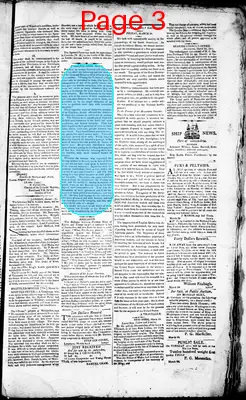
Editorial
March 29, 1811
Alexandria Daily Gazette, Commercial & Political
Alexandria, Virginia
What is this article about?
Editorial draws on Polybius to contrast Greek avarice and lack of integrity in public trust, leading to their downfall under Philip of Macedon, with Roman fidelity to oaths that sustained their republic for centuries, implying the US should emulate the Romans to avoid corruption.
Clipping
OCR Quality
98%
Excellent
Full Text
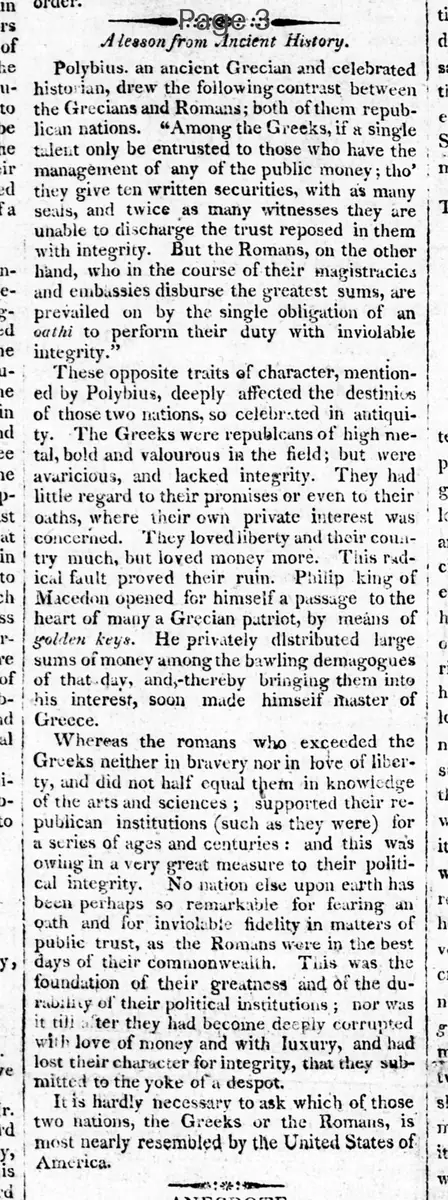
A Lesson from Ancient History.
Polybius, an ancient Grecian and celebrated historian, drew the following contrast between the Grecians and Romans; both of them republican nations. "Among the Greeks, if a single talent only be entrusted to those who have the management of any of the public money; though they give ten written securities, with as many seals, and twice as many witnesses they are unable to discharge the trust reposed in them with integrity. But the Romans, on the other hand, who in the course of their magistracies and embassies disburse the greatest sums, are prevailed on by the single obligation of an oath to perform their duty with inviolable integrity."
These opposite traits of character, mentioned by Polybius, deeply affected the destinies of those two nations, so celebrated in antiquity. The Greeks were republicans of high mettle, bold and valorous in the field; but were avaricious, and lacked integrity. They had little regard to their promises or even to their oaths, where their own private interest was concerned. They loved liberty and their country much, but loved money more. This radical fault proved their ruin. Philip king of Macedon opened for himself a passage to the heart of many a Grecian patriot, by means of golden keys. He privately distributed large sums of money among the bawling demagogues of that day, and,--thereby bringing them into his interest, soon made himself master of Greece.
Whereas the Romans who exceeded the Greeks neither in bravery nor in love of liberty, and did not half equal them in knowledge of the arts and sciences; supported their republican institutions (such as they were) for a series of ages and centuries: and this was owing in a very great measure to their political integrity. No nation else upon earth has been perhaps so remarkable for fearing an oath and for inviolable fidelity in matters of public trust, as the Romans were in the best days of their commonwealth. This was the foundation of their greatness and of the durability of their political institutions; nor was it till after they had become deeply corrupted with love of money and with luxury, and had lost their character for integrity, that they submitted to the yoke of a despot.
It is hardly necessary to ask which of those two nations, the Greeks or the Romans, is most nearly resembled by the United States of America.
Polybius, an ancient Grecian and celebrated historian, drew the following contrast between the Grecians and Romans; both of them republican nations. "Among the Greeks, if a single talent only be entrusted to those who have the management of any of the public money; though they give ten written securities, with as many seals, and twice as many witnesses they are unable to discharge the trust reposed in them with integrity. But the Romans, on the other hand, who in the course of their magistracies and embassies disburse the greatest sums, are prevailed on by the single obligation of an oath to perform their duty with inviolable integrity."
These opposite traits of character, mentioned by Polybius, deeply affected the destinies of those two nations, so celebrated in antiquity. The Greeks were republicans of high mettle, bold and valorous in the field; but were avaricious, and lacked integrity. They had little regard to their promises or even to their oaths, where their own private interest was concerned. They loved liberty and their country much, but loved money more. This radical fault proved their ruin. Philip king of Macedon opened for himself a passage to the heart of many a Grecian patriot, by means of golden keys. He privately distributed large sums of money among the bawling demagogues of that day, and,--thereby bringing them into his interest, soon made himself master of Greece.
Whereas the Romans who exceeded the Greeks neither in bravery nor in love of liberty, and did not half equal them in knowledge of the arts and sciences; supported their republican institutions (such as they were) for a series of ages and centuries: and this was owing in a very great measure to their political integrity. No nation else upon earth has been perhaps so remarkable for fearing an oath and for inviolable fidelity in matters of public trust, as the Romans were in the best days of their commonwealth. This was the foundation of their greatness and of the durability of their political institutions; nor was it till after they had become deeply corrupted with love of money and with luxury, and had lost their character for integrity, that they submitted to the yoke of a despot.
It is hardly necessary to ask which of those two nations, the Greeks or the Romans, is most nearly resembled by the United States of America.
What sub-type of article is it?
Moral Or Religious
Constitutional
What keywords are associated?
Political Integrity
Public Trust
Oaths
Greek Roman Comparison
Republican Institutions
Avarice
United States
What entities or persons were involved?
Polybius
Greeks
Romans
Philip King Of Macedon
United States Of America
Editorial Details
Primary Topic
Lesson On Political Integrity From Greek And Roman History For The United States
Stance / Tone
Cautionary Emphasis On The Importance Of Integrity For Sustaining Republican Institutions
Key Figures
Polybius
Greeks
Romans
Philip King Of Macedon
United States Of America
Key Arguments
Greeks Lacked Integrity In Handling Public Money Despite Securities
Romans Upheld Duty Through Oaths Alone
Greek Avarice Allowed Philip To Corrupt Leaders And Conquer Greece
Roman Political Integrity Sustained Their Republic For Centuries
Corruption With Money And Luxury Led Romans To Despotism
Us Should Resemble Romans More Than Greeks In Integrity