Thank you for visiting SNEWPapers!
Sign up free
Farmers Independent
Bagley, Clearwater County, Minnesota
What is this article about?
Upton Sinclair, a socialist writer, wins the Democratic nomination for California governor with a large margin, launching the 'End Poverty in California' campaign amid the Great Depression, proposing radical reforms like pensions, tax changes, and state-run industries for the unemployed, signaling a shift in conservative California politics.
Clipping
OCR Quality
Full Text
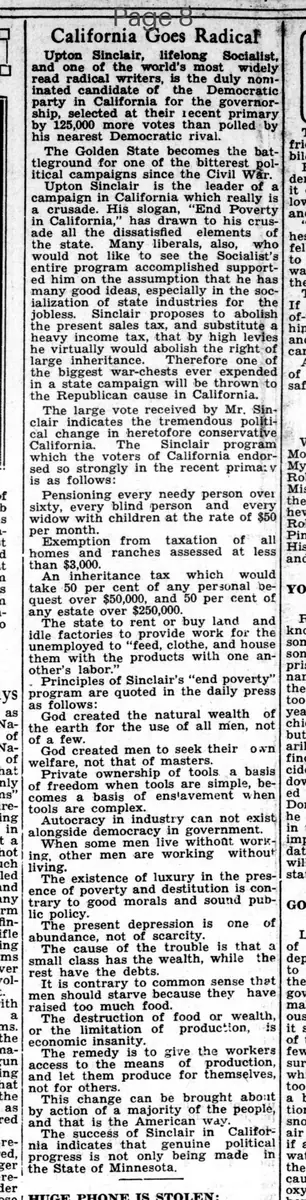
Upton Sinclair, lifelong Socialist, and one of the world's most widely read radical writers, is the duly nominated candidate of the Democratic party in California for the governorship, selected at their recent primary by 125,000 more votes than polled by his nearest Democratic rival.
The Golden State becomes the battleground for one of the bitterest political campaigns since the Civil War.
Upton Sinclair is the leader of a campaign in California which really is a crusade. His slogan, "End Poverty in California," has drawn to his crusade all the dissatisfied elements of the state. Many liberals, also, who would not like to see the Socialist's entire program accomplished supported him on the assumption that he has many good ideas, especially in the socialization of state industries for the jobless. Sinclair proposes to abolish the present sales tax, and substitute a heavy income tax, that by high levies he virtually would abolish the right of large inheritance. Therefore one of the biggest war-chests ever expended in a state campaign will be thrown to the Republican cause in California.
The large vote received by Mr. Sinclair indicates the tremendous political change in heretofore conservative California. The Sinclair program which the voters of California endorsed so strongly in the recent primary is as follows:
Pensioning every needy person over sixty, every blind person and every widow with children at the rate of $50 per month.
Exemption from taxation of all homes and ranches assessed at less than $3,000.
An inheritance tax which would take 50 per cent of any personal bequest over $50,000, and 50 per cent of any estate over $250,000.
The state to rent or buy land and idle factories to provide work for the unemployed to "feed, clothe, and house them with the products with one another's labor."
Principles of Sinclair's "end poverty" program are quoted in the daily press as follows:
God created the natural wealth of the earth for the use of all men, not of a few.
God created men to seek their own welfare, not that of masters.
Private ownership of tools, a basis of freedom when tools are simple, becomes a basis of enslavement when tools are complex.
Autocracy in industry can not exist alongside democracy in government.
When some men live without working, other men are working without living.
The existence of luxury in the presence of poverty and destitution is contrary to good morals and sound public policy.
The present depression is one of abundance, not of scarcity.
The cause of the trouble is that a small class has the wealth, while the rest have the debts.
It is contrary to common sense that men should starve because they have raised too much food.
The destruction of food or wealth, or the limitation of production, is economic insanity.
The remedy is to give the workers access to the means of production, and let them produce for themselves, not for others.
This change can be brought about by action of a majority of the people and that is the American way.
The success of Sinclair in California indicates that genuine political progress is not only being made in the State of Minnesota.
What sub-type of article is it?
What themes does it cover?
What keywords are associated?
What entities or persons were involved?
Where did it happen?
Story Details
Key Persons
Location
California
Story Details
Upton Sinclair secures Democratic nomination for governor by over 125,000 votes, promoting 'End Poverty in California' with proposals for pensions, tax exemptions, inheritance taxes, and state provision of land and factories for unemployed workers to produce essentials; his principles emphasize equitable wealth distribution and critique industrial autocracy.