Thank you for visiting SNEWPapers!
Sign up free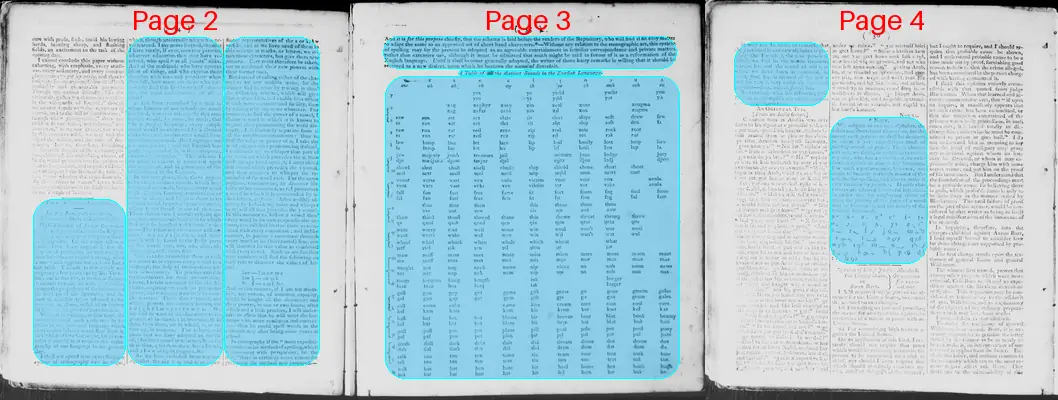
The Wheeling Repository
Wheeling, Ohio County, West Virginia
What is this article about?
An anonymous essay in the Wheeling Repository proposes a phonetic spelling system for English to address orthographic irregularities, building on Dr. Thornton's scheme. It details 11 vowel sounds, retains 17 consonants, adds 6 new characters, and includes a table of combinations. Suggests use in shorthand and correspondence, naming it 'Sonoskrit'.
Merged-components note: Components form a single article on English orthography reform, including the embedded phonetic table (RO -1, but contextually part of the article) and concluding note on shorthand; sequential reading order and text continuity across pages.
Clippings
1 of 3
OCR Quality
Full Text
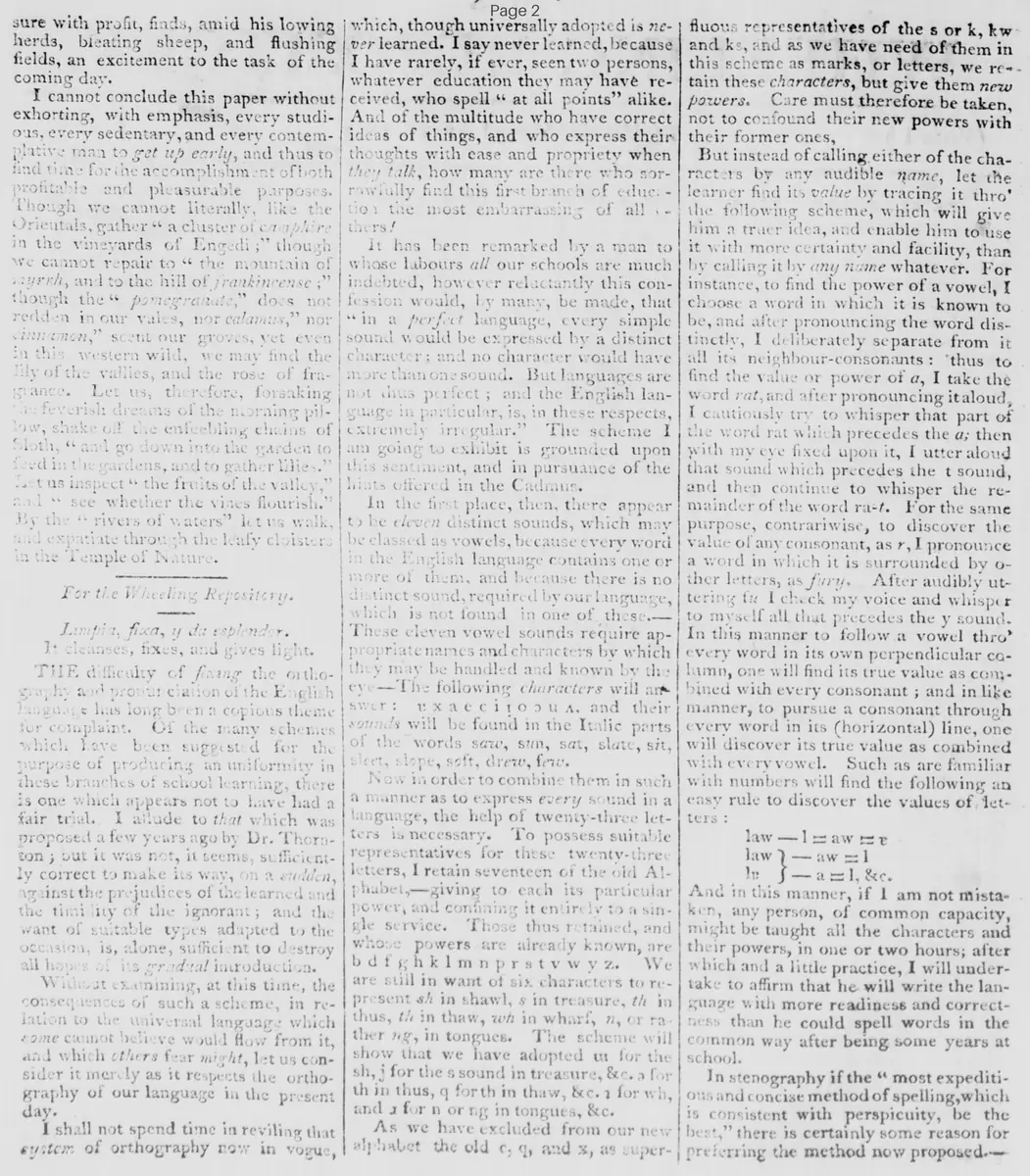
Lumina fixa, et da splendor.
It cleanses, fixes, and gives light.
The difficulty of fixing the orthography and proper pronunciation of the English language has long been a copious theme for complaint. Of the many schemes which have been suggested for the purpose of producing an uniformity in these branches of school learning, there is one which appears not to have had a fair trial. I allude to that which was proposed a few years ago by Dr. Thornton; but it was not, it seems, sufficiently correct to make its way, on a sudden, against the prejudices of the learned and the timidity of the ignorant; and the want of suitable types adapted to the occasion, is, alone, sufficient to destroy all hopes of its gradual introduction.
Without examining, at this time, the consequences of such a scheme, in relation to the universal language which one cannot believe would flow from it, and which others fear might, let us consider it merely as it respects the orthography of our language in the present day.
I shall not spend time in reviling that system of orthography now in vogue, which, though universally adopted is never learned. I say never learned, because I have rarely, if ever, seen two persons, whatever education they may have received, who spell "at all points" alike. And of the multitude who have correct ideas of things, and who express their thoughts with ease and propriety when they talk, how many are there who sorrowfully find this first branch of education the most embarrassing of all? Others!
It has been remarked by a man to whose labours all our schools are much indebted, however reluctantly this confession would, by many, be made, that "in a perfect language, every simple sound would be expressed by a distinct character: and no character would have more than one sound. But languages are not thus perfect; and the English language in particular, is, in these respects, extremely irregular." The scheme I am going to exhibit is grounded upon this sentiment, and in pursuance of the hints offered in the Cadmus.
In the first place, then, there appear to be eleven distinct sounds, which may be classed as vowels, because every word in the English language contains one or more of them, and because there is no distinct sound, required by our language, which is not found in one of these.— These eleven vowel sounds require appropriate names and characters by which they may be handled and known by the eye--The following characters will answer: a e i o u A, and their sounds will be found in the Italic parts of the words sar, sun, sat, slate, sit, alert, sleep, soft, deer, fear.
Now in order to combine them in such a manner as to express every sound in a language, the help of twenty-three letters is necessary. To possess suitable representatives for these twenty-three letters, I retain seventeen of the old Alphabet,--giving to each its particular power, and confining it entirely to a single service. Those thus retained, and whose powers are already known, are b d f g h k l m n p r s t v w y z. We are still in want of six characters to represent sh in shawl, s in treasure, th in thus, th in thaw, wh in wharf, ng in tongues. The scheme will show that we have adopted u for the sh, i for the s sound in treasure, &c. a for th in thus, q for th in thaw, &c. i for wh, and a for ng or ng in tongues, &c.
As we have excluded from our new alphabet the old c, q, and x, as superfluous representatives of the s or k, kw and ks, and as we have need of them in this scheme as marks, or letters, we retain these characters, but give them new powers. Care must therefore be taken, not to confound their new powers with their former ones,
But instead of calling either of the characters by any audible name, let the learner find its value by tracing it thro' the following scheme, which will give him a truer idea, and enable him to use it with more certainty and facility, than by calling it by any name whatever. For instance, to find the power of a vowel, I choose a word in which it is known to be, and after pronouncing the word distinctly, I deliberately separate from it all its neighbour-consonants: thus to find the value or power of a, I take the word rat, and after pronouncing it aloud. I cautiously try to whisper that part of the word rat which precedes the a; then with my eye fixed upon it, I utter aloud that sound which precedes the t sound, and then continue to whisper the remainder of the word ra-t. For the same purpose, contrariwise, to discover the value of any consonant, as r, I pronounce a word in which it is surrounded by other letters, as fury, After audibly uttering fu I check my voice and whisper to myself all that precedes the y sound.
In this manner to follow a vowel thro' every word in its own perpendicular column, one will find its true value as combined with every consonant; and in like manner, to pursue a consonant through every word in its (horizontal) line, one will discover its true value as combined with every vowel. Such as are familiar with numbers will find the following an easy rule to discover the values of letters:
law-l=aw =e
And in this manner, if I am not mistaken, any person, of common capacity, might be taught all the characters and their powers, in one or two hours; after which and a little practice, I will undertake to affirm that he will write the language with more readiness and correctness than he could spell words in the common way after being some years at school.
In stenography if the "most expeditious and concise method of spelling, which is consistent with perspicuity, be the best,' there is certainly some reason for preferring the method now proposed.-
| aw | uh | ah | eh | ay | ih | . | . | oh | auh | osh | au |
| y | yes | ye | yield | . | yacht | you | |||||
| yes | yi | yild | . | yot | yA | ||||||
| z | . | zephyr | zany | zin | zeal | zone | zeugma | ||||
| . | zefxr | zcni | zin | zil | zon | zugma | |||||
| s | saw | sun | sat | set | slate | sit | sleet | slope | soft | root | few |
| se | sxn | sat | set | slct | sit | slit | slop | soft | dru | dru | fA |
| r | raw | run | rat | red | raze | rip | reel | rote | rock | root | |
| re | rxn | rat | red | rcz | rip | rip | rot | rok | rut | ||
| 1 | law | lump | lass | let | lace | lip | leaf | lonely | lost | loop | lieu |
| le | lxmp | las | let | les | lip | lip | lif | lonli | lost | lup | lA |
| j | jaw | majesty | jamb | treasure | jail | seizure | joan | lodge | jury | ||
| dje | madjxi | djam | trejxr | djcl | sijxr | djon | ladj | djvri | |||
| w | shawl | shut | shall | shell | shade | ship | shield | shone | short | shoot | |
| wel | wxt | wall | wel | wcd | wip | wild | won | wort | wurt | ||
| v | vaunt | verse | vast | vex | vain | victim | veer | vote | vox | uvula | |
| ven | vxrs | vast | veks | vcn | viktim | vir | vot | voks | Avula | ||
| f | fall | fun | fast | fret | fame | fit | feet | foam | fog | fool | fume |
| fel | fxn | fast | fret | fcm | fit | fit | fom | fog | ful | ful | fam |
| -9 | thus | that | then | this | these | those | thou | ||||
| axs | at | en | is | ais | az | az | azw | ||||
| q | thaw | third | thank | thread | thane | thin | theme | throat | throng | threw | |
| qe | qxrd | qaik | qred | qcn | qin | qim | qrot | qro | qru | ||
| w | want | worry | wax | well | wane | win | weal | won't | wot | wool | |
| w | went | wxrri | waks | wel | wcn | win | wil | won't | wot | wul | |
| 1 | wharf | whirl | whack | when | whale | which | wheat | what | |||
| qerf | xrl | ak | en | icl | pitu | it | it | it | |||
| m | maw | muff | mass | met | mate | miss | mien | more | moss | moon | muse |
| me | mxff | mas | met | mct | mis | min | mor | mos | mun | mas | |
| n | naught | nut | nap | neck | name | nip | niece | no | nob | noon | news |
| net | nxt | nap | nek | ncm | nip | mis | no | nob | nun | nas | |
| r | tongs | tongues | hang | length | ink | longer | |||||
| taiz | txiz | har | leq | irk | luger | ||||||
| g | gall | gun | gap | get | game | gift | geese | go | gone | grooin | gules |
| gel | gxn | gap | get | gcm | gift | gis | go | gon | grum | gales | |
| k | call | come | calm | came | kiss | cream | core | cost | cool | cure | |
| kll | kxm | kam | kcm | kis | krim | kor | kost | kul | kar | ||
| b | ball | but | bat | bet | blame | bit | breeze | boat | blot | book | beauty |
| bel | bxt | bat | bet | blem | bit | brizz | bot | blot | buk | bati | |
| L | pall | puff | pan | pet | plane | pill | peal | pole | pot | pool | puny |
| pel | pxf | pan | pet | plcn | pil | pil | pol | pot | pul | pani | |
| d | daub | dull | dark | debt | dale | did | dream | drone | dot | doom | due |
| deb | dxl | dark | det | del | did | drim | dron | dot | dum | dA | |
| t | talk | tun | tan | ten | tame | tin | team | tone | trot | took | tune |
| tek | txn | tan | ten | tcm | tin | tim | ton | trot | tuk | tan | |
| h | hall | hut | hat | hen | hate | hit | heel | home | hot | hook | hug |
| hek | hxt | hat | hen | het | hit | hil | hom | hot | huk | ha |
And it is for this purpose chiefly, that the scheme is laid before the readers of the Repository, who will find it an easy matter to adapt the same to an approved set of short hand characters.* Without any relation to the stenographic art, this system of spelling may for the present be adopted as an agreeable entertainment in familiar correspondence and private matters rather than extensive use, although it must be admitted that much might be said in favour of it as a reformation of the English language.
Until it shall become generally adopted, the writer of these hasty remarks is willing that it should be received as a new dialect, upon which he bestows the name of Sonoskrit.
A Table of all the distinct Sounds in the English Language.
It may not be amiss to remark, that the j retained in our new alphabet is precisely the French j, the true power of which we find in the words treasure, seizure, &c. and the sound of old i, to which we have been accustomed, in mind, find, &c. is formed of the new a and the new i, very suddenly squeezed together--thus, maind, fiand, &c.
We conclude with the following little Lesson, to exemplify the proper sounds of the new characters.
* NOTE.
We subjoin to our new alphabet, the following short-hand characters, for the use of such persons as shall be desirous to adopt a very expeditious mode of putting sounds on paper. These characters are, we think, so simple as to enable any one who has a correct ear, to write down a speech in almost any language. For such a performance, however, one ought to become perfectly master of the scheme for spelling, and also to make it very familiar by practice. Double characters are allowed in several instances, in order that by employing either of them the joining of the parts of a word may be facilitated, and the beauty of the writing increased.
Shorthand characters: 2 x a c ct 1 1 4 0 A y? z S - r Q u c .0 q pb wpb 1 qd n 1 g k 9 b( PeG d. ) t 1 h9
What sub-type of article is it?
What keywords are associated?
Literary Details
Subject
Reform Of English Orthography And Pronunciation
Key Lines