Thank you for visiting SNEWPapers!
Sign up free
The Daily Alaska Empire
Juneau, Juneau County, Alaska
What is this article about?
In Washington on May 27, 1941, Treasury experts explain a proposed plan to Congress for $3.5 billion in new defense taxes to prevent inflation amid booming national income and defense spending, inspired by Keynes, with additional borrowing and bond sales.
Merged-components note: Merged story continuation from page 1 to page 8 based on explicit '(Continued on Page Eight)' cue.
Clippings
1 of 2
OCR Quality
Full Text
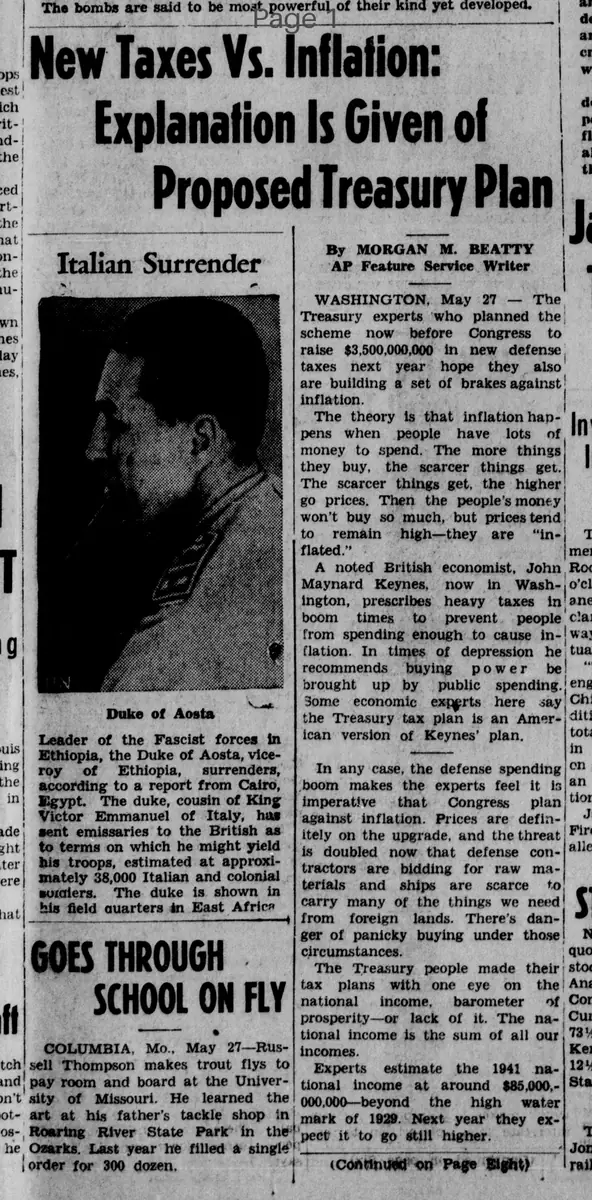
By MORGAN M. BEATTY
AP Feature Service Writer
WASHINGTON, May 27 - The Treasury experts who planned the scheme now before Congress to raise $3,500,000,000 in new defense taxes next year hope they also are building a set of brakes against inflation.
The theory is that inflation happens when people have lots of money to spend. The more things they buy, the scarcer things get. The scarcer things get, the higher go prices. Then the people's money won't buy so much, but prices tend to remain high-they are "inflated."
A noted British economist, John Maynard Keynes, now in Washington, prescribes heavy taxes in boom times to prevent people from spending enough to cause inflation. In times of depression he recommends buying power be brought up by public spending.
Some economic experts here say the Treasury tax plan is an American version of Keynes' plan.
In any case, the defense spending boom makes the experts feel it is imperative that Congress plan against inflation. Prices are definitely on the upgrade, and the threat is doubled now that defense contractors are bidding for raw materials and ships are scarce to carry many of the things we need from foreign lands. There's danger of panicky buying under those circumstances.
The Treasury people made their tax plans with one eye on the national income, barometer of prosperity-or lack of it. The national income is the sum of all our incomes.
Experts estimate the 1941 national income at around $85,000,000,000-beyond the high water mark of 1929. Next year they expect it to go still higher.
(Continued on Page Eight)
New Taxes Vs. Inflation:
Explanation Is Given
Proposed Treasury Plan
(Continued from Page One)
This increase will be a temptation to every citizen who gets his little bit of it to go out and buy his head off, especially in these times when installment buying is so easy.
The question as the Treasury men saw it was to figure out how to keep increased income from rocking the financial boat.
First, they figured they could grab off that $3,500,000,000 in extra taxes. If the government taxes your money away from you, you can't spend it.
Next, the Treasury is going into the big money market and borrow $6,000,000,000 from banks, insurance companies, etc., who received it from you. If the government borrows your money, you can't spend it.
Third. Uncle Sam is selling defense bonds and stamps to low-wage people, housewives, children. If the government syphons your pin money out of your pockets, you can't spend it.
Finally, the Treasury experts assume that many people will invest large sums of money in defense industries.
All this sounds as pat as pie, but it is not pat. The Treasury planners know they're figuring on paper, that anything could come along and scramble their figures.
Besides, they are fearful the new income tax rates won't take much money from the pockets of low-wage earners.
So don't be surprised next fall and winter if you hear talk about a brand new proposal to brake inflation. Most economists now call this possible new brake "forced saving." It might be traveling under another name by next year, but the idea is this:
On pay day the government steps in and takes, say 15 percent, of your paycheck and hands you over a receipt. The receipt may be in the form of a bond, a note or what-have-you. It is not negotiable. You can't use it for money.
The government says "We'll pay this back when the emergency is over."
Their idea would be that they were making you save money against the rainy day that inevitably follows a boom, especially wartime boom.
What sub-type of article is it?
What keywords are associated?
What entities or persons were involved?
Where did it happen?
Domestic News Details
Primary Location
Washington
Event Date
May 27, 1941
Key Persons
Outcome
proposed plan to raise $3,500,000,000 in new defense taxes, borrow $6,000,000,000, sell defense bonds and stamps, and encourage investment in defense industries to prevent inflation; potential future 'forced saving' measure discussed.
Event Details
Treasury experts propose a plan before Congress to raise $3,500,000,000 in new defense taxes next year to act as brakes against inflation during a defense spending boom. The plan draws from John Maynard Keynes' ideas of heavy taxes in boom times. National income estimated at $85,000,000,000 for 1941, expected to rise further. Additional measures include borrowing $6,000,000,000 and selling bonds to reduce spending power. Concerns remain about effectiveness on low-wage earners and potential need for 'forced saving'.