Thank you for visiting SNEWPapers!
Sign up free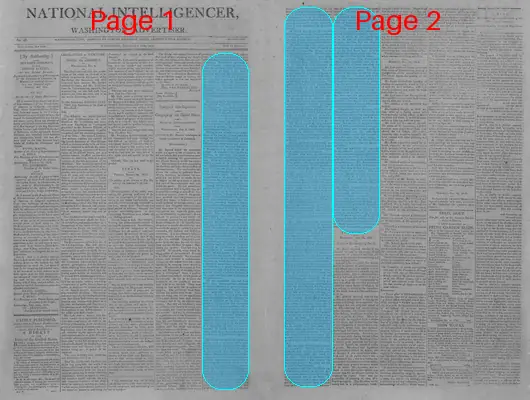
The National Intelligencer And Washington Advertiser
Washington, District Of Columbia
What is this article about?
Congressional debate on resolutions to relinquish exclusive jurisdiction over the Territory of Columbia, returning it to Maryland and Virginia. Speakers including Gregg, Smilie, Bacon, and Dennis argue over constitutional authority, contracts, property effects, and benefits of a territorial legislature.
Merged-components note: These components continue the debate in the US House of Representatives on Mr. Bacon's resolutions regarding the District of Columbia; relabeled from 'story' to 'domestic_news' as it is a report on national legislative proceedings.
Clippings

1 of 2
OCR Quality
Full Text
Mr. Gregg said he had expected, that this question would have been decided by a silent vote. He, for his part, had no intention of having troubled the committee with any observations of his on the subject, but as other gentlemen had seen proper to enter into a discus-sion of it, he would beg the indulgence of the committee, while he assigned as concisely as possible, the reasons that would influence his vote.
Having been a member of the Legis-lature at the time the act was passed for assuming the jurisdiction of the territo-ry, he foresaw pretty clearly most of the difficulties in which we are now involv-ed by that act, and therefore had given it his opposition in every stage of its passage. A majority of the Legislature, however, at that time, entertained a different opinion, and made the assump-tion. From that moment he had consi-dered a contract to be fully complete and ratified betwixt the states of Mary-land, Virginia, the people of the Ter-ritory of Columbia, and the government of the United States. That contract he considered as of permanent obliga-tion, not to be done away, but by the unanimous consent of all the parties.
Among the specific powers of Con-gress enumerated in the eighth section of the first article of the Constitution, there is this one. "Congress shall have power, to exercise exclusive legislation, in all cases whatsoever, over such dis-trict (not exceeding ten miles square) as may by the cession of particular states, and the acceptance of congress, become the seat of government of the United States." Now the states of Maryland and Virginia have made this cession, with the consent and approbation of the people in the ceded territory, and con-gress has accepted the cession, and as-sumed the jurisdiction. Are they then at liberty, or can they relinquish it with-out the consent of the other parties? It is presumed they cannot. In his opi-nion they were constitutionally and mo-rally bound to proceed in the exercise of that power regularly assumed, either im-mediately by themselves, or by the in-tervention of a territorial legislature chosen, and acting under a special act of Congress for that purpose. To relinquish the jurisdiction at this time, and recede the territory, would in his view, exhibit a surprising inconsistency of conduct in the legislature; it would discover such a versatility, such a disposition to change, as could not fail to unsettle the minds of the people, and shake their confidence in the government.
All the arguments that had been drawn from expense and inconvenience he thought admitted of an easy answer. A territorial legislature would remove every difficulty arising from these sources. It would transact all the busi-ness, now crowded on us, respecting the internal concerns of the place. The people of the territory had heretofore been averse from that measure: and no doubt that aversion had considerable in-fluence in preventing congress from a-dopting such a provision; he believed. however, that the people were fast changing their opinions on that subject; they were beginning to see the necessity of a legislature of their own, and he expected the period was not very re-mote, when there would be a universal concurrence of sentiment in favour of it.
He said he considered, as highly im-proper, every proposition which might be considered as pointing, either direct-ly or indirectly, at a removal of the seat of government from this place. The evident, the inevitable tendency of such motions was to discourage adventurers, to check improvement, and greatly to impede the prosperity of the place. In-stead of doing this, the general govern-ment ought to protect and encourage it, as far as encouragement could be given, without resorting to taxes on the other citizens of the United States. He ne-ver would agree to let his constituents de-fray one single cent, to be laid out on improvements in the city, (farther than what might be necessary to erect, and keep in repair retail buildings or the accommodation of government: But he would allow it every advantage, every encouragement to be derived, from an explicit, unequivocal and decided assurance, that it should for ever remain the seat of the government of the United States.
With this view of the subject, and under these impressions I shall give my decided negative to the propositions now on the table, and to all others of a similar nature and tendency.
Mr. Smilie could not agree either with the gentleman from Delaware or with his colleague (Mr. Gregg) on the constitutional question. We had a power to accept the cession, or not to accept it: ergo, which necessarily resulted the power of recession. Instead of arguing as the gentleman from Delaware, he would call on him to point out in the constitution the prohibition. His colleague talked of a moral obligation to keep the territory. This might exist, if it were proposed to force this territory on the states without their consent. The gentleman seems to have taken offence at the expression which had fallen from him of slaves. For his part he had never been accustomed to courtly language, but to the expression of his ideas plainly and openly as he conceived them.
He certainly had not used the expression with any intention to treat the people of this territory with disrespect: but to express his regret at the degraded situation of those who were formerly in possession of the full rights of citizenship.
The gentleman seems also offended at the epithet of tyrants applied to us. Mr. Smilie would ask the gentleman from Delaware, if ever he knew a government possessed of unlimited power, who had not abused it. This was the condition of this government, which, he however, hoped, if continued, would be moderate.
He had expected that gentlemen opposed to the recession would have shown the benefit derived to the United States from retaining the jurisdiction.
If there were none, it was useless, and dangerous, inasmuch as it could only be done at the expense of the rights of the people. He was surprised however at the remarks of the gentleman from Maryland (Mr. Dennis) that this measure would deprive 20,000 people of their rights. How could this be when they had no right to be deprived of? You may give them a charter. But of what avail will this be, when Congress may take it away at any moment? They would continue forever to be ultimately governed by a body over when they had no control. Mr. Smilie concluded by expressing that he had always thought the assumption wrong; but that he had no idea of connecting that consideration with the removal of the government. It could have no influence on his mind. He would go further, and say he had no idea of removing; nor did he believe they could remove.
Mr. Bacon said he was the more confirmed in the propriety of bringing forward his resolutions, by the remarks which had been made by gentlemen opposed to them. The question to day has turned on the constitutional power of Congress to recede. Gentlemen say there is no power given to Congress to recede. He would allow there were no express words in the constitution; but he considered the general powers given as fully competent without any such particular expression. The words in the constitution are: "The Congress shall have power to exercise exclusive legislation in all cases whatsoever, over such district (not exceeding ten miles square) as may, by cession of particular states, and the acceptance of Congress, become the seat of the government of the United States, and to exercise like authority over all places purchased by the consent of the legislature of the state in which the same shall be, or the erection of forts, magazines, arsenals, dock yards, and other needful buildings."
Now, he took it that the power of Congress extended equally and alike to all these places accepted in consequence of the cession of particular states, and it was equally absolute upon Congress to retain all, the one as well as the other.
He was apprehensive that the argument of gentlemen, if it proved any thing, proved too much. He doubted whether gentlemen would contend that when Congress once accept a piece of ground for an arsenal or a dock yard, they thereby oblige themselves to retain the exclusive jurisdiction forever. The practice of the House this very session disproved it; or they had very lately passed an act giving away the corner of a Navy Yard.
But the words of the Constitution are not imperative. They do not say that Congress shall exercise exclusive jurisdiction over the places thus ceded by the states. What is the situation of the territory at present? The laws of the states from which it was ceded are still in force in some instances.
It is said to day that this district was ceded to Congress under a contract. But this contract was not made by the individual citizens, but by the states. If then by this contract between Congress and the states, Congress have obtained their jurisdiction, by the common consent of the parties it may be done away-- and this is all that is proposed by the resolutions.
Gentlemen have observed that this and every other similar motion have the effect of depreciating property in this place. This Mr. B. very much doubted. As he were a citizen, he would consider his property more valuable under the jurisdiction of laws in the formation of which he participated, than when he had no participation. He thought, therefore, that the adoption of his resolutions would rather appreciate property, by placing those who held it on the same broad basis as to the possession of political rights with the other citizens of the United States.
The gentleman from Pennsylvania (Mr. Gregg) conceives that the decision of this question will affect the permanent seat of government. But it could have no such effect. The continuance of this place as the seat of government was connected with a contract made with individuals, which was binding on the government to remain. The government had received from the individuals a valuable consideration, and had in return given the individuals the consideration attached to their remaining here. and the government could not remove without a violation of this contract. This was his idea. The government could not remove without the consent of these individuals.
The gentleman from Maryland (Mr. Dennis) has observed that all the advantages contemplated by Congress from an exclusive jurisdiction would be frustrated by the adoption of these resolutions. But he has not named a single one of these contemplated advantages. Though called upon to name them, he had not named one. He must, therefore, conclude no one had occurred to him; and until they were named, he must doubt whether the United States derived any benefit from the exclusive jurisdiction.
The same gentleman has expressed his astonishment that these resolutions should come from this quarter of the house. He has intimated that he (Mr. Bacon) predicated his ideas on the broad basis of the rights of man. Mr. Bacon believed this would be the effect of his resolutions. One view he had was to revolt the citizens of this district with the rights of suffrage, and how they would be made slaves by a restoration to the rights of suffrage. and the common rights of their fellow citizens, he could not conceive.
Mr. Bacon terminated his remarks by observing, that as he had heard of no advantages derived to the United States from retaining exclusive jurisdiction, as there was nothing in the Constitution repugnant to a recession, as it was clearly authorized with the consent of the contracting parties, as it would not in the least affect the question of removal, as the citizens of the territory would be benefitted by it, and as a great expense of time and treasure would be saved, he considered it expedient to make the recession, provided it received the consent of the contracting parties.
(To be Continued.)
What sub-type of article is it?
What keywords are associated?
What entities or persons were involved?
Where did it happen?
Domestic News Details
Primary Location
Territory Of Columbia
Key Persons
Event Details
Debate in Congress on resolutions to recede the Territory of Columbia back to Maryland and Virginia, discussing constitutional powers, contracts with states, impacts on property and prosperity, and the need for a territorial legislature.