Thank you for visiting SNEWPapers!
Sign up free
Story
July 5, 1839
Cheraw Gazette And Pee Dee Farmer
Cheraw, Chesterfield County, South Carolina
What is this article about?
An 1839 editorial argues that prices of provisions like wheat, meat, and bread will remain high due to faster-growing consumer population from immigration, urban expansion, and labor shifts from agriculture to other pursuits, ensuring farmers' prosperity.
Clipping
OCR Quality
98%
Excellent
Full Text
THE HIGH PRICE OF PROVISIONS.
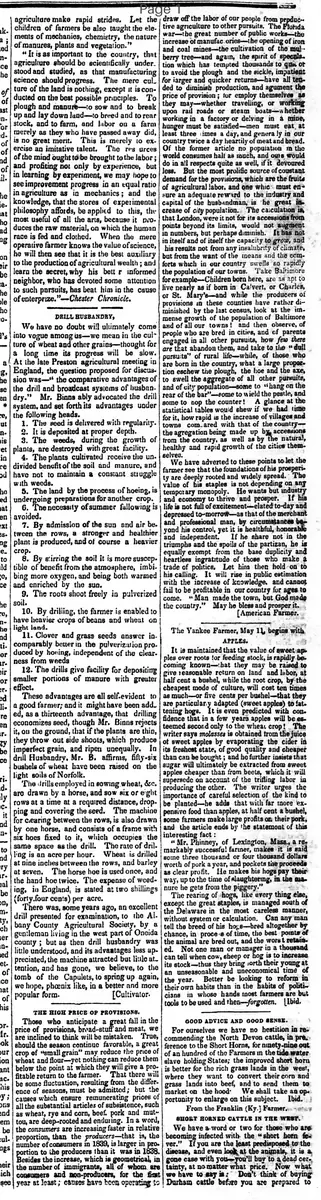
Those who anticipate a great fall in the price of provisions, bread-stuff and meat, we are inclined to think will be mistaken. True, should the season continue favorable, a great crop of "small grain" may reduce the price of wheat and flour—yet nothing can reduce them below the point at which they will give a profitable return to the farmer. That there will be some fluctuation, resulting from the difference of seasons, must be admitted; but the causes which ensure remunerating prices of all the substantial articles of subsistence, such as wheat, rye and corn, beef, pork and mutton, are deep-rooted and enduring. In a word, the consumers are increasing faster in relative proportion, than the producers—that is, the number of consumers in 1839, is larger in proportion to the producers than it was in 1838. Besides the increase, which is geometrical, in the number of immigrants, all of whom are consumers and non-producers, for the first year at least; causes have been operating to draw off the labor of our people from productive agriculture to other pursuits. The Florida war—the great number of public works—the increase of manufactories—the opening of iron and coal mines—the cultivation of the mulberry tree—and again, the spirit of speculation which has tempted thousands to quit or to avoid the plough and the sickle, impatient for larger and quicker returns—have all tended to diminish production, and augment the price of provision; for employ themselves as they may—whether travelling, or working upon rail roads or steam boats—whether working in a factory or delving in a mine hunger must be satisfied—men must eat at least three times a day, and generally in our country twice a day heartily of meat and bread. Of the former article no population in the world consumes half as much, and ours would do in all respects quite as well, if it devoured less. But the most prolific source of constant demand for the provisions, which are the fruits of agricultural labor, and one which must ensure an adequate reward to the industry and capital of the husbandman, is the great increase of city population. The calculation is that London, were it not for its accessions from points beyond its limits, would not augment in numbers, but perhaps diminish. It has not in itself and of itself the capacity to grow, and this results not from any insalubrity of climate, but from the want of the means and the comforts which in our country swells so rapidly the population of our towns. Take Baltimore for example—Children born here, are as apt to live nearly as if born in Calvert, or Charles, or St. Mary's—and while the producers of provisions in these counties have rather diminished by the last census, look at the immense growth of the population of Baltimore and of all our towns! and then observe, of people who are bred in cities, and of parents engaged in all other pursuits, how few there are that abandon them, and take to the "dull pursuits" of rural life—while, of those who are born in the country, what a large proportion eschew the plough, the hoe and the axe, to swell the aggregate of all other pursuits, and of city population—some to "hang on the rear of the bar"—some to wield the pestle, and some to hop the counter! A glance at the statistical tables would shew if we had time for it, how rapid is the increase of villages and towns compared with that of the country—the aggregation being made up by accessions from the country, as well as by the natural, healthy and rapid growth of the cities themselves.
We have adverted to these points to let the farmer see that the foundations of his prosperity are deeply rooted and widely spread. The value of his staples is not depending on any temporary monopoly. He wants but industry and economy to thrive and prosper. If his life is not full of excitement—elated to-day and depressed to-morrow—as that of the merchant and professional man, by circumstances beyond his control, yet it is healthful, honorable and independent. If he share not in the triumphs and the spoils of the partizan, he is equally exempt from the base duplicity and heartless ingratitude of those who make a trade of politics. Let him then hold-on to his calling. It will rise in public estimation with the increase of knowledge, and cannot fail to be profitable in our country for ages to come. "Man made the town, but God made the country." May he bless and prosper it, American Farmer.
Those who anticipate a great fall in the price of provisions, bread-stuff and meat, we are inclined to think will be mistaken. True, should the season continue favorable, a great crop of "small grain" may reduce the price of wheat and flour—yet nothing can reduce them below the point at which they will give a profitable return to the farmer. That there will be some fluctuation, resulting from the difference of seasons, must be admitted; but the causes which ensure remunerating prices of all the substantial articles of subsistence, such as wheat, rye and corn, beef, pork and mutton, are deep-rooted and enduring. In a word, the consumers are increasing faster in relative proportion, than the producers—that is, the number of consumers in 1839, is larger in proportion to the producers than it was in 1838. Besides the increase, which is geometrical, in the number of immigrants, all of whom are consumers and non-producers, for the first year at least; causes have been operating to draw off the labor of our people from productive agriculture to other pursuits. The Florida war—the great number of public works—the increase of manufactories—the opening of iron and coal mines—the cultivation of the mulberry tree—and again, the spirit of speculation which has tempted thousands to quit or to avoid the plough and the sickle, impatient for larger and quicker returns—have all tended to diminish production, and augment the price of provision; for employ themselves as they may—whether travelling, or working upon rail roads or steam boats—whether working in a factory or delving in a mine hunger must be satisfied—men must eat at least three times a day, and generally in our country twice a day heartily of meat and bread. Of the former article no population in the world consumes half as much, and ours would do in all respects quite as well, if it devoured less. But the most prolific source of constant demand for the provisions, which are the fruits of agricultural labor, and one which must ensure an adequate reward to the industry and capital of the husbandman, is the great increase of city population. The calculation is that London, were it not for its accessions from points beyond its limits, would not augment in numbers, but perhaps diminish. It has not in itself and of itself the capacity to grow, and this results not from any insalubrity of climate, but from the want of the means and the comforts which in our country swells so rapidly the population of our towns. Take Baltimore for example—Children born here, are as apt to live nearly as if born in Calvert, or Charles, or St. Mary's—and while the producers of provisions in these counties have rather diminished by the last census, look at the immense growth of the population of Baltimore and of all our towns! and then observe, of people who are bred in cities, and of parents engaged in all other pursuits, how few there are that abandon them, and take to the "dull pursuits" of rural life—while, of those who are born in the country, what a large proportion eschew the plough, the hoe and the axe, to swell the aggregate of all other pursuits, and of city population—some to "hang on the rear of the bar"—some to wield the pestle, and some to hop the counter! A glance at the statistical tables would shew if we had time for it, how rapid is the increase of villages and towns compared with that of the country—the aggregation being made up by accessions from the country, as well as by the natural, healthy and rapid growth of the cities themselves.
We have adverted to these points to let the farmer see that the foundations of his prosperity are deeply rooted and widely spread. The value of his staples is not depending on any temporary monopoly. He wants but industry and economy to thrive and prosper. If his life is not full of excitement—elated to-day and depressed to-morrow—as that of the merchant and professional man, by circumstances beyond his control, yet it is healthful, honorable and independent. If he share not in the triumphs and the spoils of the partizan, he is equally exempt from the base duplicity and heartless ingratitude of those who make a trade of politics. Let him then hold-on to his calling. It will rise in public estimation with the increase of knowledge, and cannot fail to be profitable in our country for ages to come. "Man made the town, but God made the country." May he bless and prosper it, American Farmer.
What sub-type of article is it?
Economic Essay
Agricultural Commentary
What themes does it cover?
Triumph
Moral Virtue
What keywords are associated?
Provisions Price
Agriculture
Population Growth
Immigration
Urbanization
Farmers Prosperity
Where did it happen?
United States, Baltimore
Story Details
Location
United States, Baltimore
Event Date
1839
Story Details
Editorial explains why provision prices remain high due to population growth outpacing production from immigration, urbanization, and labor shifts, assuring farmers of enduring profitability and independence.