Thank you for visiting SNEWPapers!
Sign up free
Letter to Editor
June 18, 1856
The Ashland Union
Ashland, Ashland County, Ohio
What is this article about?
A citizen proposes a tax reform plan to ensure equal taxation by valuing all property at cash value without exemptions and deducting personal indebtedness from assessments, criticizing current unequal laws and extravagant government spending.
Clipping
OCR Quality
96%
Excellent
Full Text
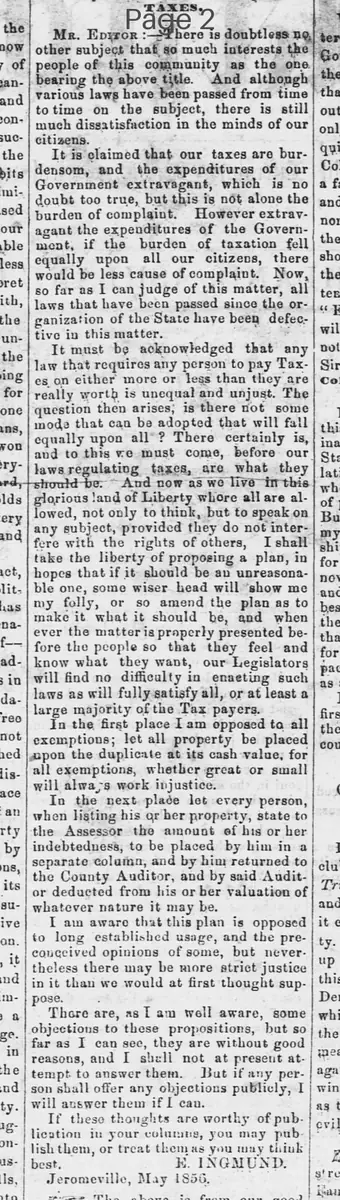
MR. EDITOR:--There is doubtless no other subject that so much interests the people of this community as the one bearing the above title. And although various laws have been passed from time to time on the subject, there is still much dissatisfaction in the minds of our citizens.
It is claimed that our taxes are burdensome, and the expenditures of our Government extravagant, which is no doubt too true, but this is not alone the burden of complaint. However extravagant the expenditures of the Government, if the burden of taxation fell equally upon all our citizens, there would be less cause of complaint. Now, so far as I can judge of this matter, all laws that have been passed since the organization of the State have been defective in this matter.
It must be acknowledged that any law that requires any person to pay Taxes on either more or less than they are really worth is unequal and unjust. The question then arises; is there not some mode that can be adopted that will fall equally upon all? There certainly is, and to this we must come, before our laws regulating taxes, are what they should be. And now as we live in this glorious land of Liberty where all are allowed, not only to think, but to speak on any subject, provided they do not interfere with the rights of others, I shall take the liberty of proposing a plan, in hopes that if it should be an unreasonable one, some wiser head will show me my folly, or so amend the plan as to make it what it should be, and whenever the matter is properly presented before the people so that they feel and know what they want, our Legislators will find no difficulty in enacting such laws as will fully satisfy all, or at least a large majority of the Tax payers.
In the first place I am opposed to all exemptions; let all property be placed upon the duplicate at its cash value, for all exemptions, whether great or small will always work injustice.
In the next place let every person, when listing his or her property, state to the Assessor the amount of his or her indebtedness, to be placed by him in a separate column, and by him returned to the County Auditor, and by said Auditor deducted from his or her valuation of whatever nature it may be.
I am aware that this plan is opposed to long established usage, and the pre-conceived opinions of some, but nevertheless there may be more strict justice in it than we would at first thought suppose.
There are, as I am well aware, some objections to these propositions, but so far as I can see, they are without good reasons, and I shall not at present attempt to answer them. But if any person shall offer any objections publicly, I will answer them if I can.
If these thoughts are worthy of publication in your columns, you may publish them, or treat them as you may think best.
E. INGMUND.
It is claimed that our taxes are burdensome, and the expenditures of our Government extravagant, which is no doubt too true, but this is not alone the burden of complaint. However extravagant the expenditures of the Government, if the burden of taxation fell equally upon all our citizens, there would be less cause of complaint. Now, so far as I can judge of this matter, all laws that have been passed since the organization of the State have been defective in this matter.
It must be acknowledged that any law that requires any person to pay Taxes on either more or less than they are really worth is unequal and unjust. The question then arises; is there not some mode that can be adopted that will fall equally upon all? There certainly is, and to this we must come, before our laws regulating taxes, are what they should be. And now as we live in this glorious land of Liberty where all are allowed, not only to think, but to speak on any subject, provided they do not interfere with the rights of others, I shall take the liberty of proposing a plan, in hopes that if it should be an unreasonable one, some wiser head will show me my folly, or so amend the plan as to make it what it should be, and whenever the matter is properly presented before the people so that they feel and know what they want, our Legislators will find no difficulty in enacting such laws as will fully satisfy all, or at least a large majority of the Tax payers.
In the first place I am opposed to all exemptions; let all property be placed upon the duplicate at its cash value, for all exemptions, whether great or small will always work injustice.
In the next place let every person, when listing his or her property, state to the Assessor the amount of his or her indebtedness, to be placed by him in a separate column, and by him returned to the County Auditor, and by said Auditor deducted from his or her valuation of whatever nature it may be.
I am aware that this plan is opposed to long established usage, and the pre-conceived opinions of some, but nevertheless there may be more strict justice in it than we would at first thought suppose.
There are, as I am well aware, some objections to these propositions, but so far as I can see, they are without good reasons, and I shall not at present attempt to answer them. But if any person shall offer any objections publicly, I will answer them if I can.
If these thoughts are worthy of publication in your columns, you may publish them, or treat them as you may think best.
E. INGMUND.
What sub-type of article is it?
Persuasive
Political
Ethical Moral
What themes does it cover?
Taxation
Economic Policy
What keywords are associated?
Tax Reform
Equal Taxation
Property Assessment
Government Spending
Tax Exemptions
Indebtedness Deduction
What entities or persons were involved?
E. Ingmund.
Mr. Editor
Letter to Editor Details
Author
E. Ingmund.
Recipient
Mr. Editor
Main Argument
proposes eliminating all tax exemptions, assessing all property at cash value, and deducting personal indebtedness to achieve equal and just taxation, addressing dissatisfaction with current unequal laws and extravagant government spending.
Notable Details
Opposed To All Exemptions As They Cause Injustice
Property Listing To Include Indebtedness Deducted By County Auditor
Invites Public Objections For Response