Thank you for visiting SNEWPapers!
Sign up free
The Rhode Island American, And General Advertiser
Providence, Providence County, Rhode Island
What is this article about?
Historical account of smallpox's absence in ancient records, emergence ~1300 years ago in Mahomedan conquests, animal origins hypothesis, massive death tolls worldwide, inoculation's drawbacks, and triumph of cowpox vaccination by 1809.
Clipping
OCR Quality
Full Text
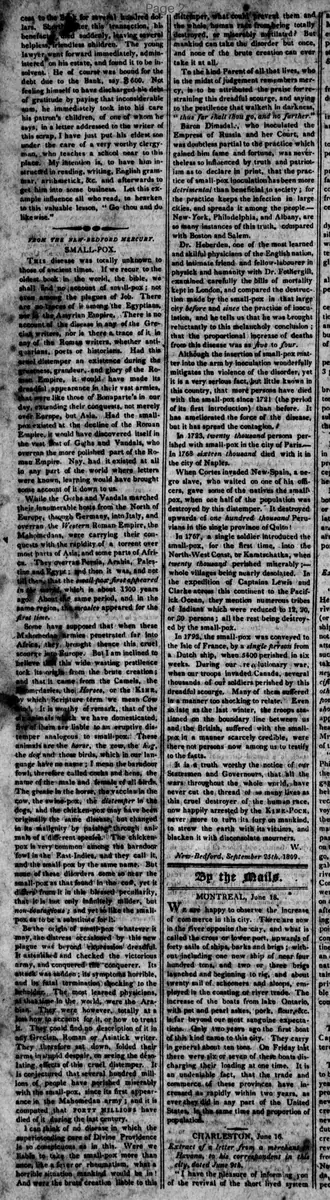
This disease was totally unknown to those of ancient times. If we recur to the oldest book in the world, the Bible, we shall find no account of small-pox; not even among the plagues of Egypt. There are no traces of it among the Egyptians, or in the Assyrian Empire. There is no account of the disease in any of the Grecian writers, nor is there a trace of it in any of the Roman writers, whether antiquarians, poets or historians. Had this cruel distemper an existence during the greatness, grandeur, and glory of the Roman Empire, it would have made its dreadful appearance in their vast armies, that were like those of Bonaparte's in our day, extending their conquests, not merely over Europe, but Asia. Had the small-pox existed at the decline of the Roman Empire, it would have discovered itself in the vast host of Goths and Vandals, who overran the more polished part of the Roman Empire. Nay, had it existed at all in any part of the world where letters were known, learning would have brought some account of it down to us.
While the Goths and Vandals marched their innumerable hosts from the North of Europe, through Germany, into Italy, and overran the Western Roman Empire, the Mahomedans were carrying their conquests with the rapidity of a torrent over most parts of Asia, and some parts of Africa. They overran Persia, Arabia, Palestine and Egypt; and then it was, and not till then, that the small pox first appeared in the world, which is about 1300 years ago. About the same period, and in the same region, the measles appeared for the first time.
Some have supposed that when these Mahomedan armies penetrated far into Africa, they brought thence this cruel scourge into Europe. But I am inclined to believe that this wide-wasting pestilence took its origin from the brute creation; and that it came from the Camels, the Dromedaries, the Horse, or the Kine, by which Scripture term we mean Cow. And it is worthy of remark, that of the six animals which we have domesticated, five of them are liable to an eruptive distemper analogous to small-pox. These animals are the horse, the cow, the hog, the dog and those birds, which in our language have no name; I mean the barndoor fowl, therefore called cocks and hens, the name of the male and female of all birds. The grease in the horse, the vaccina in the cow, the swine pox, the distemper in the dogs, and the chicken-pox may have been originally the same disease but changed in its malignity by passing through animals of a different species. The chicken-pox is very common among the barndoor fowl in the East-Indies, and they call it and the small pox by the same name. But none of these disorders comes so near the small-pox as that found in the cow, yet it differs from it in this blessed peculiarity, that it is not only infinitely milder; but non-contagious; and yet so like the small-pox as to be a substitute for it.
Be the origin of small-pox whatever it may, the distress occasioned by this new plague was beyond expression dreadful. It astonished and checked the victorious army, and conquered the conqueror. Its attack was sudden; its symptoms horrible, and its fatal termination shocking to the beholder. The most learned physicians at that time in the world were the Arabians. They were however, totally at a loss how to account for it, or how to treat it. They could find no description of it in any Grecian, Roman or Asiatic writer. They therefore sat down, folded their arms in stupid despair, on seeing the desolating effects of this cruel distemper. It is conjectured that several hundred millions of people have perished miserably with the small-pox, since its first appearance in the Mahomedan army; and it is computed that FORTY MILLIONS have died of it during the last century.
I can think of no disease in which the superintending care of Divine Providence is so conspicuous, as in this. Were we liable to take the small-pox more than once, like a fever or rheumatism, what a horrible situation mankind would be in! And were the brute creation liable to this distemper, what could prevent them and the whole human race from being totally destroyed, or miserably mutilated? But mankind can take the disorder but once, and none of the brute creation can ever take it at all.
To the kind Parent of all that lives, who in the midst of judgement remembers mercy, is to be attributed the praise for restraining this dreadful scourge, and saying to the pestilence that walketh in darkness, "thus far shalt thou go, and no farther."
Baron Dimsdale, who inoculated the Empress of Russia and her Court, and was doubtless partial to the practice which gained him fame and fortune, was nevertheless so influenced by truth and patriotism as to declare in print, that the practice of small-pox inoculation has been more detrimental than beneficial to society: for the practice keeps the infection in large cities, and spreads it among the people. New-York, Philadelphia, and Albany, are so many instances of this truth, compared with Boston and Salem.
Dr. Heberden, one of the most learned and skilful physicians of the English nation, and intimate friend and fellow-labourer in physick and humanity with Dr. Fothergill; examined carefully the bills of mortality kept in London, and compared the destruction made by the small-pox in that large city before and since the practice of inoculation, and he tells us that he was brought reluctantly to this melancholy conclusion; that the proportional increase of deaths from this disease was as five to four.
Although the insertion of small-pox matter into the arm by inoculation wonderfully mitigates the violence of the disorder, yet it is a very serious fact, but little known in this country, that more persons have died with the small-pox since 1721 (the period of its first introduction) than before. It has ameliorated the force of the disease, but it has spread the contagion.
In 1723, twenty thousand persons perished with small-pox in the City of Paris. In 1768 sixteen thousand died with it in the city of Naples.
When Cortes invaded New Spain, a negro slave, who waited on one of his officers, gave some of the natives the small-pox, when one half of the population was destroyed by this distemper. It destroyed upwards of one hundred thousand Peruvians in the single province of Quito.
In 1767, a single soldier introduced the small-pox, for the first time, into the North-West Coast, or Kamtschatka, when twenty thousand perished miserably; whole villages being nearly desolated. In the expedition of Captains Lewis and Clarke across this continent to the Pacific Ocean, they mention numerous tribes of Indians which were reduced to 12, 20, or 30 persons; all the rest being destroyed by the small-pox.
In 1793, the small-pox was conveyed to the Isle of France, by a single person from a Dutch ship, when 5400 perished in six weeks. During our revolutionary war, when our troops invaded Canada, several thousands of our soldiers perished by this dreadful scourge. Many of them suffered in a manner too shocking to relate. Even so late as the last winter, the troops stationed on the boundary line between us and the British, suffered with the small-pox in a manner scarcely credible, were there not persons now among us to testify to the facts.
It is a truth worthy the notice of our Statesmen and Governors, that all the wars throughout the whole world, have never cut the thread of so many lives as this cruel destroyer of the human race, now happily arrested by the Kine-Pock, never more to turn its fury on mankind, to strew the earth with its victims, and blacken it with disconsolate mourners.
New-Bedford, September 25th, 1809.
What sub-type of article is it?
What themes does it cover?
What keywords are associated?
What entities or persons were involved?
Where did it happen?
Story Details
Key Persons
Location
Global, Including Europe, Asia, Africa, Americas
Event Date
Ancient Times To 1809
Story Details
The article traces smallpox's unknown origins in ancient civilizations, its first appearance around 1300 years ago during Mahomedan conquests, possibly from animals like cows. It discusses the disease's devastating global impact, failed treatments, inoculation's mixed effects, and praises vaccination (Kine-Pock) as a divine remedy halting its spread.