Thank you for visiting SNEWPapers!
Sign up free
The Arkansas Whig
Little Rock, Pulaski County, Arkansas
What is this article about?
Biography of Jean A. Sutter, Swiss-born pioneer whose mill-race saw California's first gold discovery in 1848. He journeyed from Switzerland via Missouri, Oregon, and Hawaii to establish New Helvetia in 1839, rose to prominence, sided with Mexicans in war, then fell into poverty after gold rush, now living quietly at Hock Farm near Marysville.
Clipping
OCR Quality
Full Text
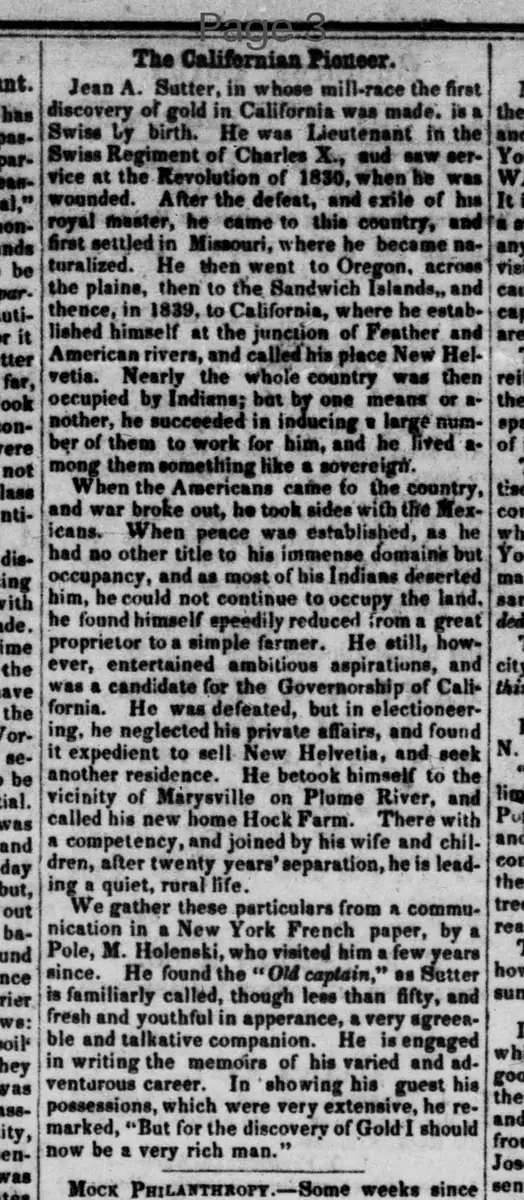
Jean A. Sutter, in whose mill-race the first discovery of gold in California was made, is a Swiss by birth. He was Lieutenant in the Swiss Regiment of Charles X., and saw service at the Revolution of 1830, when he was wounded. After the defeat, and exile of his royal master, he came to this country, and first settled in Missouri, where he became naturalized. He then went to Oregon, across the plains, then to the Sandwich Islands, and thence, in 1839, to California, where he established himself at the junction of Feather and American rivers, and called his place New Helvetia. Nearly the whole country was then occupied by Indians; but by one means or another, he succeeded in inducing large number of them to work for him, and he lived among them something like a sovereign.
When the Americans came to the country, and war broke out, he took sides with the Mexicans. When peace was established, as he had no other title to his immense domains but occupancy, and as most of his Indians deserted him, he could not continue to occupy the land. He found himself speedily reduced from a great proprietor to a simple farmer. He still, however, entertained ambitious aspirations, and was a candidate for the Governorship of California. He was defeated, but in electioneering, he neglected his private affairs, and found it expedient to sell New Helvetia, and seek another residence. He betook himself to the vicinity of Marysville on Plume River, and called his new home Hock Farm. There with a competency, and joined by his wife and children, after twenty years' separation, he is leading a quiet, rural life.
We gather these particulars from a communication in a New York French paper, by a Pole, M. Holenski, who visited him a few years since. He found the "Old captain," as Sutter is familiarly called, though less than fifty, and fresh and youthful in appearance, a very agreeable and talkative companion. He is engaged in writing the memoirs of his varied and adventurous career. In showing his guest his possessions, which were very extensive, he remarked, "But for the discovery of Gold I should now be a very rich man."
What sub-type of article is it?
What themes does it cover?
What keywords are associated?
What entities or persons were involved?
Where did it happen?
Story Details
Key Persons
Location
California, New Helvetia, Hock Farm Near Marysville
Event Date
Revolution Of 1830, 1839
Story Details
Swiss-born Sutter, wounded in 1830 revolution, emigrates to Missouri, then Oregon, Sandwich Islands, and California in 1839, establishes New Helvetia, employs Indians, sides with Mexicans in war, loses lands after peace and gold discovery, runs for governor unsuccessfully, sells property, reunites with family at Hock Farm, writes memoirs.