Thank you for visiting SNEWPapers!
Sign up free
Portland Gazette, And Maine Advertiser
Portland, Cumberland County, Maine
What is this article about?
From Washington on Dec. 15, a report on congressional proceedings includes Mr. Elliot's speech advocating for a stronger national defense system, including an efficient navy, in response to the British blockade of New York and the murder of Pierce, warning of impending threats from France similar to Prussia's fall.
Clipping
OCR Quality
Full Text
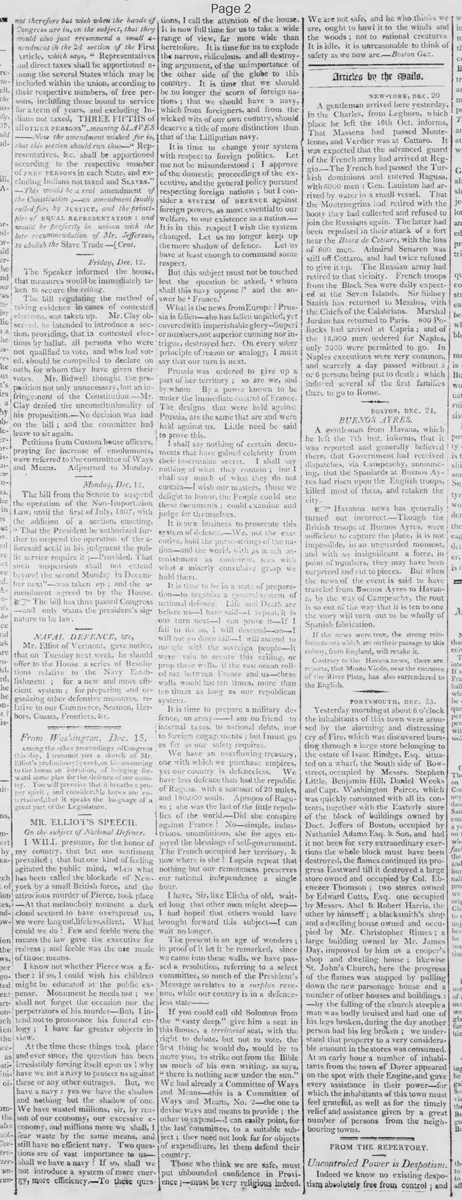
Among the other proceedings of Congress this day, I transmit you a sketch of Mr. Elliot's preliminary Speech, on his announcing to the house an intention, of bringing forward some plan for the defence of our country. You will perceive that it breathes a proper spirit; and considerable hopes are entertained, that it speaks the language of a great part of the Legislature.
MR. ELLIOT'S SPEECH.
On the subject of National Defence.
I WILL presume, for the honor of my country, that but one sentiment prevailed; that but one kind of feeling agitated the public mind, when what has been called the blockade of New-York by a small British force, and the atrocious murder of Pierce, took place —At that melancholy moment a dark cloud seemed to have overspread us, we were languid, lifeless, silent. What could we do? Few and feeble were the means the law gave the executive for redress; and feeble was the use made of those means.
I know not whether Pierce was a father: if so, I could wish his children might be educated at the public expense. Monument he needs not; we shall not forget the occasion nor the perpetrators of his murder—But, I intend not to pronounce his funeral eulogy; I have far greater objects in view.
At the time these things took place and ever since, the question has been irresistibly forcing itself upon us! why have we not a navy to protect us against these or any other outrages. But, we have a navy: yes we have the shadow and nothing but the shadow of one. We have wasted millions, sir, by reason of our economy, our excessive economy, and millions more we shall, I fear waste by the same means, and still have no efficient navy. Two questions are of vast importance to us— shall we have a navy? If so, shall we not introduce a system of more energy, more efficiency.—To these questions, I call the attention of the house.
It is now full time for us to take a wide range of view, far more wide than heretofore. It is time for us to explode the narrow, ridiculous, and all destroying argument, of the unimportance of the other side of the globe to this country. It is time that we should be no longer the scorn of foreign nations; that we should have a navy, which from foreigners, and from the wicked wits of our own country, should deserve a title of more distinction than that of the Lilliputian navy.
It is time to change your system with respect to foreign politics. Let me not be misunderstood; I approve of the domestic proceedings of the executive, and the general policy pursued respecting foreign nations; but I consider a SYSTEM of DEFENCE against foreign powers, as most essential to our welfare, to our existence as a nation.— It is in this respect I wish the system changed. Let us no longer keep up the mere shadow of defence. Let us have at least enough to command some respect.
But this subject must not be touched lest the question be asked, whom shall this navy oppose?' and the answer be France,
What is the news from Europe? Prussia is fallen—she has fallen unpitied, yet covered with imperishable glory—Superior numbers, not superior cunning nor intrigue, destroyed her. On every sober principle of reason or analogy, I must say that our turn is next.
Prussia was ordered to give up a part of her territory; so are we, and by whom? By a power known to be under the immediate control of France. The designs that were held against Prussia, are the same that are and were held against us. Little need be said to prove this.
I shall say nothing of certain documents that have gained celebrity from their inscrutable secret. I shall say nothing of what they contain; but I shall say much of what they do not contain—I wish our masters, those we delight to honor, the People could see these documents; could examine and judge for themselves.
It is our business to prosecute this system of defence.—We, not the executive, hold the purse-strings of the nation—and the world, with as much astonishment as contempt, sees with what a miserly convulsive grasp we hold them.
It is time to be in a state of preparation—to organize a general system of national defence. Life and Death are before us—I have said I repeat, it is our turn next—I can prove it If I fail to do so, I will descend—no—I will not go down nil—I will ascend to mingle with the sovereign people—It were vain to secure this ceiling, or prop these walls. if the vast ocean rolled not between France and us—these walls would last ten times, more than ten times as long as our republican system.
It is time to prepare a military defence, an army—I am no friend to internal taxes, to national debts, nor to foreign engagements; but I must go as far as our safety requires.
We have an overflowing treasury, one with which we purchase empires, yet our country is defenceless. We have less defence than had the republic of Ragusa, with a seacoast of 20 miles, and 180,000 souls. Apropos of Ragusa; she was the last of the little republics of the world.—Did she conspire against France? No—simple, industrious, unambitious, she for ages enjoyed the blessings of self-government. The French occupied her territory, & now where is she? I again repeat that nothing but our remoteness preserves our national independence a single hour.
I have, Sir, like Elisha of old, waited long that other men might sleep— I had hoped that others would have brought forward this subject—I can wait no longer.
The present is an age of wonders; in proof of it let it be remarked, since we came into these walls, we have passed a resolution, referring to a select committee, so much of the President's Message as relates to a surplus revenue, while our country is in a defenceless state—
If you could call old Solomon from the "vasty deep," give him a seat in this house, a territorial seat, with the right to debate, but not to vote, the first thing he would do, would be to move you, to strike out from the Bible so much of his own writing, as says, "there is nothing new under the sun."
We had already a Committee of Ways and Means—this is a Committee of Ways and Means, No. 2—the one to devise ways and means to provide; the other to expend—I can easily point, for the last committee, to a suitable subject; they need not look far for objects of expenditure, let them defend their country.
Those who think we are safe, must put unbounded confidence in Providence;—must be very religious indeed. We are not safe, and he who thinks we are, ought to howl it to the winds and the woods; not to rational creatures It is idle, it is unreasonable to think of safety as we now are.—Boston Gaz.
What sub-type of article is it?
What themes does it cover?
What keywords are associated?
What entities or persons were involved?
Where did it happen?
Story Details
Key Persons
Location
Washington, Congress; New York
Event Date
Dec. 15
Story Details
Mr. Elliot delivers a speech in Congress urging the establishment of an efficient navy and national defense system to protect against British and French threats, referencing the recent blockade of New York and murder of Pierce, the fall of Prussia, and the need to abandon excessive economy for security.