Thank you for visiting SNEWPapers!
Sign up free
Daily Kennebec Journal
Augusta, Kennebec County, Maine
What is this article about?
G. T. Fletcher writes from Highland Park, Illinois, on March 8, 1880, to the Kennebec Journal editor, reminiscing about his Maine home and the paper's influence. He describes the mild winter, impassable muddy roads, scenic city features, Lake Michigan's beauty, local residents including telephone inventor Elisha Gray, and anticipates future letters on Chicago and prairie farming.
Merged-components note: The short editorial note provides context for the preceding letter to the editor; merging as they form a single logical unit.
Clipping
OCR Quality
Full Text
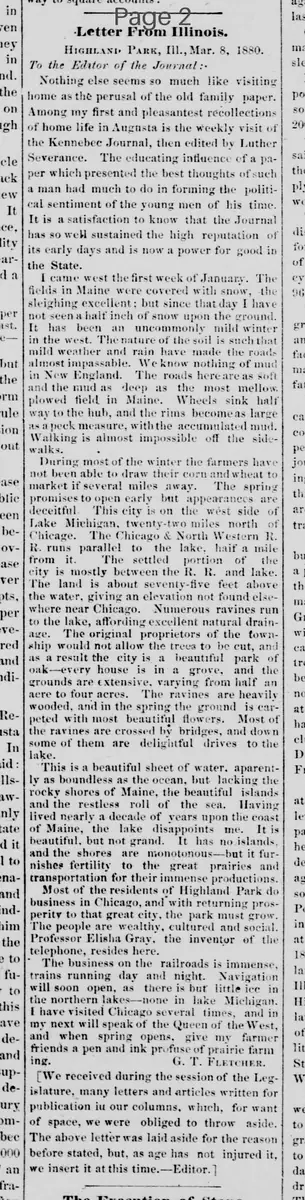
HIGHLAND PARK, Ill., Mar. 8, 1880.
To the Editor of the Journal:
Nothing else seems so much like visiting home as the perusal of the old family paper. Among my first and pleasantest recollections of home life in Augusta is the weekly visit of the Kennebec Journal, then edited by Luther Severance. The educating influence of a paper which presented the best thoughts of such a man had much to do in forming the political sentiment of the young men of his time. It is a satisfaction to know that the Journal has so well sustained the high reputation of its early days and is now a power for good in the State.
I came west the first week of January. The fields in Maine were covered with snow, the sleighing excellent; but since that day I have not seen a half inch of snow upon the ground. It has been an uncommonly mild winter in the west. The nature of the soil is such that mild weather and rain have made the roads almost impassable. We know nothing of mud in New England. The roads here are as soft and the mud as deep as the most mellow plowed field in Maine. Wheels sink half way to the hub, and the rims become as large as a peck measure, with the accumulated mud. Walking is almost impossible off the side-walks.
During most of the winter the farmers have not been able to draw their corn and wheat to market if several miles away. The spring promises to open early but appearances are deceitful. This city is on the west side of Lake Michigan, twenty-two miles north of Chicago. The Chicago & North Western R. R. runs parallel to the lake, half a mile from it.
The settled portion of the city is mostly between the R. R. and lake. The land is about seventy-five feet above the water, giving an elevation not found elsewhere near Chicago. Numerous ravines run to the lake, affording excellent natural drainage. The original proprietors of the township would not allow the trees to be cut, and as a result the city is a beautiful park of oak-every house is in a grove, and the grounds are extensive, varying from half an acre to four acres. The ravines are heavily wooded, and in the spring the ground is carpeted with most beautiful flowers. Most of the ravines are crossed by bridges, and down some of them are delightful drives to the lake.
This is a beautiful sheet of water, apparently as boundless as the ocean, but lacking the rocky shores of Maine, the beautiful islands and the restless roll of the sea. Having lived nearly a decade of years upon the coast of Maine, the lake disappoints me. It is beautiful, but not grand. It has no islands, and the shores are monotonous-but it furnishes fertility to the great prairies and transportation for their immense productions.
Most of the residents of Highland Park do business in Chicago, and with returning prosperity to that great city, the park must grow. The people are wealthy, cultured and social. Professor Elisha Gray, the inventor of the telephone, resides here.
The business on the railroads is immense, trains running day and night. Navigation will soon open, as there is but little ice in the northern lakes-none in Lake Michigan.
I have visited Chicago several times, and in my next will speak of the Queen of the West, and when spring opens, give my farmer friends a pen and ink profuse of prairie farming.
G. T. FLETCHER.
We received during the session of the Legislature, many letters and articles written for publication in our columns, which, for want of space, we were obliged to throw aside. The above letter was laid aside for the reason before stated, but, as age has not injured it we insert it at this time.-Editor.
What sub-type of article is it?
What themes does it cover?
What keywords are associated?
What entities or persons were involved?
Letter to Editor Details
Author
G. T. Fletcher
Recipient
To The Editor Of The Journal
Main Argument
shares personal experiences of relocating from maine to highland park, illinois, highlighting contrasts in weather, roads, natural features, and local life, while praising the kennebec journal's enduring influence.
Notable Details