Thank you for visiting SNEWPapers!
Sign up free
Story
October 16, 1944
The Wilmington Morning Star
Wilmington, New Hanover County, North Carolina
What is this article about?
North Carolina farm leaders and industrialists convened in Raleigh to discuss post-war agricultural planning, emphasizing soil conservation, fair income, family living improvements, and rural development for better citizenship.
Clipping
OCR Quality
95%
Excellent
Full Text
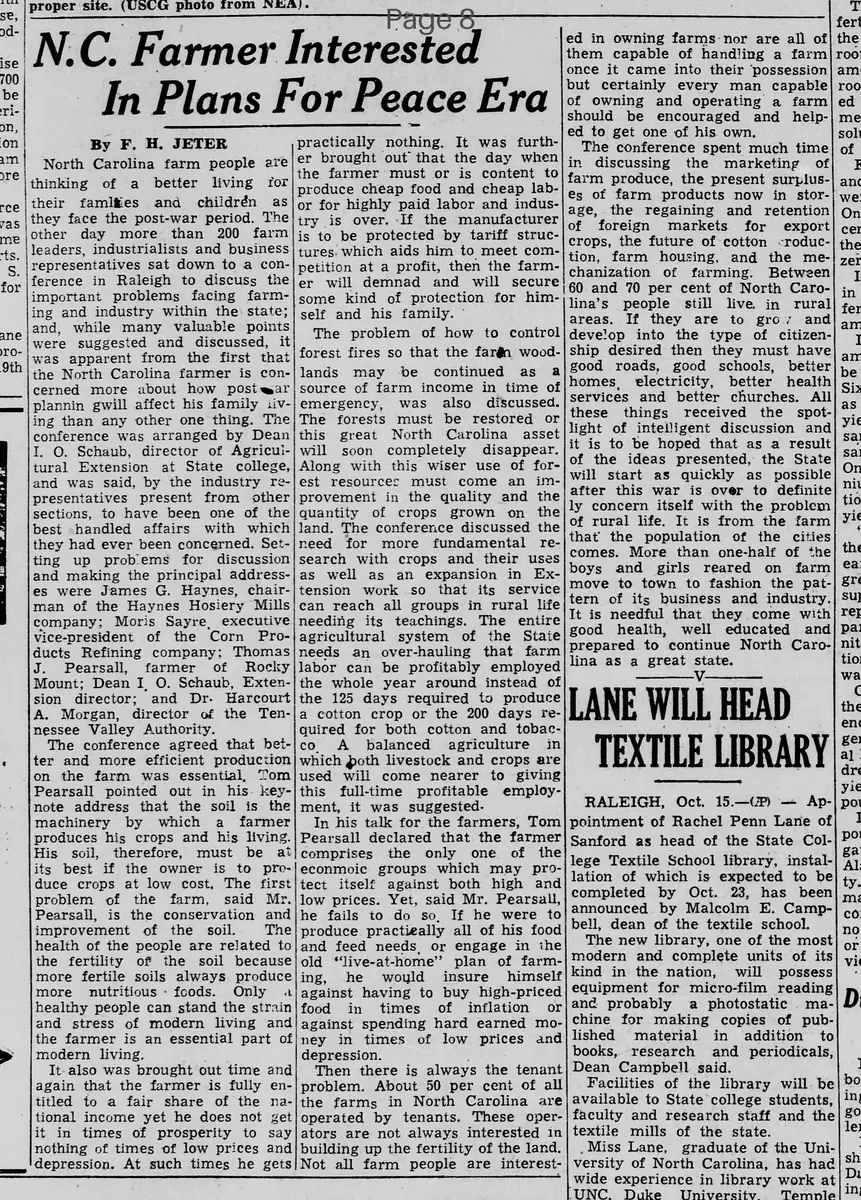
N.C. Farmer Interested
In Plans For Peace Era
By F. H. JETER
North Carolina farm people are thinking of a better living for their families and children as they face the post-war period. The other day more than 200 farm leaders, industrialists and business representatives sat down to a conference in Raleigh to discuss the important problems facing farming and industry within the state; and, while many valuable points were suggested and discussed, it was apparent from the first that the North Carolina farmer is concerned more about how post war planning will affect his family living than any other one thing. The conference was arranged by Dean I. O. Schaub, director of Agricultural Extension at State college, and was said, by the industry representatives present from other sections, to have been one of the best handled affairs with which they had ever been concerned. Setting up problems for discussion and making the principal addresses were James G. K. Haynes, chairman of the Haynes Hosiery Mills company; Morris Sayre executive vice-president of the Corn Products Refining company; Thomas J. Pearsall, farmer of Rocky Mount; Dean I O. Schaub. Extension director; and Dr. Harcourt A. Morgan. director of the Tennessee Valley Authority.
The conference agreed that better and more efficient production on the farm was essential. Tom Pearsall pointed out in his keynote address that the soil is the machinery by which a farmer produces his crops and his living. His soil, therefore, must be at its best if the owner is to produce crops at low cost. The first problem of the farm, said Mr. Pearsall, is the conservation and improvement of the soil.
The health of the people are related to the fertility of the soil because more fertile soils always produce more nutritious foods. Only healthy people can stand the strain and stress of modern living and the farmer is an essential part of modern living.
It also was brought out time and again that the farmer is fully entitled to a fair share of the national income yet he does not get it in times of prosperity to say nothing of times of low prices and depression. At such times he gets practically nothing. It was further brought out that the day when the farmer must or is content to produce cheap food and cheap labor for highly paid labor and industry is over. If the manufacturer is to be protected by tariff structures, which aids him to meet competition at a profit, then the farmer will demand and will secure some kind of protection for himself and his family.
The problem of how to control forest fires so that the farm woodlands may be continued as a source of farm income in time of emergency, was also discussed. The forests must be restored or this great North Carolina asset will soon completely disappear. Along with this wiser use of forest resources must come an improvement in the quality and the quantity of crops grown on the land. The conference discussed the need for more fundamental research with crops and their uses as well as an expansion in Extension work so that its service can reach all groups in rural life needing its teachings. The entire agricultural system of the State needs an over-hauling that farm labor can be profitably employed the whole year around instead of the 125 days required to produce a cotton crop or the 200 days required for both cotton and tobacco. A balanced agriculture in which both livestock and crops are used will come nearer to giving this full-time profitable employment, it was suggested.
In his talk for the farmers. Tom Pearsall declared that the farmer comprises the only one of the economic groups which may protect itself against both high and low prices. Yet, said Mr. Pearsall, he fails to do so If he were to produce practically all of his food and feed needs. or engage in the old "live-at-home" plan of farming, he would insure himself against having to buy high-priced food in times of inflation or against spending hard earned money in times of low prices and depression.
Then there is always the tenant problem. About 50 per cent of all the farms in North Carolina are operated by tenants. These operators are not always interested in building up the fertility of the land. Not all farm people are interested in owning farms nor are all of them capable of handling a farm once it came into their possession but certainly every man capable of owning and operating a farm should be encouraged and helped to get one of his own.
The conference spent much time in discussing the marketing of farm produce, the present surpluses of farm products now in storage. the regaining and retention of foreign markets for export crops, the future of cotton production, farm housing, and the mechanization of farming. Between 60 and 70 per cent of North Carolina's people still live. in rural areas. If they are to grow, and develop into the type of citizenship desired then they must have good roads, good schools, better homes electricity, better health services and better churches. All these things received the spotlight of intelligent discussion and it is to be hoped that as a result of the ideas presented, the State will start as quickly as possible after this war is over to definitely concern itself with the problem of rural life. It is from the farm that' the population of the cities comes. More than one-half of the boys and girls reared on farm move to town to fashion the pattern of its business and industry It is needful that they come with good health, well educated and prepared to continue North Carolina as a great state.
In Plans For Peace Era
By F. H. JETER
North Carolina farm people are thinking of a better living for their families and children as they face the post-war period. The other day more than 200 farm leaders, industrialists and business representatives sat down to a conference in Raleigh to discuss the important problems facing farming and industry within the state; and, while many valuable points were suggested and discussed, it was apparent from the first that the North Carolina farmer is concerned more about how post war planning will affect his family living than any other one thing. The conference was arranged by Dean I. O. Schaub, director of Agricultural Extension at State college, and was said, by the industry representatives present from other sections, to have been one of the best handled affairs with which they had ever been concerned. Setting up problems for discussion and making the principal addresses were James G. K. Haynes, chairman of the Haynes Hosiery Mills company; Morris Sayre executive vice-president of the Corn Products Refining company; Thomas J. Pearsall, farmer of Rocky Mount; Dean I O. Schaub. Extension director; and Dr. Harcourt A. Morgan. director of the Tennessee Valley Authority.
The conference agreed that better and more efficient production on the farm was essential. Tom Pearsall pointed out in his keynote address that the soil is the machinery by which a farmer produces his crops and his living. His soil, therefore, must be at its best if the owner is to produce crops at low cost. The first problem of the farm, said Mr. Pearsall, is the conservation and improvement of the soil.
The health of the people are related to the fertility of the soil because more fertile soils always produce more nutritious foods. Only healthy people can stand the strain and stress of modern living and the farmer is an essential part of modern living.
It also was brought out time and again that the farmer is fully entitled to a fair share of the national income yet he does not get it in times of prosperity to say nothing of times of low prices and depression. At such times he gets practically nothing. It was further brought out that the day when the farmer must or is content to produce cheap food and cheap labor for highly paid labor and industry is over. If the manufacturer is to be protected by tariff structures, which aids him to meet competition at a profit, then the farmer will demand and will secure some kind of protection for himself and his family.
The problem of how to control forest fires so that the farm woodlands may be continued as a source of farm income in time of emergency, was also discussed. The forests must be restored or this great North Carolina asset will soon completely disappear. Along with this wiser use of forest resources must come an improvement in the quality and the quantity of crops grown on the land. The conference discussed the need for more fundamental research with crops and their uses as well as an expansion in Extension work so that its service can reach all groups in rural life needing its teachings. The entire agricultural system of the State needs an over-hauling that farm labor can be profitably employed the whole year around instead of the 125 days required to produce a cotton crop or the 200 days required for both cotton and tobacco. A balanced agriculture in which both livestock and crops are used will come nearer to giving this full-time profitable employment, it was suggested.
In his talk for the farmers. Tom Pearsall declared that the farmer comprises the only one of the economic groups which may protect itself against both high and low prices. Yet, said Mr. Pearsall, he fails to do so If he were to produce practically all of his food and feed needs. or engage in the old "live-at-home" plan of farming, he would insure himself against having to buy high-priced food in times of inflation or against spending hard earned money in times of low prices and depression.
Then there is always the tenant problem. About 50 per cent of all the farms in North Carolina are operated by tenants. These operators are not always interested in building up the fertility of the land. Not all farm people are interested in owning farms nor are all of them capable of handling a farm once it came into their possession but certainly every man capable of owning and operating a farm should be encouraged and helped to get one of his own.
The conference spent much time in discussing the marketing of farm produce, the present surpluses of farm products now in storage. the regaining and retention of foreign markets for export crops, the future of cotton production, farm housing, and the mechanization of farming. Between 60 and 70 per cent of North Carolina's people still live. in rural areas. If they are to grow, and develop into the type of citizenship desired then they must have good roads, good schools, better homes electricity, better health services and better churches. All these things received the spotlight of intelligent discussion and it is to be hoped that as a result of the ideas presented, the State will start as quickly as possible after this war is over to definitely concern itself with the problem of rural life. It is from the farm that' the population of the cities comes. More than one-half of the boys and girls reared on farm move to town to fashion the pattern of its business and industry It is needful that they come with good health, well educated and prepared to continue North Carolina as a great state.
What sub-type of article is it?
Historical Event
What themes does it cover?
Family
Justice
Survival
What keywords are associated?
Post War Planning
North Carolina Farming
Soil Conservation
Rural Development
Agricultural Conference
Family Living
Fair Income
What entities or persons were involved?
F. H. Jeter
Dean I. O. Schaub
James G. K. Haynes
Morris Sayre
Thomas J. Pearsall
Dr. Harcourt A. Morgan
Where did it happen?
Raleigh, North Carolina
Story Details
Key Persons
F. H. Jeter
Dean I. O. Schaub
James G. K. Haynes
Morris Sayre
Thomas J. Pearsall
Dr. Harcourt A. Morgan
Location
Raleigh, North Carolina
Event Date
Post War Period
Story Details
Over 200 farm leaders and industrialists discussed post-war agricultural challenges in Raleigh, focusing on soil conservation, fair income shares, family living improvements, forest protection, balanced farming, tenant issues, marketing, and rural infrastructure to enhance citizenship.