Thank you for visiting SNEWPapers!
Sign up free
Editorial
December 2, 1789
Gazette Of The United States
New York, New York County, New York
What is this article about?
The Observer critiques the fluctuating value of depreciated paper certificates used for taxes in post-Revolutionary United States, arguing it oppresses the poor by forcing them to buy at high discounts while benefiting the wealthy speculators. Advocates for stable currency tied to mercantile banks.
Clipping
OCR Quality
98%
Excellent
Full Text
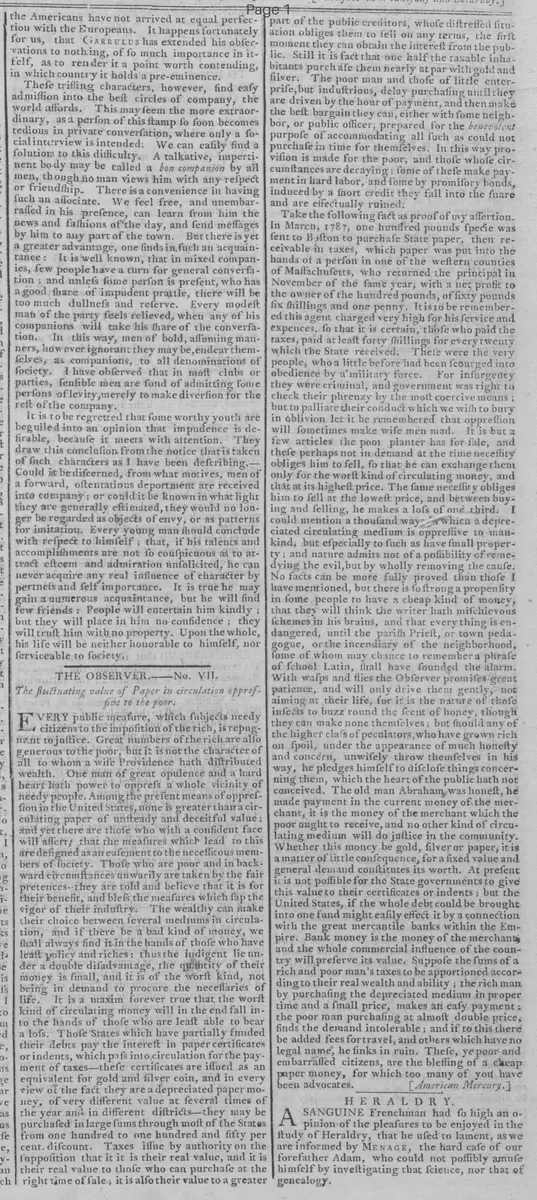
THE OBSERVER. No. VII.
The fluctuating value of Paper in circulation oppressive to the poor.
Every public measure, which subjects needy citizens to the imposition of the rich, is repugnant to justice. Great numbers of the rich are also generous to the poor, but it is not the character of all to whom a wise Providence hath distributed wealth. One man of great opulence and a hard heart hath power to oppress a whole vicinity of needy people. Among the present means of oppression in the United States, none is greater than a circulating paper of unsteady and deceitful value; and yet there are those who with a confident face will assert, that the measures which lead to this are designed as an easement to the necessitous members of society. Those who are poor and in backward circumstances unwarily are taken by the fair pretences--they are told and believe that it is for their benefit, and bless the measures which sap the vigor of their industry. The wealthy can make their choice between several mediums in circulation, and if there be a bad kind of money, we shall always find it in the hands of those who have least policy and riches: thus the indigent lie under a double disadvantage, the quantity of their money is small, and it is of the worst kind, not being in demand to procure the necessaries of life. It is a maxim forever true that the worst kind of circulating money will in the end fall into the hands of those who are least able to bear a loss. Those States which have partially funded their debts pay the interest in paper certificates or indents, which pass into circulation for the payment of taxes these certificates are issued as an equivalent for gold and silver coin, and in every view of the fact they are a depreciated paper money, of very different value at several times of the year and in different districts—they may be purchased in large sums through most of the States from one hundred to one hundred and fifty per cent. discount. Taxes issue by authority on the supposition that it is their real value, and it is their real value to those who can purchase at the right time of sale.; it is also their value to a greater part of the public creditors, whose distressed situation obliges them to sell on any terms, the first moment they can obtain the interest from the public. Still it is fact that one half the taxable inhabitants purchase them nearly at par with gold and silver. The poor man and those of little enterprise, but industrious, delay purchasing until they are driven by the hour of payment, and then make the best bargain they can, either with some neighbor, or public officer; prepared for the benevolent purpose of accommodating all such as could not purchase in time for themselves. In this way provision is made for the poor, and those whose circumstances are decaying; some of these make payment in hard labor, and some by promissory bonds, induced by a short credit they fall into the snare and are effectually ruined.
Take the following fact as proof of my assertion. In March, 1787, one hundred pounds specie was sent to Boston to purchase State paper, then receivable in taxes, which paper was put into the hands of a person in one of the western counties of Massachusetts, who returned the principal in November of the same year, with a net profit to the owner of the hundred pounds, of sixty pounds six shillings and one penny. It is to be remembered this agent charged very high for his service and expenses, so that it is certain, those who paid the taxes, paid at least forty shillings for every twenty which the State received. These were the very people, who a little before had been scourged into obedience by a military force. For insurgency they were criminal, and government was right to check their phrenzy by the most coercive means; but to palliate their conduct which we wish to bury in oblivion let it be remembered that oppression will sometimes make wise men mad. It is but a few articles the poor planter has for sale, and these perhaps not in demand at the time necessity obliges him to sell, so that he can exchange them only for the worst kind of circulating money, and that at its highest price. The same necessity obliges him to sell at the lowest price, and between buying and selling, he makes a loss of one third. I could mention a thousand ways in which a depreciated circulating medium is oppressive to mankind, but especially to such as have small property; and nature admits not of a possibility of remedying the evil, but by wholly removing the cause. No facts can be more fully proved than those I have mentioned, but there is so strong a propensity in some people to have a cheap kind of money, that they will think the writer hath mischievous schemes in his brains, and that every thing is endangered, until the parish Priest, or town pedagogue, or the incendiary of the neighborhood, some of whom may chance to remember a phrase of school Latin, shall have sounded the alarm. With wasps and flies the Observer promises great patience, and will only drive them gently, not aiming at their life, for it is the nature of those insects to buzz round the scent of honey, though they can make none themselves; but should any of the higher class of speculators, who have grown rich on spoil, under the appearance of much honesty and concern, unwisely throw themselves in his way, he pledges himself to disclose things concerning them, which the heart of the public hath not conceived. The old man Abraham was honest, he made payment in the current money of the merchant, it is the money of the merchant which the poor ought to receive, and no other kind of circulating medium will do justice in the community. Whether this money be gold, silver or paper, it is a matter of little consequence, for a fixed value and general demand constitutes its worth. At present it is not possible for the State governments to give this value to their certificates or indents; but the United States, if the whole debt could be brought into one fund might easily effect it by a connection with the great mercantile banks within the Empire. Bank money is the money of the merchant and the whole commercial influence of the country will preserve its value. Suppose the sums of a rich and poor man's taxes to be apportioned according to their real wealth and ability; the rich man by purchasing the depreciated medium in proper time and a small price, makes an easy payment; the poor man purchasing at almost double price, finds the demand intolerable; and if to this there be added fees for travel, and others which have no legal name, he sinks in ruin. These, ye poor and embarrassed citizens, are the blessing of a cheap paper money, for which too many of you have been advocates.
[American Mercury.]
The fluctuating value of Paper in circulation oppressive to the poor.
Every public measure, which subjects needy citizens to the imposition of the rich, is repugnant to justice. Great numbers of the rich are also generous to the poor, but it is not the character of all to whom a wise Providence hath distributed wealth. One man of great opulence and a hard heart hath power to oppress a whole vicinity of needy people. Among the present means of oppression in the United States, none is greater than a circulating paper of unsteady and deceitful value; and yet there are those who with a confident face will assert, that the measures which lead to this are designed as an easement to the necessitous members of society. Those who are poor and in backward circumstances unwarily are taken by the fair pretences--they are told and believe that it is for their benefit, and bless the measures which sap the vigor of their industry. The wealthy can make their choice between several mediums in circulation, and if there be a bad kind of money, we shall always find it in the hands of those who have least policy and riches: thus the indigent lie under a double disadvantage, the quantity of their money is small, and it is of the worst kind, not being in demand to procure the necessaries of life. It is a maxim forever true that the worst kind of circulating money will in the end fall into the hands of those who are least able to bear a loss. Those States which have partially funded their debts pay the interest in paper certificates or indents, which pass into circulation for the payment of taxes these certificates are issued as an equivalent for gold and silver coin, and in every view of the fact they are a depreciated paper money, of very different value at several times of the year and in different districts—they may be purchased in large sums through most of the States from one hundred to one hundred and fifty per cent. discount. Taxes issue by authority on the supposition that it is their real value, and it is their real value to those who can purchase at the right time of sale.; it is also their value to a greater part of the public creditors, whose distressed situation obliges them to sell on any terms, the first moment they can obtain the interest from the public. Still it is fact that one half the taxable inhabitants purchase them nearly at par with gold and silver. The poor man and those of little enterprise, but industrious, delay purchasing until they are driven by the hour of payment, and then make the best bargain they can, either with some neighbor, or public officer; prepared for the benevolent purpose of accommodating all such as could not purchase in time for themselves. In this way provision is made for the poor, and those whose circumstances are decaying; some of these make payment in hard labor, and some by promissory bonds, induced by a short credit they fall into the snare and are effectually ruined.
Take the following fact as proof of my assertion. In March, 1787, one hundred pounds specie was sent to Boston to purchase State paper, then receivable in taxes, which paper was put into the hands of a person in one of the western counties of Massachusetts, who returned the principal in November of the same year, with a net profit to the owner of the hundred pounds, of sixty pounds six shillings and one penny. It is to be remembered this agent charged very high for his service and expenses, so that it is certain, those who paid the taxes, paid at least forty shillings for every twenty which the State received. These were the very people, who a little before had been scourged into obedience by a military force. For insurgency they were criminal, and government was right to check their phrenzy by the most coercive means; but to palliate their conduct which we wish to bury in oblivion let it be remembered that oppression will sometimes make wise men mad. It is but a few articles the poor planter has for sale, and these perhaps not in demand at the time necessity obliges him to sell, so that he can exchange them only for the worst kind of circulating money, and that at its highest price. The same necessity obliges him to sell at the lowest price, and between buying and selling, he makes a loss of one third. I could mention a thousand ways in which a depreciated circulating medium is oppressive to mankind, but especially to such as have small property; and nature admits not of a possibility of remedying the evil, but by wholly removing the cause. No facts can be more fully proved than those I have mentioned, but there is so strong a propensity in some people to have a cheap kind of money, that they will think the writer hath mischievous schemes in his brains, and that every thing is endangered, until the parish Priest, or town pedagogue, or the incendiary of the neighborhood, some of whom may chance to remember a phrase of school Latin, shall have sounded the alarm. With wasps and flies the Observer promises great patience, and will only drive them gently, not aiming at their life, for it is the nature of those insects to buzz round the scent of honey, though they can make none themselves; but should any of the higher class of speculators, who have grown rich on spoil, under the appearance of much honesty and concern, unwisely throw themselves in his way, he pledges himself to disclose things concerning them, which the heart of the public hath not conceived. The old man Abraham was honest, he made payment in the current money of the merchant, it is the money of the merchant which the poor ought to receive, and no other kind of circulating medium will do justice in the community. Whether this money be gold, silver or paper, it is a matter of little consequence, for a fixed value and general demand constitutes its worth. At present it is not possible for the State governments to give this value to their certificates or indents; but the United States, if the whole debt could be brought into one fund might easily effect it by a connection with the great mercantile banks within the Empire. Bank money is the money of the merchant and the whole commercial influence of the country will preserve its value. Suppose the sums of a rich and poor man's taxes to be apportioned according to their real wealth and ability; the rich man by purchasing the depreciated medium in proper time and a small price, makes an easy payment; the poor man purchasing at almost double price, finds the demand intolerable; and if to this there be added fees for travel, and others which have no legal name, he sinks in ruin. These, ye poor and embarrassed citizens, are the blessing of a cheap paper money, for which too many of you have been advocates.
[American Mercury.]
What sub-type of article is it?
Economic Policy
Taxation
What keywords are associated?
Paper Money
Depreciation
Tax Certificates
Poor Oppression
Currency Value
Speculation
Stable Banking
What entities or persons were involved?
The Poor
The Rich
Public Creditors
State Governments
United States
Speculators
Editorial Details
Primary Topic
Fluctuating Value Of Paper Money Oppressive To The Poor
Stance / Tone
Critical Of Depreciated Paper Currency And Its Burden On The Poor
Key Figures
The Poor
The Rich
Public Creditors
State Governments
United States
Speculators
Key Arguments
Fluctuating Paper Money Disadvantages The Poor By Forcing Them To Use The Worst Currency
Wealthy Can Choose Better Mediums And Profit From Discounts On Tax Certificates
Poor Buy Certificates At High Prices Or Pay With Labor/Bonds, Leading To Ruin
Example: 1787 Purchase In Boston Yielded 60% Profit For Speculator, Overcharging Taxpayers
Oppression From Depreciated Money Contributed To Insurgencies Like Shays' Rebellion
Remedy Requires Stable Currency Tied To Mercantile Banks