Thank you for visiting SNEWPapers!
Sign up free
Story
July 27, 1878
Public Ledger
Memphis, Shelby County, Tennessee
What is this article about?
Ex-President Ulysses S. Grant arrives in Hamburg on July 2 and shares his reflections on the American Civil War, including strategies, losses, and assessments of generals like Lee, Sherman, Sheridan, Johnston, and others, in a conversation reported from New York on July 24.
Clipping
OCR Quality
95%
Excellent
Full Text
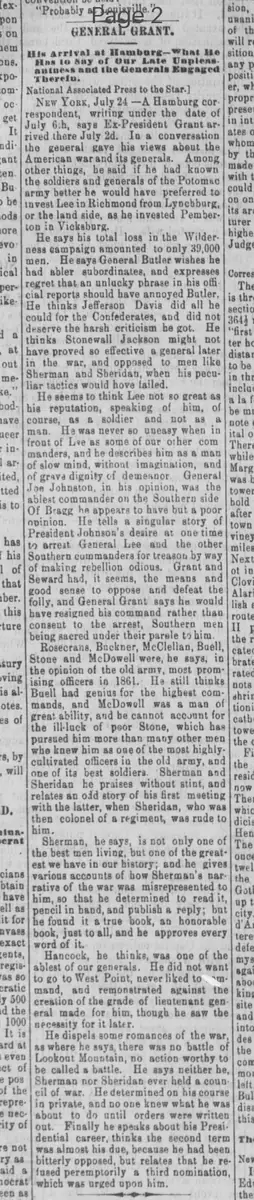
GENERAL GRANT.
His Arrival at Hamburg-What He Has to Say of Our Late Unpleasantness and the Generals Engaged Therein.
[National Associated Press to the Appeal.]
New York, July 24.-A Hamburg correspondent, writing under the date of July 6th, says Ex-President Grant arrived there July 2d. In a conversation the general gave his views about the American war and its generals. Among other things, he said if he had known the soldiers and generals of the Potomac army better he would have preferred to invest Lee in Richmond from Lynchburg, or the land side, as he invested Pemberton in Vicksburg.
He says his total loss in the Wilderness campaign amounted to only 39,000 men. He says General Butler wishes he had abler subordinates, and expresses regret that an unlucky phrase in his official reports should have annoyed Butler.
He thinks Jefferson Davis did all he could for the Confederates, and did not deserve the harsh criticism he got. He thinks Stonewall Jackson might not have proved so effective a general later in the war, and opposed to men like Sherman and Sheridan, when his peculiar tactics would have failed.
He seems to think Lee not so great as his reputation, speaking of him, of course, as a soldier and not as a man. He was never so uneasy when in front of Lee as some of our other commanders, and he describes him as a man of slow mind, without imagination, and of grave dignity of demeanor. General Joe Johnston, in his opinion, was the ablest commander on the Southern side. Of Bragg he appears to have but a poor opinion. He tells a singular story of President Johnson's desire at one time to arrest General Lee and the other Southern commanders for treason by way of making rebellion odious. Grant and Seward had, it seems, the means and good sense to oppose and defeat the folly, and General Grant says he would have resigned his command rather than consent to the arrest, Southern men being sacred under their parole to him.
Rosecrans, Buckner, McClellan, Buell, Stone and McDowell were, he says, in the opinion of the old army, most promising officers in 1861. He still thinks Buell had genius for the highest commands, and McDowell was a man of great ability, and he cannot account for the ill-luck of poor Stone, which has pursued him more than many other men who knew him as one of the most highly cultivated officers in the old army, and one of its best soldiers. Sherman and Sheridan he praises without stint, and relates an odd story of his first meeting with the latter, when Sheridan, who was then colonel of a regiment, was rude to him.
Sherman, he says, is not only one of the best men living, but one of the greatest we have in our history; and he gives various accounts of how Sherman's narrative of the war was misrepresented to him, so that he determined to read it, pencil in hand, and publish a reply; but he found it a true book, an honorable book, just to all, and he approves every word of it.
Hancock, he thinks, was one of the ablest of our generals. He did not want to go to West Point, never liked to command, and remonstrated against the creation of the grade of lieutenant general made for him, though he saw the necessity for it later.
He dispels some romances of the war, as where he says, there was no battle of Lookout Mountain, no action worthy to be called a battle. He says neither he, Sherman nor Sheridan ever held a council of war. He determined on his course in private, and no one knew what he was about to do until orders were written out. Finally he speaks about his Presidential career, thinks the second term was almost his due, because he had been bitterly opposed, but relates that he refused peremptorily a third nomination, which was urged upon him.
His Arrival at Hamburg-What He Has to Say of Our Late Unpleasantness and the Generals Engaged Therein.
[National Associated Press to the Appeal.]
New York, July 24.-A Hamburg correspondent, writing under the date of July 6th, says Ex-President Grant arrived there July 2d. In a conversation the general gave his views about the American war and its generals. Among other things, he said if he had known the soldiers and generals of the Potomac army better he would have preferred to invest Lee in Richmond from Lynchburg, or the land side, as he invested Pemberton in Vicksburg.
He says his total loss in the Wilderness campaign amounted to only 39,000 men. He says General Butler wishes he had abler subordinates, and expresses regret that an unlucky phrase in his official reports should have annoyed Butler.
He thinks Jefferson Davis did all he could for the Confederates, and did not deserve the harsh criticism he got. He thinks Stonewall Jackson might not have proved so effective a general later in the war, and opposed to men like Sherman and Sheridan, when his peculiar tactics would have failed.
He seems to think Lee not so great as his reputation, speaking of him, of course, as a soldier and not as a man. He was never so uneasy when in front of Lee as some of our other commanders, and he describes him as a man of slow mind, without imagination, and of grave dignity of demeanor. General Joe Johnston, in his opinion, was the ablest commander on the Southern side. Of Bragg he appears to have but a poor opinion. He tells a singular story of President Johnson's desire at one time to arrest General Lee and the other Southern commanders for treason by way of making rebellion odious. Grant and Seward had, it seems, the means and good sense to oppose and defeat the folly, and General Grant says he would have resigned his command rather than consent to the arrest, Southern men being sacred under their parole to him.
Rosecrans, Buckner, McClellan, Buell, Stone and McDowell were, he says, in the opinion of the old army, most promising officers in 1861. He still thinks Buell had genius for the highest commands, and McDowell was a man of great ability, and he cannot account for the ill-luck of poor Stone, which has pursued him more than many other men who knew him as one of the most highly cultivated officers in the old army, and one of its best soldiers. Sherman and Sheridan he praises without stint, and relates an odd story of his first meeting with the latter, when Sheridan, who was then colonel of a regiment, was rude to him.
Sherman, he says, is not only one of the best men living, but one of the greatest we have in our history; and he gives various accounts of how Sherman's narrative of the war was misrepresented to him, so that he determined to read it, pencil in hand, and publish a reply; but he found it a true book, an honorable book, just to all, and he approves every word of it.
Hancock, he thinks, was one of the ablest of our generals. He did not want to go to West Point, never liked to command, and remonstrated against the creation of the grade of lieutenant general made for him, though he saw the necessity for it later.
He dispels some romances of the war, as where he says, there was no battle of Lookout Mountain, no action worthy to be called a battle. He says neither he, Sherman nor Sheridan ever held a council of war. He determined on his course in private, and no one knew what he was about to do until orders were written out. Finally he speaks about his Presidential career, thinks the second term was almost his due, because he had been bitterly opposed, but relates that he refused peremptorily a third nomination, which was urged upon him.
What sub-type of article is it?
Biography
Historical Event
What themes does it cover?
Bravery Heroism
Justice
Triumph
What keywords are associated?
Grant
Civil War
Generals
Lee
Sherman
Sheridan
Hamburg
Wilderness Campaign
What entities or persons were involved?
Grant
Lee
Pemberton
Butler
Jefferson Davis
Stonewall Jackson
Sherman
Sheridan
Joe Johnston
Bragg
President Johnson
Seward
Rosecrans
Buckner
Mcclellan
Buell
Stone
Mcdowell
Hancock
Where did it happen?
Hamburg
Story Details
Key Persons
Grant
Lee
Pemberton
Butler
Jefferson Davis
Stonewall Jackson
Sherman
Sheridan
Joe Johnston
Bragg
President Johnson
Seward
Rosecrans
Buckner
Mcclellan
Buell
Stone
Mcdowell
Hancock
Location
Hamburg
Event Date
July 2d
Story Details
Ex-President Grant arrives in Hamburg and converses about the Civil War, sharing views on strategies like investing Lee in Richmond, losses in the Wilderness campaign, assessments of generals' abilities and reputations, anecdotes about meetings and decisions, and his presidential career.